#211: TEN YEARS OF WRITING THIS STUFF
In 2015, I launched this weblog. It has been a decade of writing, now over 200 articles, totaling about 150,000 words. For reference, the first Harry Potter book contains 76,944 words.
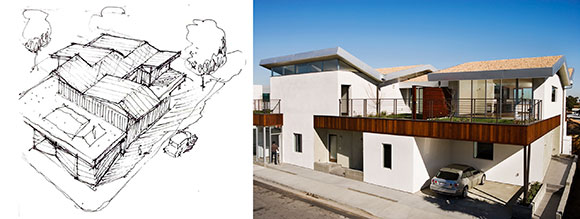
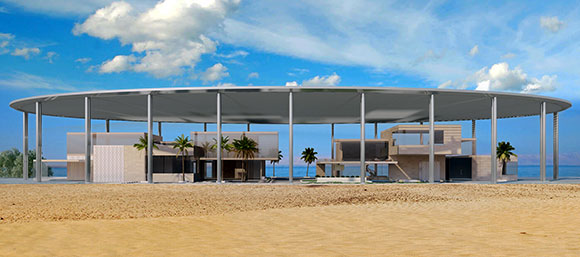
At the northern tip of the Red Sea, east of Egypt, south of Jordan, an ambitious region of industry, global trade, recreation, and housing has been underway. For this newly planned community, Poon Design was invited to provide sketch concepts for five residential prototypes, to be mass produced throughout the neighborhood. From the archives, I share our 2019 studies that explore new ideas in the architecture of grand private estates. In this West Asian and Middle Eastern context, how is a house a home?
As with fashion, the architecture of Prada Tokyo Aoyama, Japan, embodies the relationship between spectacle and spectator, between the structure and its visitor. At Prada, international shoppers, hip apparel, and innovative architecture are boldly on display, ready for consumption.
In June, LACMA invited select visitors to marvel at their nearly finished $750 million museum. Of this project by Pritzker-honored, Swiss architect, Peter Zumthor, celebration and applause accompanied uneasiness and doubt.
Over time, architects have appeared in hundreds of movies and TV shows—from Paul Newman to Tom Hanks, Michelle Pfeiffer to Sharon Stone, Keanu Reeves to Elliot Page. But this architect trope is rarely integral to the story. With the 2024 film, The Brutalist, we finally have a movie with an architect being an architect. But I raise an eyebrow or two.
It’s not something I usually do—review a book, that is. Critically speaking, I wouldn’t call this a book review. It is more of an architectural observation. Reading and experiencing Mark Z. Danielewski’s 2000 debut novel, House of Leaves, is an encounter through space and time. Yes, a physical phenomenon—much more than simply turning pages.