Tag Archives: CUSTOMER

#215: WHO DO WE SERVE?

November 28, 2025

(photo by Michael Sy)

As architects, who do we serve? As a client business, we serve our paying customers. As licensed professionals, we serve regulatory standards and safety codes. As community members, we serve society. As creative individuals, we serve an artistic agenda and the zeitgeist.

(photo by Jon Tyson on Unsplash)

What happens when an architect knows that a client request is not right? Do we serve the client or the project? Is the customer always right, as the trite retail truism suggest?

There is a difference between serving those who pay for our services vs. recognizing the end users. For example, a school district may sign our contract and pay our monthly invoices, but the educational buildings we design support the students and teachers—the end users.

In an unfortunate example, a colleague architect focused their attention on how students would learn at a new high school—serving the end users. The paying client felt the architect’s service—and loyalty even—were not prioritized appropriately. This architect was fired.

(photo by MChe Lee on Unsplash)

As state-licensed experts, architects are bound to ethical and professional responsibilities to “protect the health, safety, and welfare of the public.” When designing a theater for example, architects are required by building codes to design the appropriate number of emergency exits. Let’s say three exits are required, but the client wants only two. Here, we serve the safety and welfare of the theater-going audience, not the client.

(photo by Tarik Haiga on Unsplash)

Architects also serve the environment, as stewards of this planet. Whether a project’s goals prioritize sustainability or not, architects are charged with minimizing negative environmental impacts. We are responsible to consider the lifecycle of a building and its energy efficiency, waste reduction, and green materials. Though a project may be for today, architects’ decisions serve future generations of the planet’s inhabitants.

(photo by Qingbao Meng on Unsplash)

There are fixed values that architects also serve, some mundane and some obvious. As a manager of a project’s delivery, architects are beholden to a budget and schedule. Also, science forces a framework around our creative decisions. Our ideas are bound by constructability and the laws of gravity. Though we may envision a dramatic cantilevered structure off a cliff over the ocean, rules of engineering require reality checks.
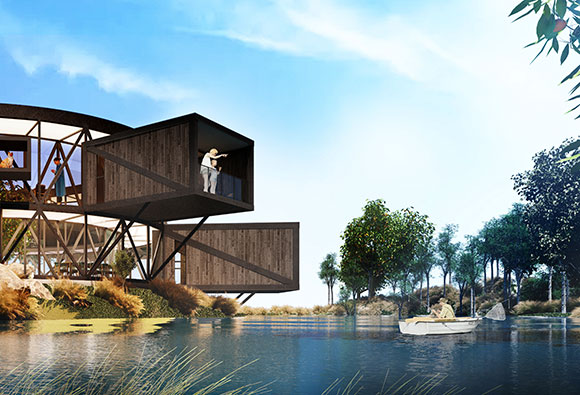
Circle House, Three Lakes, Wisconsin, by Poon Design

For better or for worse, architects also serve their ego. We apply our skills to shape a world vision that buzzes around in our brains. If Frank Lloyd Wright generically served the client who sought a weekend retreat house in Pennsylvania, there would be no Falling Water. Wright’s ego—and even arrogance towards the laws of gravity—delivered the dramatic three-story residence that cantilevers over a small waterfall. (I mention arrogance, because as impressive as the design is, ignoring the laws of science has resulted in a home plagued with sagging terraces, sinking floors, cracking concrete, and water leaks.)
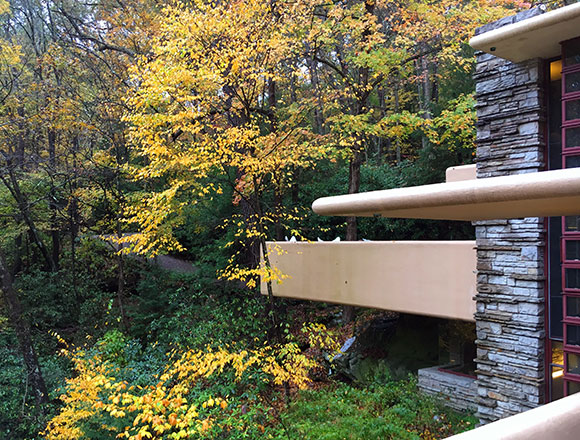
Falling Water, Mill Run, Pennsylvania (photo by Anthony Poon)

So yes, architects serve a creative agenda whether a personal one, a movement like Post-Modernism or Mid-Century Modern Revival, or current themes of the industry, such as AI, prefab, and resilience. Amongst such interests, we also serve our clients and projects, society as a whole, end users, the environment, and our present and future. And gravity. Juggling all this is no easy task.


upper left: St. Coletta School of Greater Washington, Washington, DC, Post-Modernism by Michael Graves (photo from ludosici.com); upper right: Mid-Century Modernism, Palm Springs, California (photo Peter Thomas on Unsplash); lower left: Modular prefab house, by Poon Design for ReMo (photo by Anthony Poon); lower right: Fire hazard, Bintan Island, Indonesia (photo by Thomas Ehling on Unsplash)

#119: IS THE CUSTOMER ALWAYS RIGHT?

June 12, 2020

Reception for the Culver City Chamber of Commerce held at the studio of Poon Design (photo by Culver City Chamber)

In my high school days, I worked at the Gap. The sales training stated this golden rule, “The customer is always right.” But in the business of architecture, is the customer always right?

Architects are hired to deliver a design that will suit the client’s needs. But an architect is also retained for a creative vision, and such a vision, often a personal one to the architect, could be at odds with the client’s wishes.

My first employer, the Gap (photo from adweek.com)

Years ago, for a husband-wife couple in Brentwood, I designed (what I thought was) a perfectly proportioned window for the dining room. During the window installation, the clients stated that they wanted a bigger window.

I recommended, “No! Reasons why: 1) A bigger window be out of proportion with the room. 2) The glare would be too much. 3) The view is only towards an unattractive concrete wall a few feet away. 4) You would lose privacy.”

The client disagreed and paid for the construction to be torn apart and a new window ordered. When  installed and completed, the clients were befuddled, “1) Why is this window so ridiculously large? 2) Why is there so much glare? 3) Why am I looking towards a side alley? 4) Why can my neighbors view into my formal dinners?”

The client was wrong, and I was right.

Not the actual Brentwood project of mine, but you get the idea. (photo from cantanwindows.com)

During the fireworks of this one customer debate or which there are many, I wondered how hard I should apply my Gap training. Is the client always right, even when I know they are wrong? What about my years of architecture education, professional apprenticeship, job training, etc.—not to mention my awards, client references, and articles? The Golden Rule from my youthful days of sales training may be tarnished.

We architects are in a client service industry, but we are also experts. Some might say that architectural design is subjective as in art. So why wouldn’t a client be allowed to chime in with their ideas? But the client did not attend architecture school and is not licensed by the state. Architects work not only with aesthetics and abstract thinking, but life safety, engineering and building codes.

Honpuku Temple, Awaji, Japan, by Tadao Ando (photo by shangshang0719 from Pixabay)

Additionally, architects have a personal vision for the world. Sometimes the vision is explicit as in Tadao Ando’s poetic concrete structures or Richard Meier’s modern white buildings. In these cases, you hire the architect for their creations. You probably don’t argue that you, as the customer, know what is better for the architectural composition, or that you think the columns holding up the roof should be thinner.

Getty Center, Los Angeles, California, by Richard Meier (photo by Uriel del Carmen on Unsplash)

Sometimes I want to exclaim to a frustrating client, “Hey, if you think you know what is best, if you want to design this yourself, just go ahead. I quit!” But I never have been so exasperated and discouraged as to forget that business is business. There are clients that listen to the expert that they hired, and there are clients that despite their lack of experience, think they know best and end up being their own worst enemy. And our client business is made up of the entire spectrum.

© Poon Design Inc.