Tag Archives: DOWNTOWN LOS ANGELES

#221: L.A. LIVE TRANSFORMED
March 13, 2026

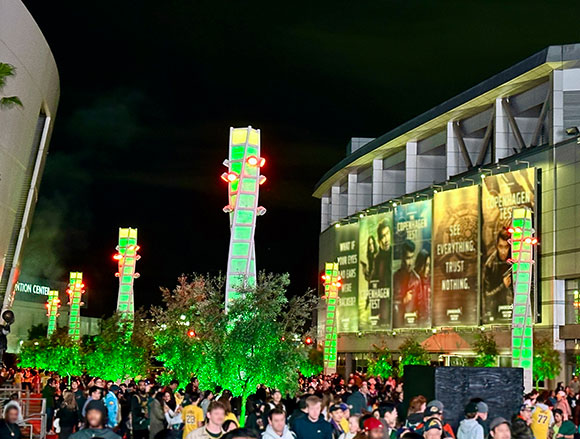
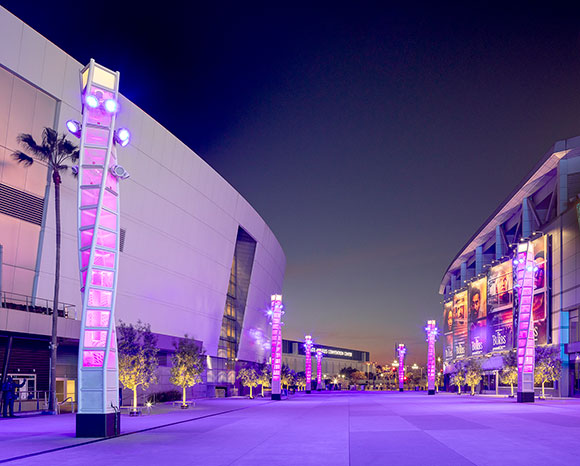
Chick Hearn Court at L.A. LIVE, by Poon Design, looking west with Crypto.com Arena on the left (photo by Bradley Wheeler)

It started with a study of adding lamp posts in downtown Los Angeles. It ended up with Poon Design, AEG (Anschutz Entertainment Group), and a team of consultants transforming a six-lane, 1/3 mile long vehicular thoroughfare into a public plaza of over three acres.

As the name describes literally, L.A. LIVE is a premiere destination for live entertainment in Los Angeles, owned and operated by AEG, a global sports and entertainment company. Between Crypto.com Arena (home of the Los Angeles Kings and Lakers) and Peacock Theater, and adjacent to the Ritz-Carlton, JW Marriott, and the L.A. Convention Center—sits Chick Hearn Court.
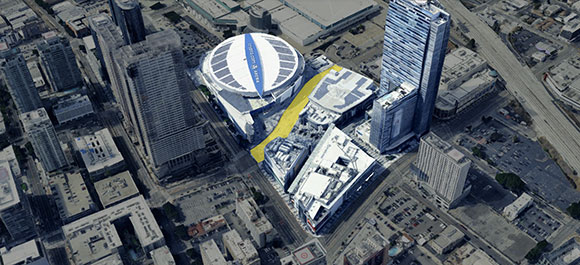
L.A. LIVE highlighted within downtown Los Angeles (background photo from Google Earth)

The previous condition never made sense to me: 20,000 celebratory sports fans pour out of the arena and are often confronted by cars rushing by the venue’s front door, when the street isn’t temporarily closed down. The visitors to L.A. LIVE’s events, restaurants, shops, bowling alley, cinema, and museum deserve something more, and not just safety—rather, something transformative, deserving for those who have dubbed L.A. LIVE the “Times Square of the West Coast.”
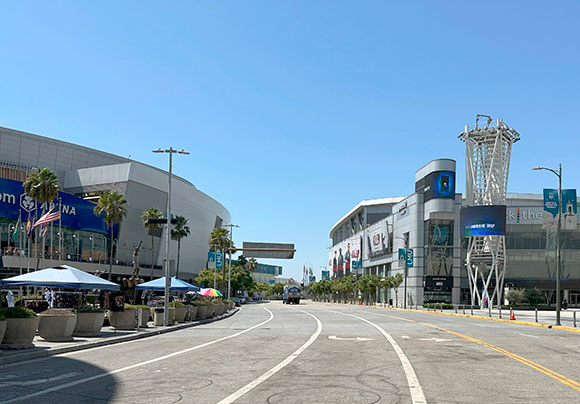
BEFORE: Previous Chick Hearn Court at L.A. LIVE as a six-lane vehicular street (photo by Poon Design)

The first step of AEG’s agenda closed this road to vehicular traffic. But not simply eliminating the street. Through an enormous amount of concrete, the entire road was raised 6 inches to be flush with surrounding curbs and sidewalks, removing all vestiges that this thoroughfare was once for vehicles. Standard city asphalt was replaced with colored patterned concrete and greenscape, by landscape architect, RELM Studio, in collaboration with engineers, KPFF and FPL  and constructed by PCL Construction. Re-envisioning the street as a plaza unites L.A. LIVE on the north with Crypto.com Arena on the south, offering a new front door to the area.
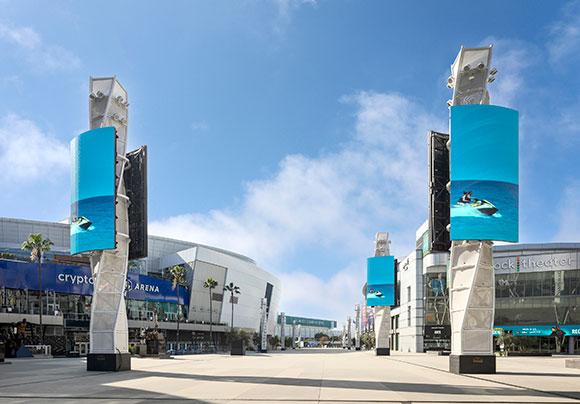
AFTER: The new Chick Hearn Court at L.A. LIVE as a civic plaza, by Poon Design (photo by Bradley Wheeler)

The initial proposed towers for this new public space evolved from providing illumination and housing security cameras and speakers. After Poon Design presented several radical options to AEG, such as a dozen large arches, it became clear that such towers should do much more than address functional requirements.
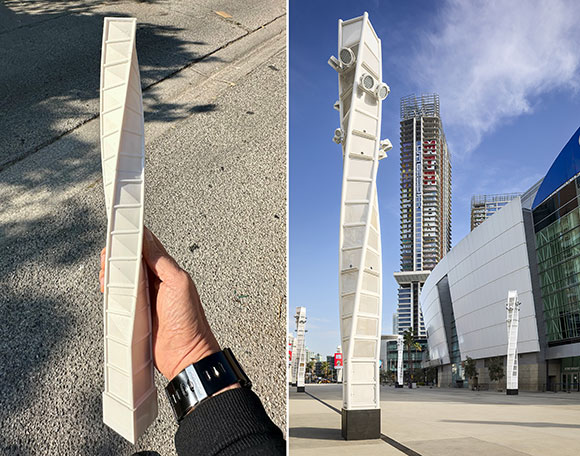
left: Model studying a twisting box truss, by Poon Design (photo by Poon Design); right: Chick Hearn Court, by Poon Design, looking west with Crypto.com Arena on the right (photo by Bradley Wheeler)

Our creative agenda became heroic and grand, more urban in scale, philosophical even. The towers became ambitious structures that framed open space and defined social areas—signaled an unknown but welcoming future. Poon Design’s 10 twisting media towers (three at 58’ tall and seven at 37’)—blend architecture, sculpture, art, technology, and urban design. The towers march down the re-envisioned Chick Hearn Court at LA. LIVE—from awkward street to pedestrian plaza—adding rhythm and beat. With six 13’ x 23’ curved digital screens by Anthony James Partners and everchanging LED lighting design by ME Engineers—media, advertisements, and visual arts flood the space with entertainment.
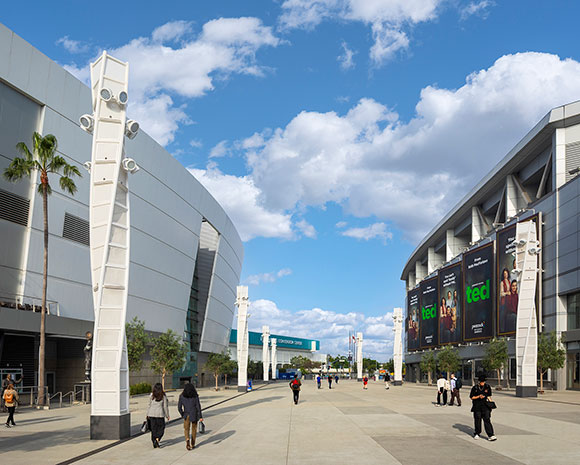
Infilled with an expanded metal mesh exterior, the box-truss towers spiral upward—a challenging feat of engineering and fabrication accomplished by project partners, LA Propoint and JAMA. The three tallest towers frame the most active area of L.A. LIVE, a zone that greets the tens of thousands of attendees for a concert by world-renowed artists or perhaps a Lakers/Kings game.
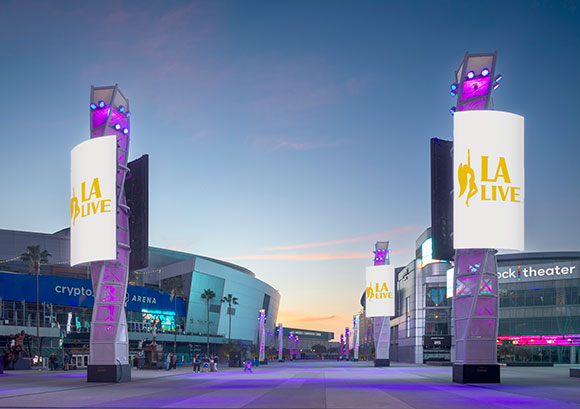
Chick Hearn Court at L.A. LIVE, by Poon Design, looking west (photo by Bradley Wheeler)
Chick Hearn Court at L.A. LIVE, by Poon Design, looking northwest (photo by Anthony Poon)

We have added to the urban fabric of Los Angeles, contributing bold ideas both at a people and city scale. In a landmark partnership with AEG, the re-envisioned and expanded plaza captured the attention of the Academy of Motion Picture Arts and Sciences. Commencing 2029, the Academy Awards and its famed red carpet Oscar’s reception will be hosted at L.A. LIVE and the Peacock Theater.
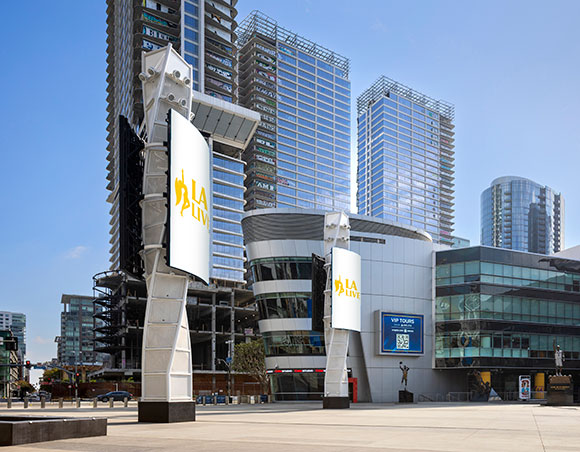

Chick Hearn Court at L.A. LIVE, by Poon Design, looking southeast with Crypto.com Arena in the background (photo by Bradley Wheeler)

#80: TIMELESSNESS: THE MANY LIVES OF THE BRADBURY BUILDING

March 23, 2018

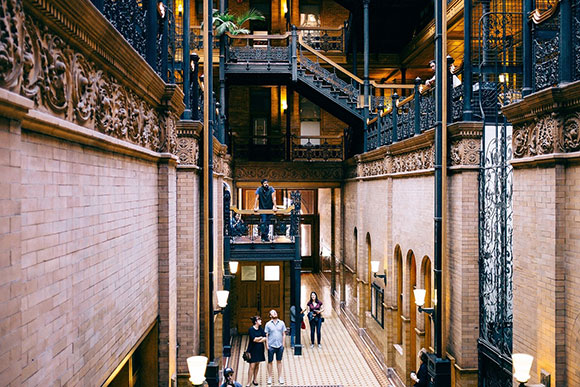
Atrium of the Bradbury Building (photo by StockSnap from Pixabay)

In 1893, architect Sumner Hunt served up the beloved Bradbury Building, a jewel in the gritty South Broadway area of downtown Los Angeles. To talk about the building’s elegance is akin to commenting on the freshness of the sushi from world-acclaimed chef Jiro One.

Rather than discuss the obvious beauty of the Bradbury, I am more fascinated by the architecture’s numerous chapters of evolution and interpretation. There are many lives to this iconic building, from film to music videos. Why and how?

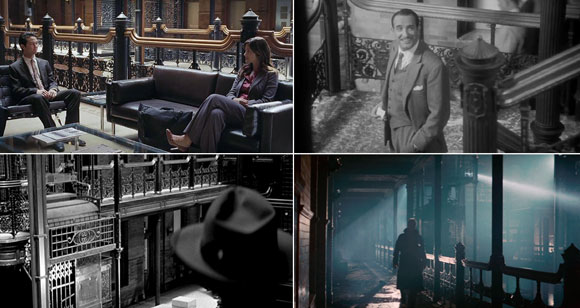
upper left: (500) Days of Summer (2009); upper right: The Artist (2011); lower left: Shockproof (1949); lower right: Blade Runner (1982)

Following the Bradbury Building’s 1971 Landmark status from the National Register of Historic Places, the building fell into sad disrepair. In 1982, the sci-fi cult classic, Blade Runner, exploited the deteriorating building, reinterpreting the once glorious Renaissance Revival style, into a goth dystopian backdrop. Prior to this, film noir of the 40’s and 50’s appropriated the building for haunting backdrops.

The Bradbury Building also found its way into dozens of movies of all types, from Chinatown in 1974 to Lethal Weapon in 1988, from Pay It Forward in 2000, to (500) Days of Summer in 2009.

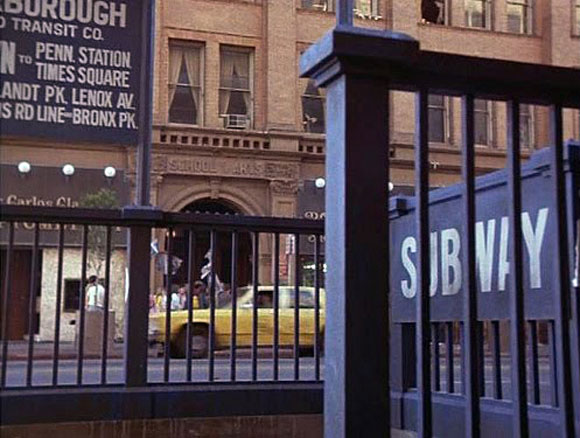
Television series, Fame (1982)

For television, the Bradbury offered its architecture for the 60’s series, Outer Limits, as well as to Mission Impossible, from the 70’s. In the 80’s, the building represented the performing arts high school in Fame, and more recently, a setting for CSI NY. In both of these, this Los Angeles building was ironically and oddly the best choice to represent the backdrop of New York City.

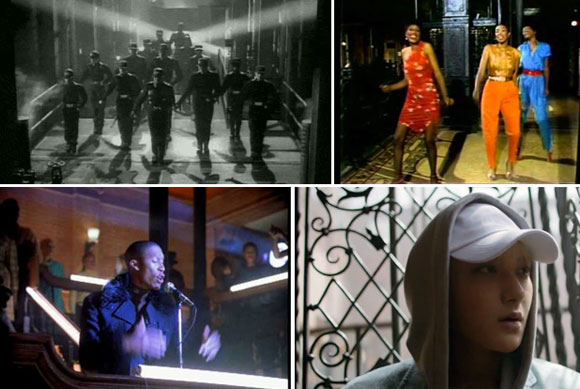
upper left: Janet Jackson in Rhythm (1989); upper right: The Pointer Sisters in He’s So Shy (1980); lower left: Tony! Toni! Tone in Let’s Get Down (1998); lower right: Huang Zitao in The Road (2016)

Music videos have also seized the Bradbury design for various moods and vibes over the decades, to include stars such as Janet Jackson, Earth Wind and Fire, Genesis, The Pointer Sisters, and even Chinese pop sensation, Huang Zitao. And don’t forget Justin Timberlake’s current hit, Say Something.

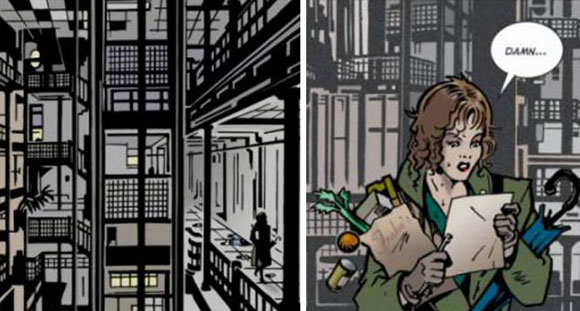
Going further into pop culture, DC and Marvel Comics created comic book characters that occupied the Bradbury Building. The actual offices of Marvel Comics had the real Bradbury Building as its home.

The Order, Marvel Comics (2002)

What is it about this one building that makes it the canvas for so many different brush strokes and stories? I argue that the Bradbury design is timeless and essential, if such concepts exist.

(A side note: Nearly every client of mine requests a design that is “warm, welcoming and timeless.” I chuckle a little, because when a client asks for these qualities, they proclaim their desires as if it was an original idea, as if it wasn’t already so obvious and cliché. I have yet to hear a client state, “I want a design that is uninviting, full of fads and will quickly go out of style!”)

How is timelessness captured? A traditional house with a porch and columns, for example, appears timeless to some, but to others, it might simply be old fashion, like some grandmother’s cottage. On the other hand, a Zaha Hadid design might appear timeless because it looks to the future. But for many critics, her architecture will only be recognized as a product of a certain chapter in time.

left: traditional (photo by Phil Hearing on Unsplash); right: Heydar Aliyev Center, Baku, by Zaha Hadid (photo by Safe Republic on Unsplash)

The many lives of the Bradbury Building speak to a timeless design because it succeeds at the essence of architecture, without ever being stylistic. The architecture excels at something as basic as how natural light transforms the sense of place throughout each hour of the day. In addition to Hunt’s thoughtful use of textures, colors and craft, this designer carefully explored the essentials of architecture. Space, proportion and air places the Bradbury Building in history. And I look forward to its next 100 years.

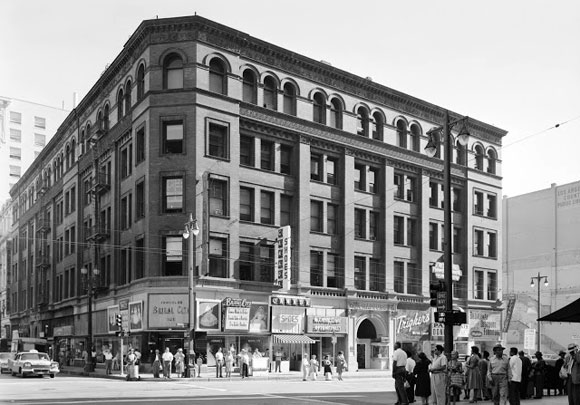
Early days of the Bradbury Building (photo from glamamor.com)
© Poon Design Inc.