Tag Archives: PLAN CHECK

#229: THE INDUSTRY | THEY ARE A-CHANGIN’
August 28, 2026

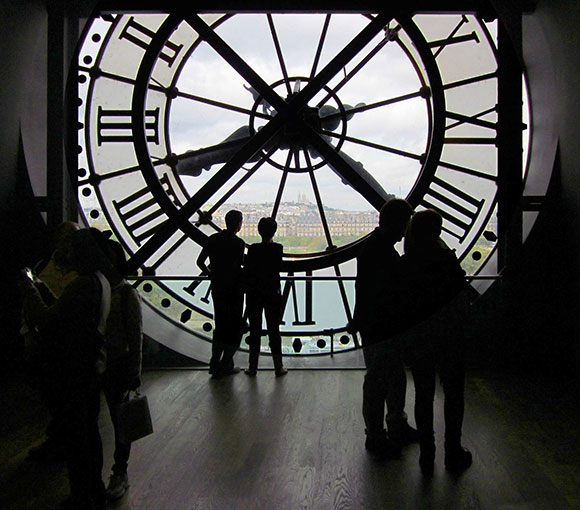
Musée d'Orsay, Paris, France (photo by Guy Dugas on Pixabay)

It’s true: Life just gets more and more complicated. And so it is for the field of architecture. Do we yearn for simpler times—the cherished good ol’ days? Progress is good, supposedly. For better or worse, the evolution of business is inevitable. Bob Dylan said it well: “The order is rapidly fadin’. And the first one now will later be last. For the times, they are a-changin’.”
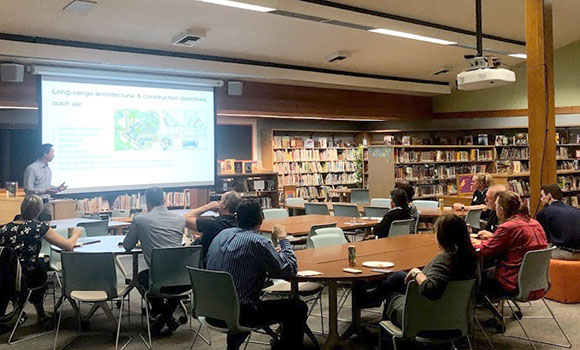
Poon Design workshop, Berkeley Hall, Los Angeles, California (photo by Poon Design)

Architecture is a client service, and in the past, communication was primarily an in-person presentation at the architect’s office, followed by some phone calls, maybe a fax(!). Today, the portals of communication are not just endless and endlessly advancing: email, voicemail, texts, socials, WeChat/VoIP, FaceTime, Zoom/Teams/Meet, IM, chat rooms, ChatGPT, VR/AR/AI—so many more to come that we can’t even imagine. One day, my thoughts about a project may instantaneously appear within the consciousness of the client.

(photo by Edar on Pixabay)

Take contracts. In the early days of “gentlemen relations,” a hand shake or one’s word sealed the deal. To quote Tom Cruise’s 1996 film, Jerry Maguire, “I don’t do contracts, but what you do have is my word. And it’s stronger than oak.”

Generations ago, the industry standard contract between architect and client from the American Institute of Architects (“AIA”) was a one- or two-page document. Today, the norm is the AIA B101 contract used in conjunction with the AIA A201—a total of 57 pages. Add in exhibits, recitals, definitions, general provisions, amendments, disclosures, and legal this-n-that. Don’t be surprised to see contracts nearing 100 pages.
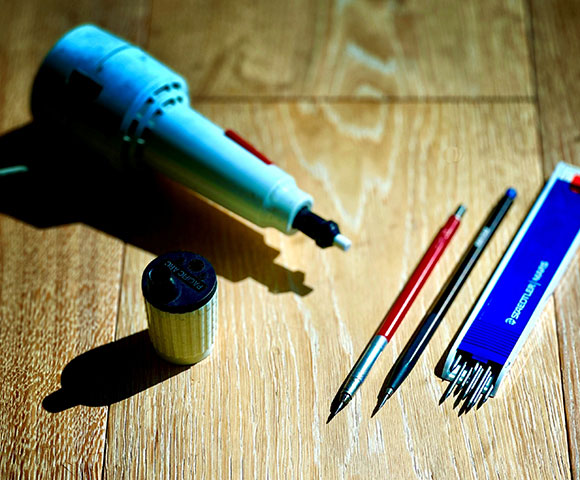
(photo by Poon Design)

I recall that in my 20s, as a new employee, I only needed to bring basic drafting tools. The company supplied the necessary daily needs. Meaning, I brought my mechanical pencil, and the company supplied the lead sticks. Meaning, I brought my electric eraser, and the company supplied the eraser sticks.

These days, the tools have evolved from pencil and paper to the vast array of software, like Windows, Microsoft, Adobe, AutoCAD, Revit, 3ds, Enscape, SketchUp, and so on. Incoming like a meteor is AI. There is also the hardware, like a computer, multiple monitors, Cat6, battery backup, surge protector, and all sorts of ergonomic paraphernalia from an adjustable standing desk to a tilt-swivel keyboard tray.
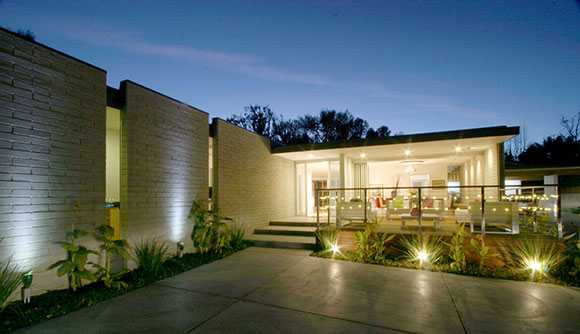
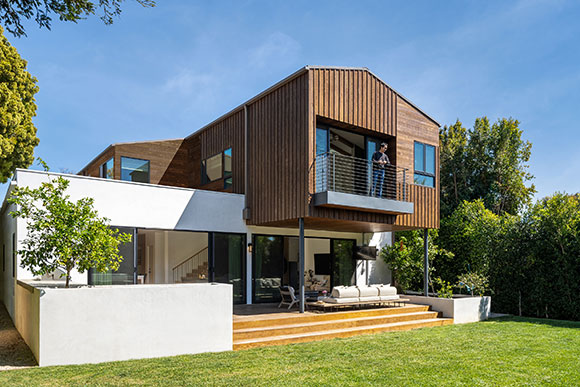
S/B House, Encino, California, by Poon Design (photo by Poon Design)

I remember when I could walk into the Plan Check counter for say, a house renovation. I would walk out with agency approvals within an hour or two. Today, that same project could take 6 to 12 months to be approved, as the single counter approach has been replaced by ever changing multiple departments on multiple floors in multiple buildings. And the times, they aren’t just a-changin’, codes and processes are a-changin’ so fast that the city departments themselves are sometimes unaware of their own changes.
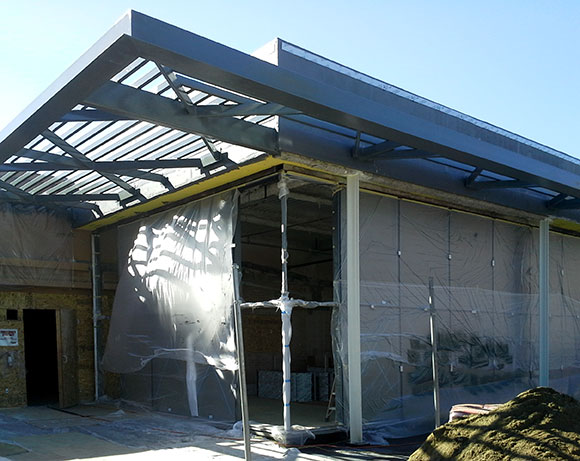
Din Tai Fung, South Coast Plaza, Costa Mesa, California, by Poon Design (photo by Poon Design)

Construction was once a craft, performed by guilds of craftsmen and artisans. An architect’s construction drawings back then stated the design intent in a dozen or so sheets. From such drawings, the contractor/craftsmen knew what to do, took pride in what they were building.

For the present, that same project might require hundreds of drawings, notes, specifications, disclaimers, and endless details and dimensions—suggesting that the contractor will do it wrong, try to cut a corner to make a buck, and/or takes no interest in the design. Such ridiculously meticulous and exhaustive construction drawings become the unfortunate legal requirements that inherently pit an architect against a contractor, like a soon-to-be-married couple confronting a 100-page prenup.

The ol’ days of construction involved a master architect providing verbal direction at the site. That is replaced today by an architect drowning under extensive construction administrative services, such as: RFIs (Request for Information); submittals and samples: construction management software: meeting agendas and minutes; and numerous site meetings, video conferences, and office hours. The concept of craftsmen building with artisanal delight has been reduced to a subcontractor or vendor asking an architect to approve the nails and screws being used.

(Photo by Markus Kammermann on Pixabay)

The thing about change today is that it isn’t just always happening; change is happening faster than we are prepared for. By the time today’s webinar on the ‘predictions of AI in the workplace’ has concluded, AI has already exceeded these predictions. We know change is coming down the road, but we don’t know what change is coming down the road. As we struggle to adapt to self-driving cars, flying cars are advancing in other countries. Perhaps the fictional Star Trek “transporter” is already a reality—“beaming” someone to any location or even another planet by dematerializing the person into energy.
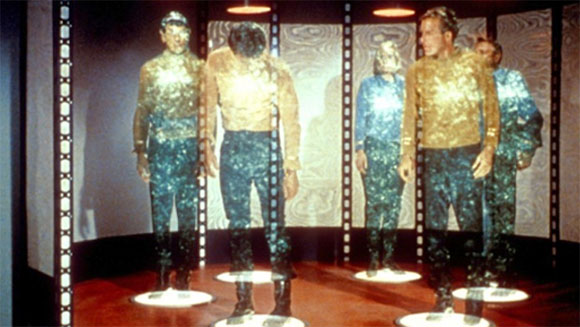
Transporter from TV series, Star Trek, 1960s (photo from CBS/whatculture.com)

Bob was astute:

     “The battle outside ragin’
     Will soon shake your windows and rattle your walls
     For the times, they are a-changin’”

Mural on South 5th Street, Minneapolis, Minnesota, (photo by Nikoloz Gachechiladze on Unsplash

#214: IS 85% GOOD ENOUGH?

November 7, 2025

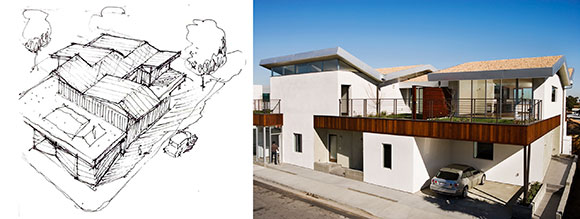
Score: 93%. WV Mixed-Use Project, Manhattan Beach, California, by Poon Design and Steve Lazar (drawing by Anthony Poon, photo by Gregg Segal)

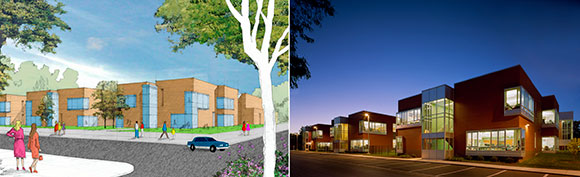
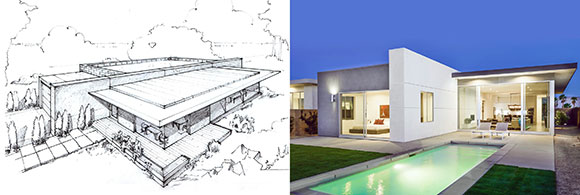
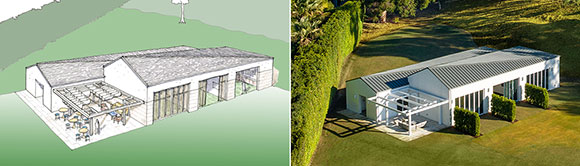
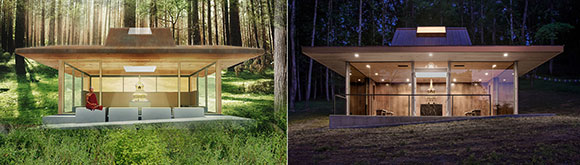
At Poon Design Inc., we evaluate the completion of each project. The question is this: What percentage of the original design is evident in the built work? If we are successful, the final results capture the initial concept, and we pat ourselves on the back for achieving 95% or higher. But sometimes, we get only 70% or lower, meaning the original design got compromised along the way. Why/how?

Score: 96%. Greenman Elementary School, Aurora, Illinois, California, by Anthony Poon w/ A4E and Cordogan, Clark & Associates (drawing by Anthony Poon, photo by Mark Ballogg)

Every new project commences with bold ideas captured in initial sketches, conceptual models, preliminary computer renderings, or even a powerful written statement. All architects have great genius designs in their heads. But keeping alive the spirit of the original thinking can be a challenge over the duration of a project, whether a house, school, or restaurant. During these years in the making—sometimes one, sometimes ten—several influences impact a project as it progresses from the early design work to phases of development, technical refinement, approvals, and construction.

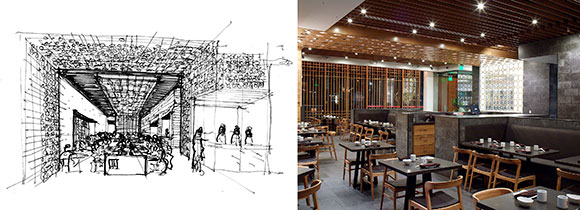
Score: 85%. Din Tai Fung, The Americana at Brand, Glendale, California, by Poon Design (drawing by Anthony Poon, photo by Gregg Segal)

From the start, the architect evaluates the client’s wishes compared to their budget. So many projects begin with an ambitious client program followed by a creative architect vision. When the construction costs arrive, we often find the dollars lacking. In turn, the creative vision gets paired down, or as some colleagues like to say (misleadingly), “value-engineered.”

Score: 80%. Colby Residence, Los Angeles, California, by Poon Design (drawing by Anthony Poon, photo by Hunter Kerhart)

The realities of a project, such as structural engineering, can also hinder a valiant design. Sure, the architect might envision a museum without columns or a concert hall with a glass roof, but are such things physically possible? Perhaps they are within the laws of science, but at what cost? When reality sets in, the museum ends up with a dozen columns and walls, and the glass concert hall has a conventional metal roof.

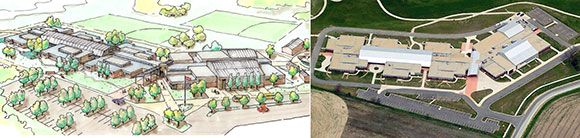
Score: 92%. Herget Middle School, Aurora, Illinois, California, by Anthony Poon w/ A4E and Cordogan, Clark & Associates (drawing by Anthony Poon, photo by Google Earth)

All projects go through the city Plan Check process, where the design is examined by various agencies for approval. Often the moving-target city codes can be a damper on a great design. For example, the gourmet restaurant with an open kitchen and big sliding doors to a patio will not be approved by the health department due to flies getting in the kitchen.

Score: 82%. Sushi Noguchi, Yorba Linda, California, by Poon Design (drawing by Anthony Poon, photo by Poon Design)

If a design survives the above, then comes construction. Will the contractor follow the architect’s drawings? What is the quality of the contractor’s work? Will materials be substituted for inferior ones? Will the client make changes during construction?

Score: 92%. Escena I-3 Residence, Palm Springs, California, by Poon Design and Andrew Adler (drawing by Anthony Poon, photo by Chris Miller)

Let’s also look in the mirror. Did the architectural team have the know-how and guts to develop a good idea? It’s about courage. Is the architect brave enough? Clients too need some pluck as well as faith. Architects need to earn the trust of the client to pursue the right ideas for the right project.

Score: 97%. Golf Performance Center, Los Angeles, California, by Poon Design (drawing by Anthony Poon, photo by Hunter Kerhart)

Poon Design is fortunate to have a few projects score above 90%. 100% is probably an impossibility. The projects that fall short are 50% to 75%. If our average is about 85%, is that good enough? (The project shown here are, or course, ones that have scored on the higher side.)

Score: 91%. Vosges Haut-Chocolat, Beverly Hills, California, by Poon Design (drawing by Anthony Poon, photo by Poon Design)

It takes a tremendous amount of perseverance, tenacity, and dedication to keep one’s ideas alive through the many phases of a project, through the many forces that aim to water down the original thinking. Most architects are perfectionist, so 90% or even 95% might not be good enough.

As the 18th century French philosopher, Voltaire, suggested, “good enough is the enemy of perfection.”

Score: 91%. Reliquary Stupa Structure, Natural Bridge, Virginia, by Poon Design (rendering by Poon Design, photo by Mark Ballogg)

#184: THE ROLLER COASTER OF ARCHITECTURE

March 15, 2024

Apartment Complex, Redlands, California, by Poon Design

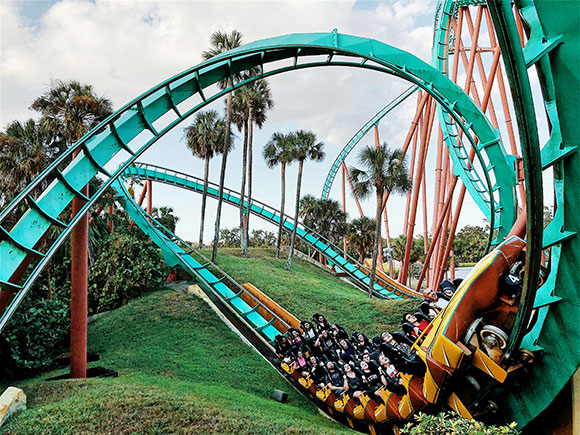
If you ask an architect, “How are things in architecture?”—you will typically hear about the ups and downs. Few architects will boast about how things are super great. The industry is often a roller coaster of highs and lows, climbs and falls, and exhilaration and fear.

Roller coaster (photo by Matt Bowden on Unsplash)

Once a dentist has a client, he will return for a check-up regularly. Once an accountant has a client, she will return annually to have her taxes filed. But in architecture, once the project is completed, the client has no more need for design services. Unlike dentistry, an architectural client doesn’t usually return with new buildings to design every six months.

Colby Residence, Los Angeles, by Poon Design (photo by Hunter Kerhart)

If an architect doesn’t have a new project to start on the tails of a completed project, this architect experiences the lows of the profession, e.g., loss of income, underutilized staff, lays off, etc. When the architect gets a new project, you have the highs, e.g., a new endeavor, signed contract and retainer, excited client, etc.

And if the architect gets a new project while working on current projects, she experiences both a high and a low, sometimes referred to as “a good problem.” This circumstance of winning too much work might be exhilarating, but also challenging, as in not enough architects in the firm to do the work. The quality of work might go down, overtime is required, management is stressed thin.

Traffic light (photo by almani on Unsplash)

During the life of a roller coaster project, the pace starts and stops. A client might decide quickly on the proposed design, such as instantly in a meeting, or take months to think things over with colleagues, friends, and family. If the client moves quickly, we have work to do, but if not, we wait twiddling our thumbs. Architecture is a customer-service industry, and every customer, good or bad, is a unique twist or turn of the adventure.

When the project is submitted to the city agencies (here and here) for approvals, the Plan Check process can take a few months for a small project and a few years for a large one. Within this Kafka-esque process and red tape, city codes have become frustrating moving targets, with updates every year, even every month—where the city staff themselves don’t know what they are enforcing.

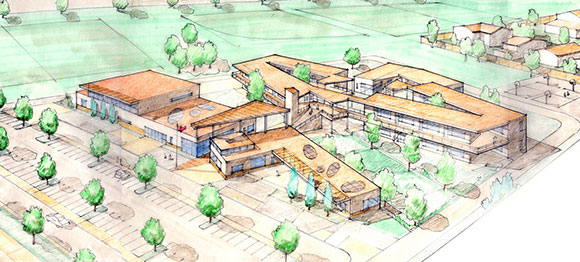
Jurupa K-8 School, Jurupa Unified School District, Riverside, California, by Anthony Poon (w/ A4E)

Architecture relies on the economy and the world. Confidence in the market sparks architectural activity which in turns keeps the construction industry active. If interest rates are too high for example, clients are hesitant to move a project forward, whether borrowing money to add onto one’s house or leveraging capital to build a performing arts center. Consider the national and global challenges of the recent years that have impacted the business of architecture: pandemic, labor shortage, shipping crisis, fuel costs, market instability, elections—even two wars.

Wall Street (photo by Daniel Lloyd Blunk-Fernández on Unsplash)

The project budget is no doubt part of the roller coaster. Why might a project go over budget? Lots of reasons.

Add to all this the ongoing changes in technology, construction, and methodology, from AI to modular to 3D printing. Don’t forget recent movements such as biophilia, resilience, and sustainability, as well as best practices, diversity, equity, and inclusion.

Escena Horizon Residence, Palm Springs, California, by Poon Design and Andrew Adler (photo by Lance Gerber)

Most design businesses—small and entrepreneurial or large and corporate—want a well-oiled machine, but the reality may be closer to juggling a season of smooth sailing vs. being on the brink of financial disaster. Alongside this balancing act comes the joys of a ribbon cutting, happy client, industry honor, or public endorsement and applause.

The nature of our industry comprises the delight and elation of an amusement park ride. Creativity drives architecture, and the process, more often circular than linear, defines architecture.

© Poon Design Inc.