#52: THE MEEK AND THE MIGHTY

December 23, 2016
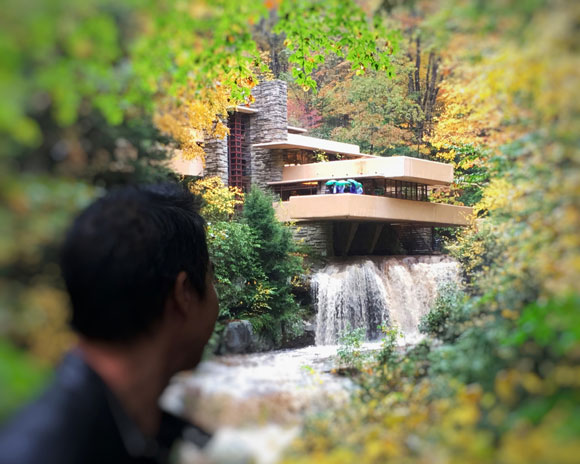
I recently had the joy of visiting two homes designed by Frank Lloyd Wright: a modest design and his most ambitious.

The cozy Pope-Leighey House in Virginia totals a mere 1,200 square feet. In stark contrast, the visionary estate known as Fallingwater in Pennsylvania has a 2,900 square foot residence, 2,500 square feet of terraces, and a guest house of 1,700 square feet. Surrounded by 5,000 acres of the Bear Run Nature Reserve, this house cantilevers over a waterfall.

When historians speak of Wright’s homes as being intimately scaled, was this because Wright had a unique interpretation of domestic life, or was it because he was petite? Only 5′ – 7”.

#51: THE WORLD FAMOUS FRANK GEHRY AND THE BEST JOB I DIDN’T WANT

December 9, 2016

I got the job! Unfortunately.

Not too many architecture companies were hiring during the economic recession of the 90’s. Though I held an impressive piece of simulated parchment that stated in fancy calligraphy, “Master of Architecture,” I could only find temp work as a paralegal, basically a data entry person.

After two years, one of my hundreds of resumes reached the right person. I received a call from the offices of Frank O. Gehry and Partners!

#50: GOOD APPLES

November 25, 2016

I have clients that make getting out of bed worth the effort, after I have fallen asleep at 2:30 a.m. working on their project. These are clients that show up early to my office, eager to see the freshest designs for their vacation house or new church. They find joy in my creative process.

For a good client, architecture takes on an extraordinary role.

#49: BAD APPLES

November 11, 2016

No client names are mentioned. This essay will not kill my career, but I certainly have no shortage of battle scars from ridiculous clients. When it comes to what a client can demand of their architect, I am sure that they are not yet done with me.

Yes, clients.

#48: HALLOWEEN AND ABSTRACT EXPRESSIONISM

October 28, 2016

Halloween costumes are typically representational, not abstract. Costumes are always something—like a princess, pirate or witch. On Halloween, Harry Potters, President Obamas and Katniss Everdeens roam the streets.

But. What about costumes based on abstract concepts? Can one dress up as wonder, rigor or overtime?

As with the Post World War II art movement known as Abstract Expressionism, can Halloween costumes be non-representational? Can costumes be non-thematic, non-literal and non-figurative?

#47: THE RELEVANCE OF PERSONAL EXPERIENCE

October 14, 2016

The overdue National Museum of African American History and Culture recently opened in Washington, DC. Masterfully composed by British architect David Adjaye, born in Tanzania—I ask the question: does such a museum have to be designed by an architect of African descent?

Or, was the 1993 Holocaust Memorial Museum, also in D.C., best designed by James Freed, born to a Jewish family in Germany? Was Freed’s vision compromised or complimented by the design partnership with Chinese-American architect, I.M. Pei?

© Poon Design Inc.