
#233: BROKEN RULES | ARCHITECTURE OF THE OUTRAGEOUS
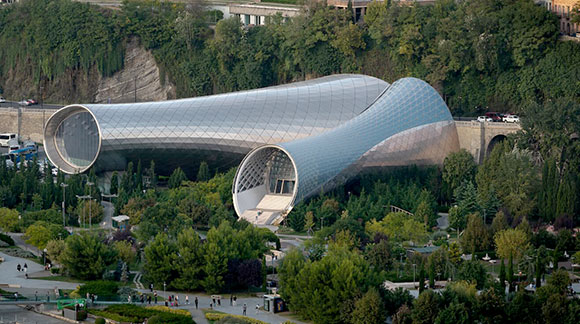
Rike Tubes, Tbilisi, Georgia (photo by Yaroslav Lukiyanchenko)
Picasso once declared, “Learn the rules like a pro, so you can break them like an artist.” In schools of thought—from Baroque to Rococo, Art Nouveau to Art Deco, Bauhaus to Post-Modernism—rules are constantly being broken. But a current slew of architecture are not only breaking the rules, canons are being eviscerated.
Architecture is getting stronger and stranger by the day. In the US, Canada, England, Spain, or UAE, audacious and hard-hitting designs descend upon us, like dauntless foreign objects. As Beethoven’s Late Piano Sonatas created a fissure in musical evolution—a MCU timeline of sorts—the projects below launch a new chapter of ideas.
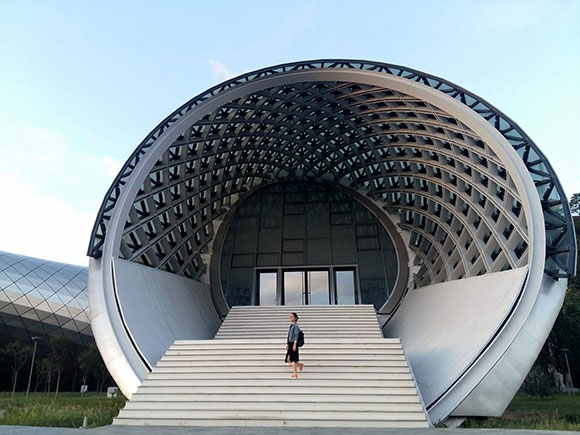
1: In Tbilisi, Georgia, Eastern Europe, the Rike Tubes call out to the adjacent river and city skyline through giant horn-like sculptures. Architect Fuksas Studio delivers a bizarre diptych cultural center with a 566-seat musical venue, exhibition areas, and cafeteria. Despite the artistic ambition, the interiors were never completed, and the entire project is slated for demolition.
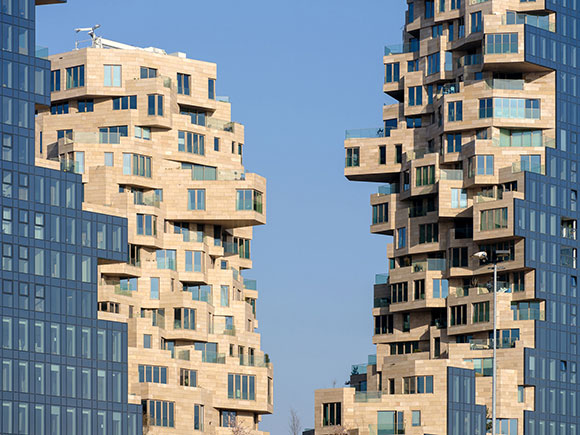
2: Inspired by geology, MVRDV designed the Valley, three large mixed-use towers in Amsterdam—with cantilevered apartments over offices, shops, and cultural facilities. The architects stated that, “the glass block has crumbled away to reveal craggy rock faces,” displaying a stark contrast between reflective glassy surfaces and shattered stone forms.
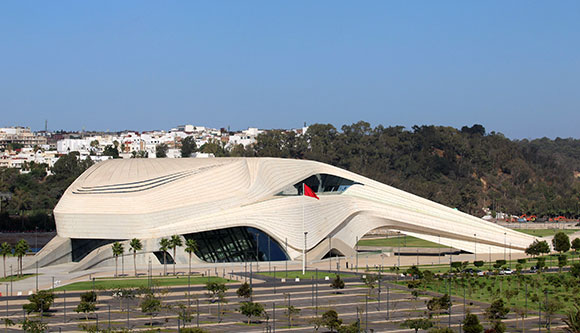
3: Sinuous forms and curves are not new to architect Zaha Hadid and her posthumous firm. In Morocco, the Royal Theatre of Rabat contains an 1,800-seat indoor theater, 7,000-seat outdoor theater, and experimental performance space. The winding Bou Regreg River, as well as Arabic calligraphy, inspired Hadid’s signature process of shape-making refined by digital parametric technology.
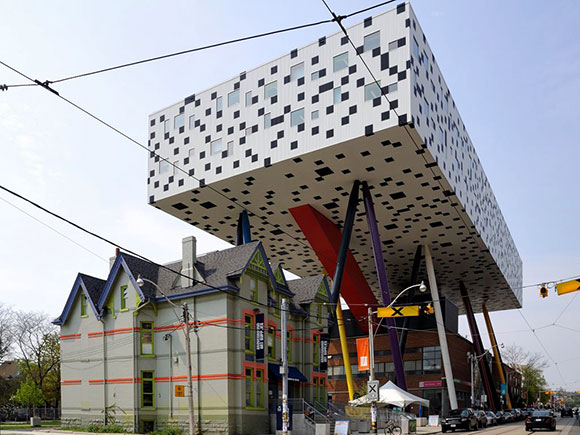
4: A playful checkered mass hovers 85 feet in the air over existing buildings. For this Sharp Centre for Design, Ontario College of Art and Design, Canada, Alsop Architects gather art studios, metalwork workshops, lecture halls, offices, galleries, research centers, and lounges into an addition that does not want to be seamless with its context.
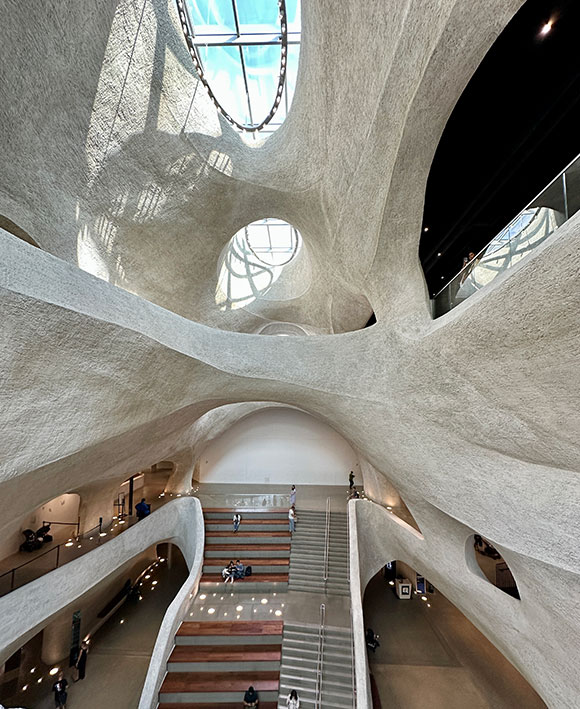
5: Of the Richard Gilder Center for Science, Education, and Innovation, Gang Studio explains the design as, “porous geologic formation shaped by the flow of wind and water.” Structural concrete sprayed onto rebar cages creates the five-story organic forms that contain 230,000 square feet for 3 million scientific specimens. This addition to the American Museum of Natural History offers yet another iconic work of architecture for Manhattan.
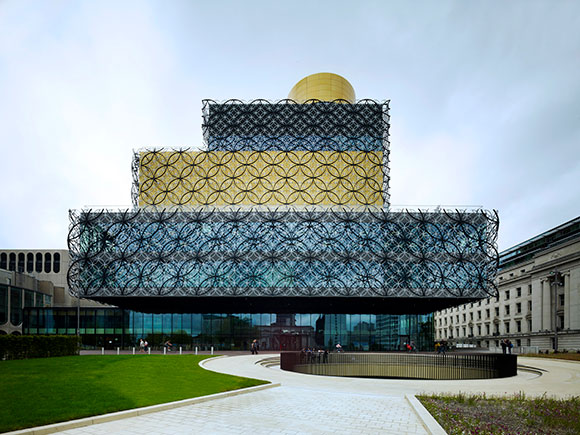
6: Mecanoo’s 310,000-square-foot Library of Birmingham honors the artisanal metalwork tradition of a former English industrial town. The skeletal skin of interlocking circles upon circles creates a sunscreen with an incredible play of shadow, geometry, whimsy, and mystery.
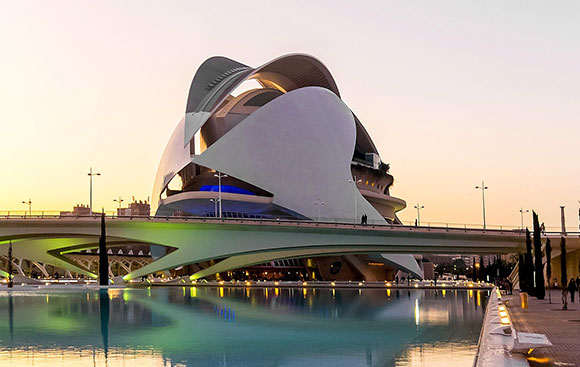
7: in Valencia, Spain, like a giant beetle ready to crawl forward or a spaceship ready to launch skyward, the Palau de les Arts Reina Sofía contains four auditoriums and stands as the tallest opera house in the world—nearly 250 feet high. Here, architect/engineer Santiago Calatrava dives deep into his usual territory, a blend of zoomorphic forms, curving shapes that imply movement, and organic skeletal lines.
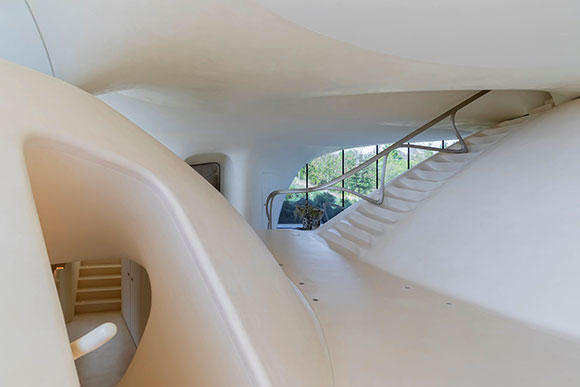
8: Architects Diller Scofidio + Renfro named this East Hampton residence, the Blue Dream. Inspired by the coastal sand dunes of New York’s Long Island, the exterior structure employs compound curves of GFRP (Glass Fiber Reinforced Polymer), a material use in making fighter jets. Within the 11,450-square-foot, three-bedroom home, interior surfaces are covered in “micro-concrete”—a waxed, polymer-modified, cement-based coating. For the art collecting owners, will the shaped walls serve their display of art?
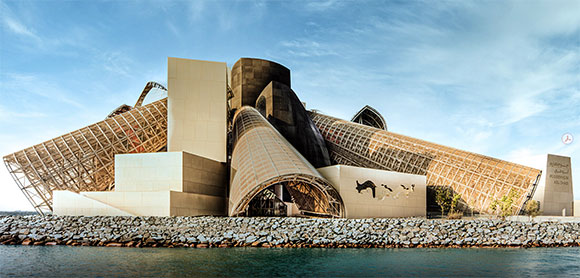
9: Two decades in the making and opening soon, unfortunately after Frank Gehry’s passing, his massive and ambitious Guggenheim Abu Dhabi offers 320,000 square feet with 130,000 square feet dedicated to exhibition space. Gehry’s curious and complex museum joins buildings from Pritzker-prized architects, Jean Nouvel and Norman Foster, as well as architect David Adjaye, at UAE’s Saadiyat Island—an evolving hub of tourism, art, and culture.
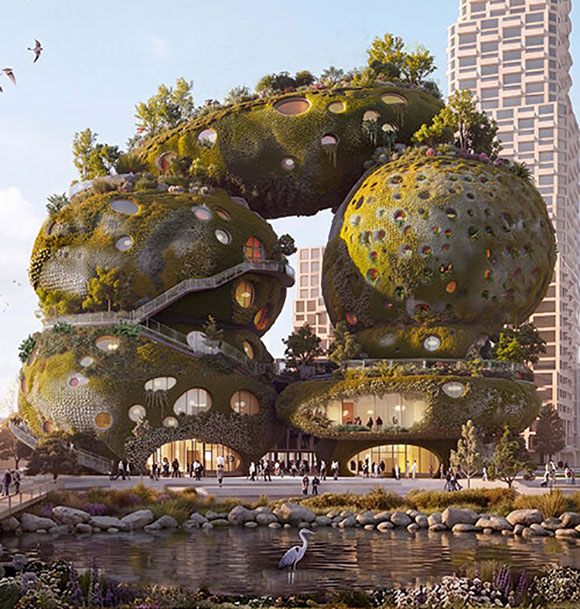
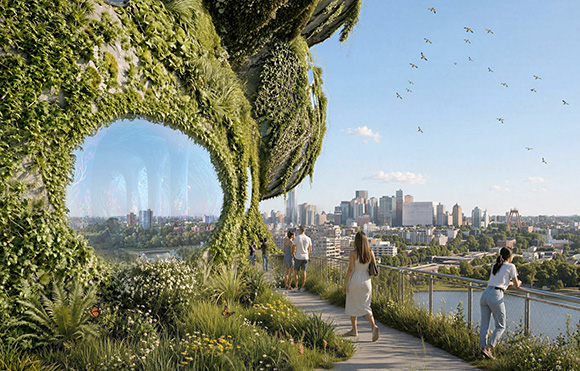
10: Not yet constructed, this Rotterdam ROCKS! drives an outrageous school of thought. Architect MVRDV’s competition-winning design for Rotterdam conceives of a symbolic structure that aims to encourage ecological and societal change. Public landscape, greenery caves, terraces, and extensive exhibitions will immerse visitors in the hospitality and education of nature.
Akin to Picasso, the Dalai Lama asserted something similar, “Know the rules well, so you can break them effectively.” Or General Douglas MacArthur proclaimed, “Rules are mostly made to be broken…” The sentiment is commonplace, even trite these days, as pop culture appropriates the idiom.
What are rules for if not order, conformity, and relevance? But rules, tenets, and canons—even entire art movements—can dangerously be reduced to a template, then formulaic results, then predictability. On the other hand, novelty and defiance comprise a risky endeavor. If we all subscribe to the avant-garde and iconoclasts and rule-breaking upon rule-breaking become the norm, what is left? Will the spirited work above have a lasting impact, or be only an end in themselves?
Another famous quote, a 16th century English proverb: “Time will tell.”
