Tag Archives: CASE STUDY

#227: “ON FIRES AND SOCIAL AGENDA,” PART 2 OF 2 | A TIPPING POINT?
July 17, 2026

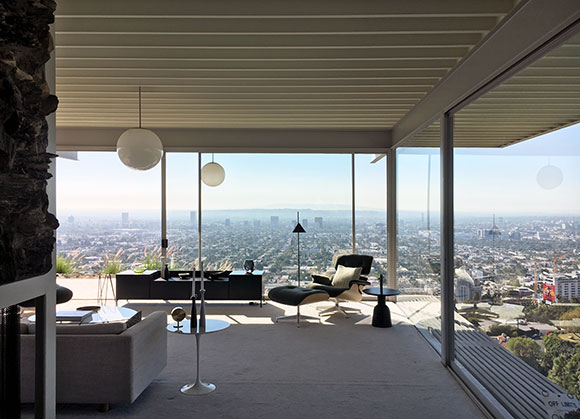
Stahl House, Case Study House #22, Los Angeles, California (photo by Anthony Poon)

Following up on Part 1 of the 661st episode of the podcast, Convo by Design, here are additional highlights (edited for length and clarity). Host Josh Cooperman and I discuss, “Redefining the ‘Strength’ of Southern California Architecture,” and a “tipping point” in architecture.
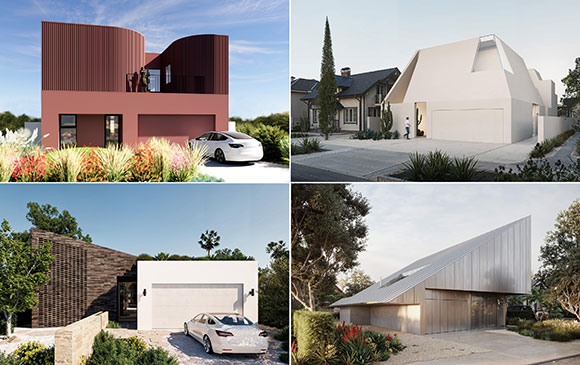
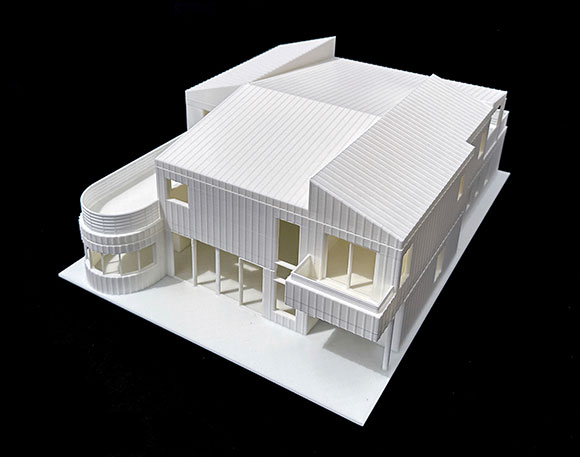
Proposed house designs from Case Study 2.0: upper left: WORD; upper right: BSPK Design; lower left: Emre Arolat Architecture; lower right: Solkatt

Anthony Poon: Josh, you’re suggesting that we may be at a tipping point in our industry because of all these things from AI to fires. And the last time we had one was with veterans coming home. That launched a lot of new ideas for Mid-Century architecture.

But the interesting thing is that I haven’t yet seen anything impactful come out of all these discussions we’re having. The reference to Mid-Century design is obviously the Case Study program. Right now, there are multiple Case Study-like programs going on. Architects are calling them Case Study 2.0 or Case Study: Adapt. Have any of these houses been built yet? Any of them being permitted? They’re just ideas and renderings. I’m still waiting to see all these new ideas executed. What’s come out of this so-called tipping point?

Josh Cooperman: Can I challenge you on that for a second?

Anthony: Sure.

(image by Gerd Altmann on Pixabay)

Josh: I don’t know if this is a perfect example, but I was talking to companies that are looking at ways of using technology, using AI, using actuators, using certain things, etc. So here’s the example: A home is wi-fi enabled, and it’s smart enough, and it’s connected to the weather service. When a fire breaks out, it can calculate the direction of the wind, force of the wind, where the fire is, in which direction. If the fire is a mile to two miles away from the home downwind, the house automatically closes the eaves. Is it a perfect solution? No, I don’t think there is any such thing as a perfect solution, but it is a thing. So does that fit as an evolving thought process into a new Case Study program?

Anthony: I think it does in the sense that these kind of ideas push something larger, which is kinetic architecture. And the fantasy is that if this computer can figure out that a fire is coming, it’d be great if this house could pick itself up and get out of the way. Or maybe the house drops down metal shades or soaks the roof with water. But I think the ideas must be bigger than that, because the fire’s still coming and could wipe out another 10,000 homes.

I think one of the reasons to slow down this reconstruction effort is to look at a new social agenda. We’re basically rebuilding the same way. We’re building spacious single family residences on the same spacious lots, when Southern California is plagued with not having enough housing. There’s a housing shortage. Why aren’t people looking at different density rules? Why isn’t multifamily design one of the more prominent approaches to rebuilding? Why are we just plopping down the same houses on the same lots?
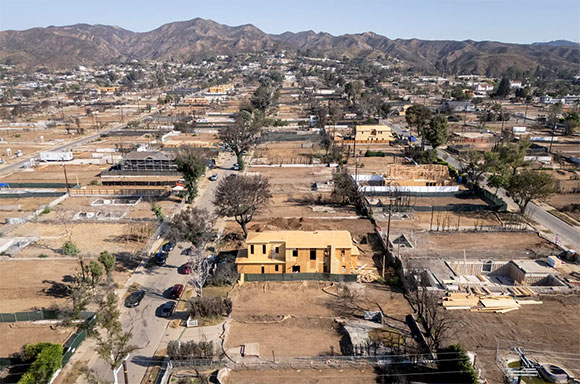
Pacific Palisades, California (photo by Myung J. Chun, Los Angeles Times via Getty Images)

Josh: I think time really does fly when you’re having fun. Let me end it with this. I’m asking you to get your crystal ball out. What is going to be the next and most impactful thing that comes? What’s the next domino in architectural evolution? I’m curious how things are going to change for you in the next 18 months to three years.

Anthony: I know AI is being talked about a lot, but that’s a subset under the umbrella of technology. Actually, what I think is going to drastically change is the role of the architect. We were joking earlier: When doing a house for a husband and wife, we’ve become marriage counselors. Or in working with a family who has lost everything in a fire, we’ve become an emotional support professional/therapist.

I think the role of the architect is shifting, happily expanding into many other things. We are not just designers. We’ve become civic leaders and community engagement experts. We’re rethinking how entire communities and towns should be rebuilt. Josh, you’ve once used the word “futurist,” and architects are that too. We’re looking at social agendas and how we can affect such things through our skills in creativity, design thinking, and problem solving. So my guess is that the role of an architect is going to continue to evolve into broader and broader fields.
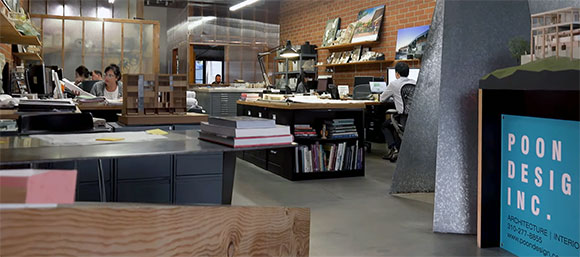

Poon Design Inc., Los Angeles, California (photo by Grant Bozigian)

#225: “ON FIRES AND SOCIAL AGENDA,” PART 1 OF 2 | RESILIENCE AND DINGBATS

June 5, 2026

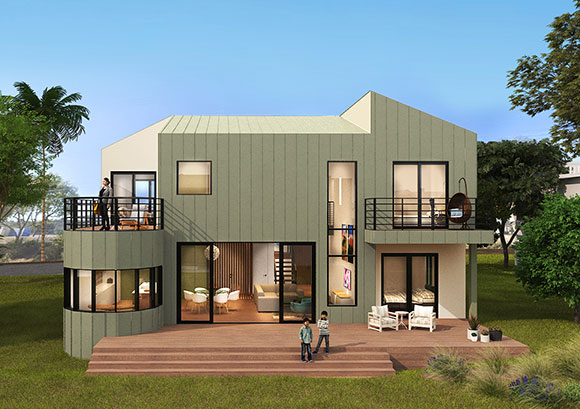
Marquez Residence, Pacific Palisades, California, by Poon Design (photo by Anthony Poon)

On the 661st episode of the podcast, Convo by Design, we examined, “Redefining the ‘Strength’ of Southern California Architecture,” with host Josh Cooperman and architects Ben Ballentine and Luis Murillo. From our 90-minute conversation, here is part 1—highlights between Josh and me, edited for length and clarity.

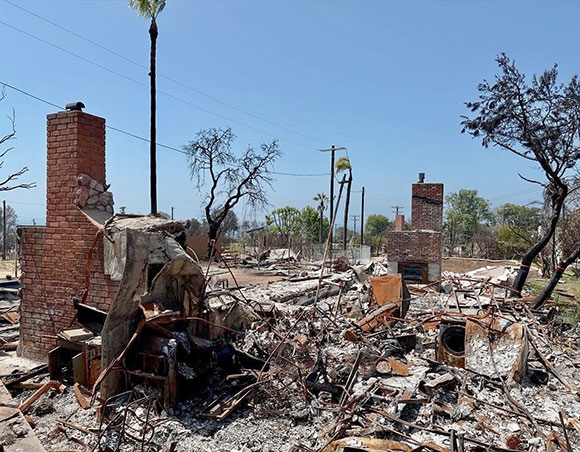
2025 Fires, Pacific Palisades, California (photo by Anthony Poon)

Josh Cooperman: It’s incredible to think that a year and four months after the wildfires in Southern California on January 7th, 2025—that absolutely decimated the Pacific Palisades and Altadena—that we’re still talking about it in terms of recovery, because the process has been so slow. And in the wake of the devastation, the architectural community in Southern California is facing a reckoning. It has no choice.

The idea about strengthening the enclosure, strengthening the envelope of an architectural structure—be it residential, hospitality, commercial, healthcare—the ideas about it haven’t necessarily changed much, but the perceptions have. In five short years, we’ve gone from something that was globally impactful like a pandemic to something that is regionally impactful like the fires, which made everyone think more about the changing nature of architecture. How did all that change the way you work?

Marquez Residence, Pacific Palisades, California, by Poon Design. Under the Fire Rebuilt Executive Order, this new house replaces the previous one lost entirely to the 2025 Palisades Fire. Fire-resistive and noncombustible strategies include: all metal framing (no wood); exterior walls and roof of Grade A metal panels; moisture-resistant gypsum sheathing; unvented attic, and mineral wool insulation. The removal of exterior decor eliminates where embers can collect, and also achieves the desired contemporary, bold character of the home. For an expedited schedule, Poon Design qualified as a licensed professional under the Los Angeles Self-Certification Pilot Program.

Anthony Poon: Well, Josh, you mentioned “strengthening” of the building. That’s only one small part of the exercise. I think this conversation should also be about resilience. There’s really no way you can strengthen a building enough to survive the disasters that may come. It’s equally important to think about how a building recovers from a fire, hurricane, earthquake. And how does a building support the community after something catastrophic? So it isn’t just about being stronger. It’s about being resilient and resourceful, and how to rebuild what we just lost.

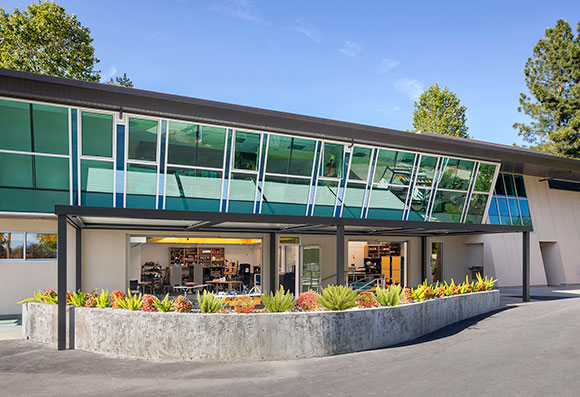
STEM Classroom Building, Berkeley Hall School, Los Angeles, California (photo by Bradley Wheeler)

Of course the fires are on everyone’s mind, but building strength and resilience involve much more. Being that we design schools, we have to be conscious about designing strength in new ways—for example, school shootings, unfortunately. It’s a difficult conversation when you’re designing a great school, and a teacher asks where the students should hide during a shooting. Will this amount of windows, which we all want for natural light and the indoor/outdoor connection, be an issue?

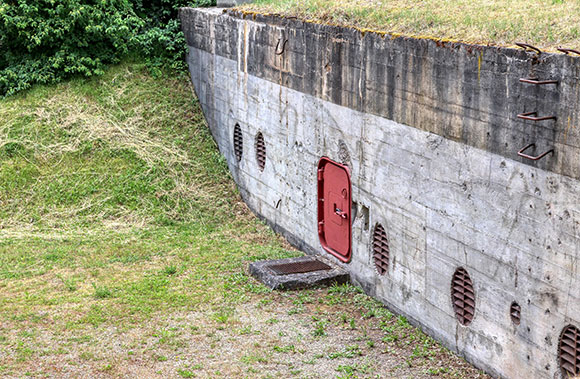
If we’re just going to design for strength, you’re going to have a house that is a bomb shelter. Or a school that is all concrete with metal bars in the windows. So there must be a balance. It’s not just “form follows function,” because if the function is strength and security, what kind of form are you ending up?

Concrete bomb shelter (photo by Alexander Fox | PlaNet Fox on Pixabay)

Josh: I don’t think that there is any real critique of architecture anymore. How there are still dingbats in this city is just staggering to me.

Anthony: But it’s great that dingbats still exists.

Josh: Is it?

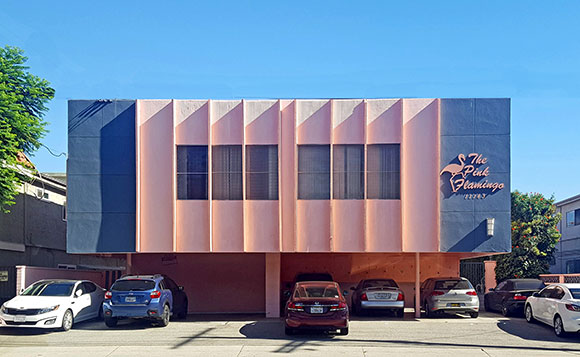
Anthony: Dingbats are such a legacy of Los Angeles—the period, the style, something so unique and cool within our architectural culture.

Josh: Okay, great point. But Dingbats were notorious for crumbling in earthquakes. They were not well built, just like the Googies. I’m going to put a pin in this—I love my debates with you, and I’m definitely coming back to it. I feel that there is an opportunity for architects now to do something significant. Maybe the last time this happened was when the GIs came home from World War II.

The Pink Flamingo, Dingbat-style apartment building, Studio, City, California (photo on laconservancy.org)

Josh: So okay, are you changing the way you specify?

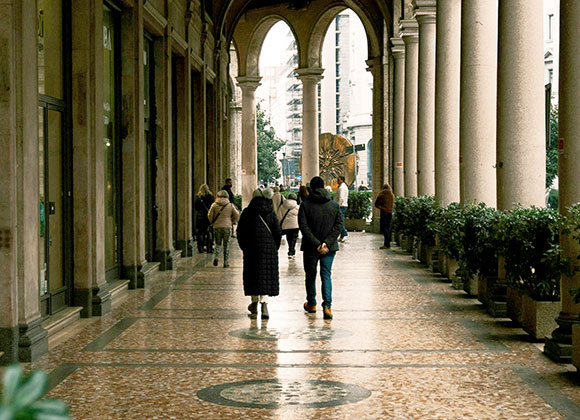
Anthony: With specifications, we have to talk about investment and value. If we’re designing, say a hotel lobby, it could be an affordable ceramic tile flooring or something that’s twice as expensive like terrazzo. But we point out how ceramic tile is not going to last as long as terrazzo. Tile is going to chip, need to be regrouted, and/or replaced altogether. Terrazzo can last 50 years, a hundred years.

Terrazzo flooring, Via Adalberto Catena, Milan, Italy (photo by Patricia Haller-Anguela on Unsplash)
New materials in fashion (photo by Faheem Ahmed on Unsplash)

I believe it was Ben that mentioned, “authenticity” in materials. I think with growing technology, the focus on authentic and real materials might start to fade.

I think back to the older days of fashion. Then, it was important that a suit was 100% real wool or a tie 100% real silk. But nowadays, fashion is driven by all kinds of new materials, like polyblends, synthetic stretch materials, plant-based latex—things that old school fashion designers would have never considered.

Similar options exist today in architecture. Yeah, I agree that fake stone trying to look like real stone is not good, but there’s so many other kinds of new materials. And this gets back to fire resistance. There are materials— like natural wood—that may not do as well as some of these new material combinations and technologies.

Josh: How do we find the time to research all this?

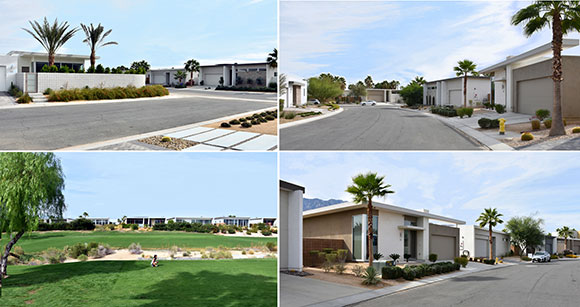
Anthony: It’s almost like how can you not, because of the risk of doing something wrong? Something I think about is scale. If you do a single custom house, you could try some new things and even take a few risks. But we’ve done mass production housing, as in tract homes, where a single house design is replicated a hundred times. If you get one material thing wrong, like, “We tried that and it didn’t work,” well, you’re not just getting a call from one client, you might get a class action lawsuit. So that’s when we experiment less and go back to best practices.

Mass production/tract housing, Escena, Palm Springs, California, by Andrew Adler and Poon Design (photos by Anthony Poon)
© Poon Design Inc.