Tag Archives: FIRES

#225: “ON FIRES AND SOCIAL AGENDA,” PART 1 OF 2 | RESILIENCE AND DINGBATS

June 5, 2026

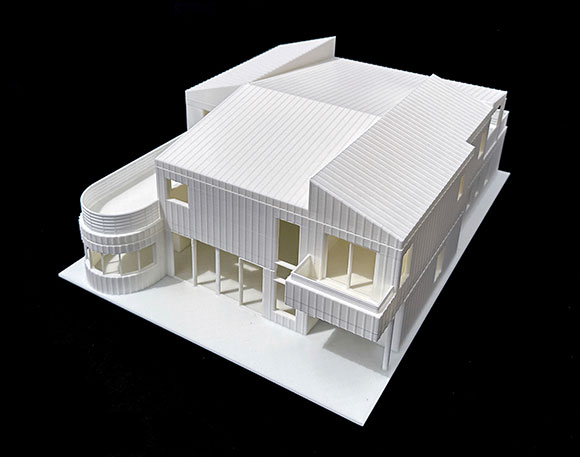
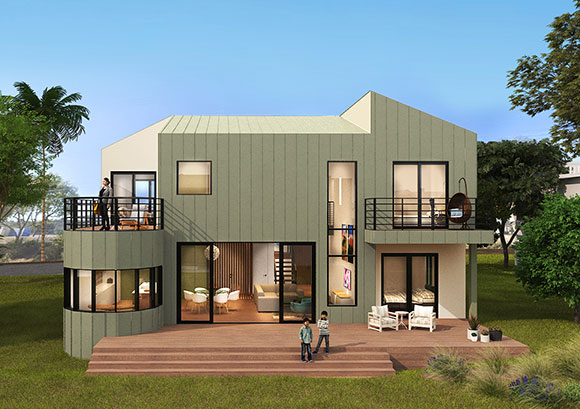
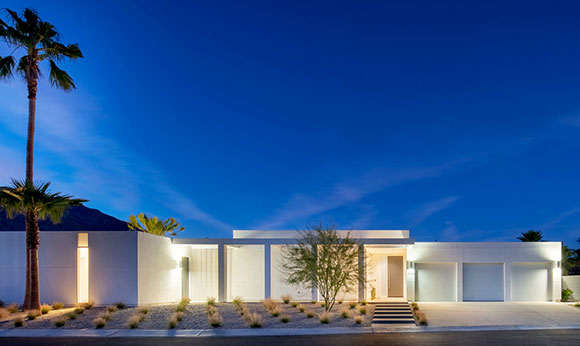
Marquez Residence, Pacific Palisades, California, by Poon Design (photo by Anthony Poon)

On the 661st episode of the podcast, Convo by Design, we examined, “Redefining the ‘Strength’ of Southern California Architecture,” with host Josh Cooperman and architects Ben Ballentine and Luis Murillo. From our 90-minute conversation, here is part 1—highlights between Josh and me, edited for length and clarity.

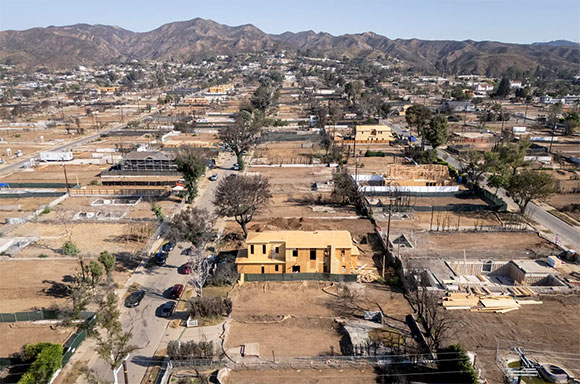
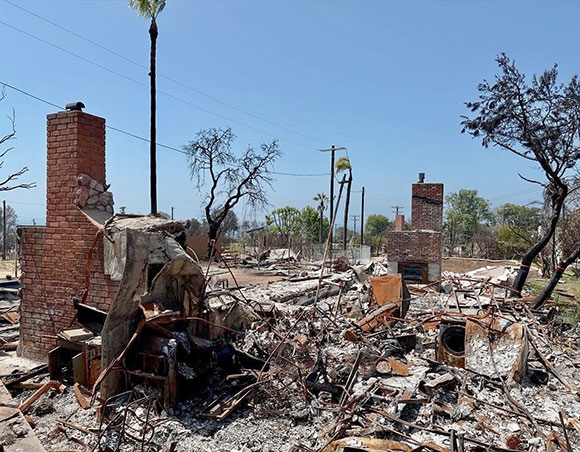
2025 Fires, Pacific Palisades, California (photo by Anthony Poon)

Josh Cooperman: It’s incredible to think that a year and four months after the wildfires in Southern California on January 7th, 2025—that absolutely decimated the Pacific Palisades and Altadena—that we’re still talking about it in terms of recovery, because the process has been so slow. And in the wake of the devastation, the architectural community in Southern California is facing a reckoning. It has no choice.

The idea about strengthening the enclosure, strengthening the envelope of an architectural structure—be it residential, hospitality, commercial, healthcare—the ideas about it haven’t necessarily changed much, but the perceptions have. In five short years, we’ve gone from something that was globally impactful like a pandemic to something that is regionally impactful like the fires, which made everyone think more about the changing nature of architecture. How did all that change the way you work?

Marquez Residence, Pacific Palisades, California, by Poon Design. Under the Fire Rebuilt Executive Order, this new house replaces the previous one lost entirely to the 2025 Palisades Fire. Fire-resistive and noncombustible strategies include: all metal framing (no wood); exterior walls and roof of Grade A metal panels; moisture-resistant gypsum sheathing; unvented attic, and mineral wool insulation. The removal of exterior decor eliminates where embers can collect, and also achieves the desired contemporary, bold character of the home. For an expedited schedule, Poon Design qualified as a licensed professional under the Los Angeles Self-Certification Pilot Program.

Anthony Poon: Well, Josh, you mentioned “strengthening” of the building. That’s only one small part of the exercise. I think this conversation should also be about resilience. There’s really no way you can strengthen a building enough to survive the disasters that may come. It’s equally important to think about how a building recovers from a fire, hurricane, earthquake. And how does a building support the community after something catastrophic? So it isn’t just about being stronger. It’s about being resilient and resourceful, and how to rebuild what we just lost.

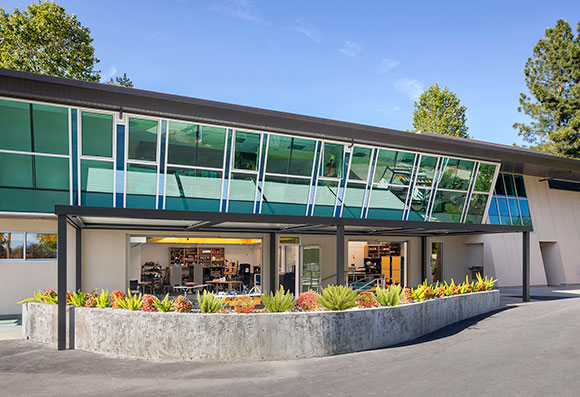
STEM Classroom Building, Berkeley Hall School, Los Angeles, California (photo by Bradley Wheeler)

Of course the fires are on everyone’s mind, but building strength and resilience involve much more. Being that we design schools, we have to be conscious about designing strength in new ways—for example, school shootings, unfortunately. It’s a difficult conversation when you’re designing a great school, and a teacher asks where the students should hide during a shooting. Will this amount of windows, which we all want for natural light and the indoor/outdoor connection, be an issue?

If we’re just going to design for strength, you’re going to have a house that is a bomb shelter. Or a school that is all concrete with metal bars in the windows. So there must be a balance. It’s not just “form follows function,” because if the function is strength and security, what kind of form are you ending up?

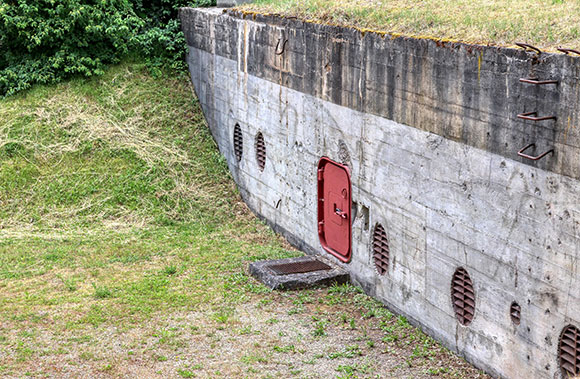
Concrete bomb shelter (photo by Alexander Fox | PlaNet Fox on Pixabay)

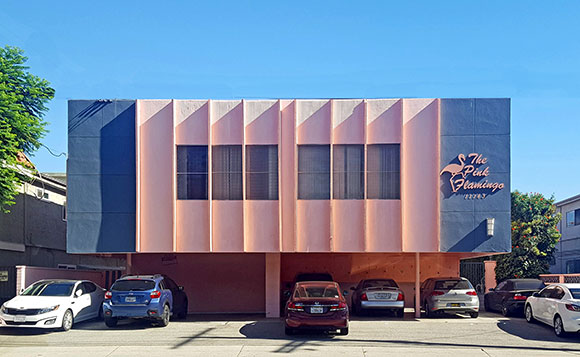
Josh: I don’t think that there is any real critique of architecture anymore. How there are still dingbats in this city is just staggering to me.

Anthony: But it’s great that dingbats still exists.

Josh: Is it?

Anthony: Dingbats are such a legacy of Los Angeles—the period, the style, something so unique and cool within our architectural culture.

Josh: Okay, great point. But Dingbats were notorious for crumbling in earthquakes. They were not well built, just like the Googies. I’m going to put a pin in this—I love my debates with you, and I’m definitely coming back to it. I feel that there is an opportunity for architects now to do something significant. Maybe the last time this happened was when the GIs came home from World War II.

The Pink Flamingo, Dingbat-style apartment building, Studio, City, California (photo on laconservancy.org)

Josh: So okay, are you changing the way you specify?

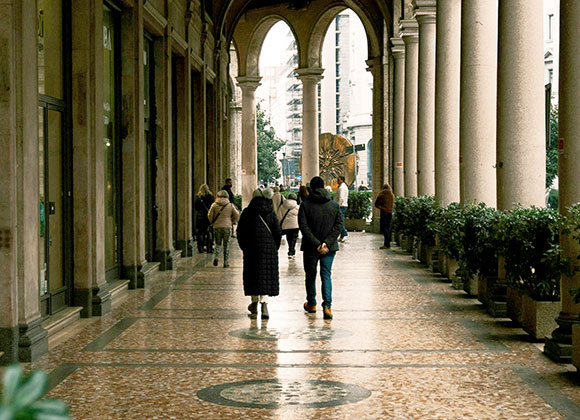
Anthony: With specifications, we have to talk about investment and value. If we’re designing, say a hotel lobby, it could be an affordable ceramic tile flooring or something that’s twice as expensive like terrazzo. But we point out how ceramic tile is not going to last as long as terrazzo. Tile is going to chip, need to be regrouted, and/or replaced altogether. Terrazzo can last 50 years, a hundred years.

Terrazzo flooring, Via Adalberto Catena, Milan, Italy (photo by Patricia Haller-Anguela on Unsplash)
New materials in fashion (photo by Faheem Ahmed on Unsplash)

I believe it was Ben that mentioned, “authenticity” in materials. I think with growing technology, the focus on authentic and real materials might start to fade.

I think back to the older days of fashion. Then, it was important that a suit was 100% real wool or a tie 100% real silk. But nowadays, fashion is driven by all kinds of new materials, like polyblends, synthetic stretch materials, plant-based latex—things that old school fashion designers would have never considered.

Similar options exist today in architecture. Yeah, I agree that fake stone trying to look like real stone is not good, but there’s so many other kinds of new materials. And this gets back to fire resistance. There are materials— like natural wood—that may not do as well as some of these new material combinations and technologies.

Josh: How do we find the time to research all this?

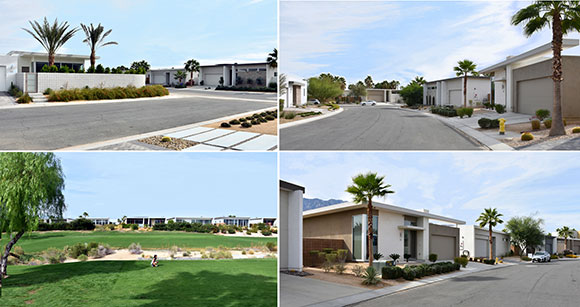
Anthony: It’s almost like how can you not, because of the risk of doing something wrong? Something I think about is scale. If you do a single custom house, you could try some new things and even take a few risks. But we’ve done mass production housing, as in tract homes, where a single house design is replicated a hundred times. If you get one material thing wrong, like, “We tried that and it didn’t work,” well, you’re not just getting a call from one client, you might get a class action lawsuit. So that’s when we experiment less and go back to best practices.

Mass production/tract housing, Escena, Palm Springs, California, by Andrew Adler and Poon Design (photos by Anthony Poon)

#117: SHIFTING GROUNDS IN ARCHITECTURE

May 1, 2020

Fires at the 405 freeway, near where I previously resided. (photo from abcnews.go.com)

(Original feature editorial published in California Homes: The Essential Guide, Architects & Builders 2020)

As earthquakes and fires challenge our complacency, as a decade concludes, the design industry confronts transitions and shifting grounds. No, not trends in popular paint colors. And not faux-Cape-Cod homes on the west side. Architecture is one of the few remaining noble fields where those who choose to participate do so because architecture has the capacity to change the world.

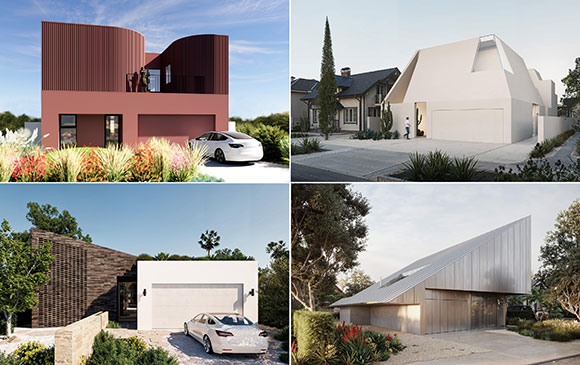
Yet another trendy faux Georgian/Cape-Cod/Shingle/Ranch-inspired home—a blend of architectural styles that has little relevance to our Southern California context and climate (background photo from Pixabay on Pexels)
Poon Design is honored to be one of the few green architecture businesses, acknowledged as a Certified Innovator, Sustainable Business Certification Program.

SUSTAINABILITY AND RESILIENCE

Sustainability is not a fad, no longer just a movement. It is mission critical. Being green does not simply comprise solar panels on the roof with recycled materials in the kitchen. Being an advocate for the environment has evolved into a lifelong commitment to our global community.

Last year as Poon Design Inc. received its certification as a sustainable business from the California Green Business Network, our pledge went beyond saving on paper and electricity. Our calling involves educating clients, participating in community service, and thinking beyond the physical environment, to include our economic and social circumstances.

Add the recent interests in biophilia and the instinctive association to nature and all forms of life. More crucial is what is known today as resilient design. How does architecture recover from disaster, whether fire or flood—even terrorism or a school shooting?

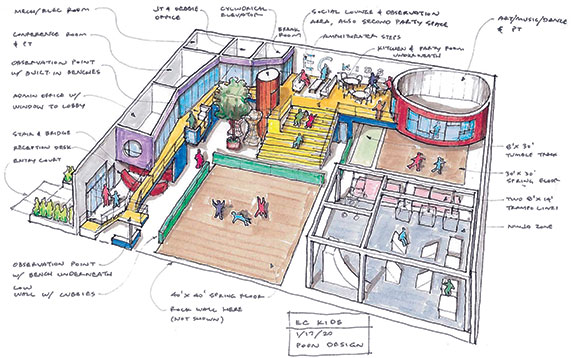
EC Kids fitness center and ninja gym, Culver City, by Poon Design (sketch by Anthony Poon)

TECHNOLOGY AND PROCESS

I embrace the old school tools of my trade that include a pencil, triangle and drafting table. A quantum leap for design arrived with digital technology. Computers and algorithms are not just powerful tools for the creative process, but also for construction. But I argue that our clients have been saturated with this promising call of a technological future.

For the design process, hands-on, rolling-up-one’s-sleeves, real-time methods replace clicks of the mouse. Expressive hand drawings far outshine the heavily-Photoshopped computer rendering. A 3D-rendering captures what the house might look like. But a hand-drawn sketch captures the emotion. When in construction, Poon Design challenges the machine-made and the factory-produced output. We embrace the hand-crafted that expresses the human touch.

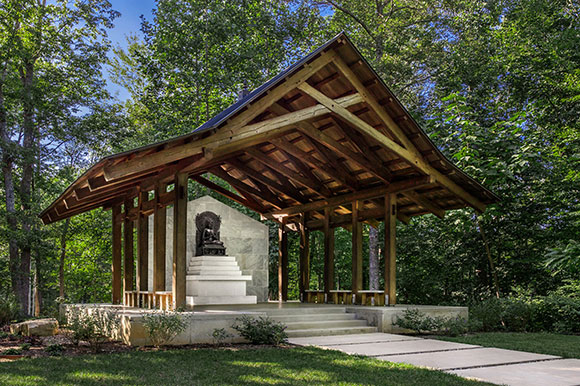
Buddhist Temple, The 14th Shamarpa Reliquary Building, Natural Bridge, Virginia. One of four completed buildings by Poon Design for a 400-acre international Buddhist retreat. Universally sacred, this design expresses a crafted and quiet architecture of both human and spiritual hands. (photo by Mark Ballogg)

BLURRING THE LINES

Where advantageous, architects became design-builders. Where necessary, lines between architects and interiors designers became fuzzy. Where strategic, architects designed furniture and interior designers designed bedding and kitchenware. Though the business model of single-minded specialization is an expedient method to market one’s brand, such as being the expert of Spanish Colonial estates in Beverly Hills, the current industry reveres the design companies of greater depth and complexity. As Frank Lloyd Wright promoted decades ago, ambitious design studios offer an array of services under one roof, from architecture to interiors, from furniture to graphics, from landscape to product design. With the right client, Poon Design adds branding, fashion, art/music curation, and certified feng shui services.

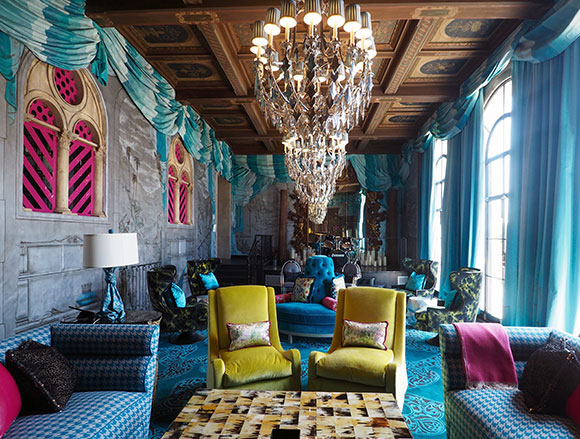
Living room of an estate in Beverly Hills, California, architecture by Martin/Poon Architects, interiors by Timothy Corrigan. (photo by Anthony Poon)

For each designer focusing exclusively on luxury single-family residences, there are architects embracing tract homes, prefabricated ADUs, affordable housing, and co-living mixed-use projects. Why can’t the architect of homes design a Buddhist temple?

Linea Residence G, Palm Springs, California. This production house design and similar others by designer/developer, Andrew Adler, and Poon Design have been built and sold, totaling 230 completed projects in and around Palm Springs. 2018 Winner of Best in Housing Design for North America, The American Institute of Architects. (photo by Hunter Kerhart)

CONSTANT CHANGE

Practically a cliché these days, Heraclitus proclaimed, “The only constant in life is change.” The truism still applies.

I don’t have a crystal ball, nor do my fellow classmates. But we are somewhat Futurists and we encounter the patterns. 1) The significance of community outweighs the consequence of self. 2) Face-to-face, hands-on interaction prevails over phone texts and posting on Instagram. 3) There are no limits to what a designer can design, what a creative mind can create.

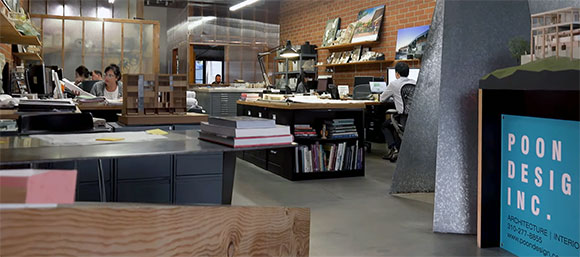
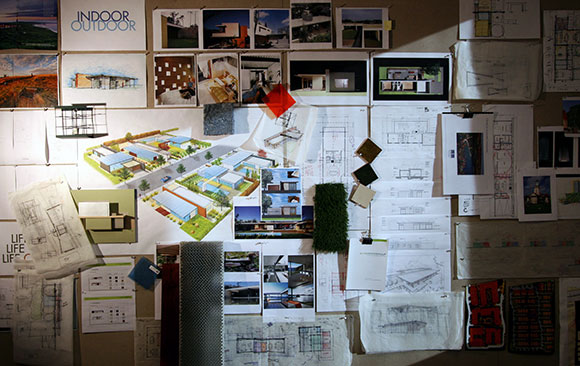
Conference room wall at Poon Design, Los Angeles, California (photo by Anthony Poon)
© Poon Design Inc.