Tag Archives: MICHAEL GOVAN

#224: LOVE HIM, HATE HIM, BUT DON’T IGNORE ZUMTHOR
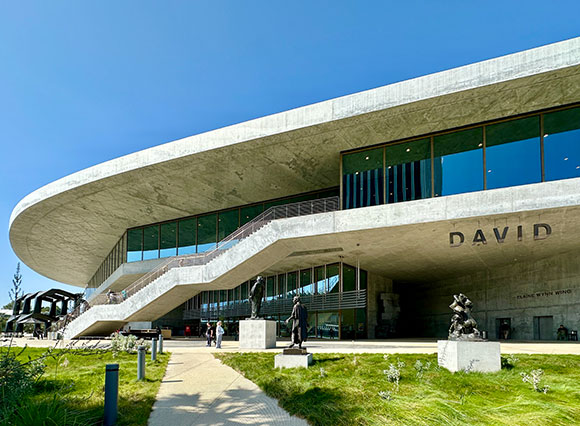
May 15, 2026

(photo by Anthony Poon)

25 years in the making, the new Los Angeles County Museum of Art (“LACMA”) recently opened to the public. The adjectives are in: ravishing, dismal, lyrical, divisive, pugnacious, palpable, disorienting, iconic, polarizing, dazzling, inelegant, revolutionary, one-liner, monotonous, and so on. The range of commentary is vast, being that much of criticism is subjective.

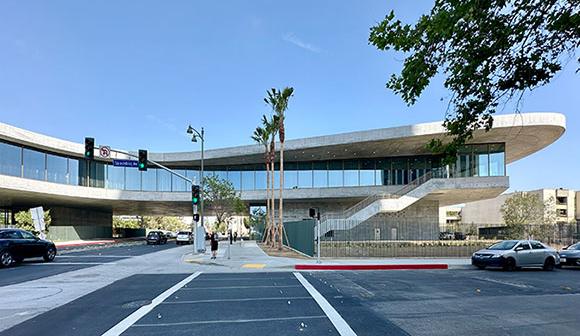
(photo courtesy of Iwan Baan)
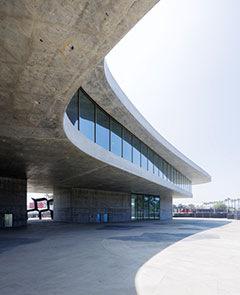
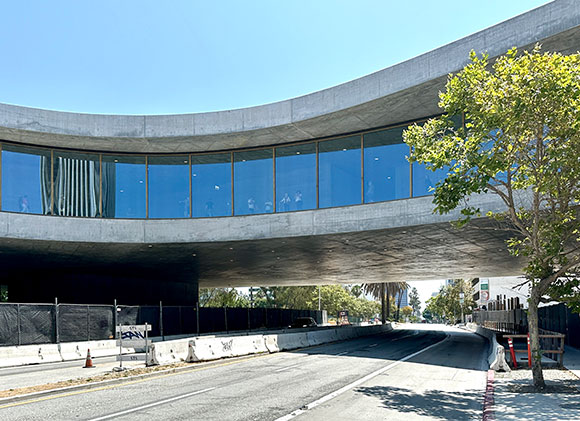
Spanning over Wilshire Boulevard. (photo by Anthony Poon)

Then there are the facts:

– $724 million construction cost: $74 million over budget.
– 110,000 square feet of new gallery space: 10,000 square feet less than the museum it replaces.
– Anticipated April 2026 completion: Several years behind schedule.
– Two million cubic feet of concrete used: Staggering carbon emissions.
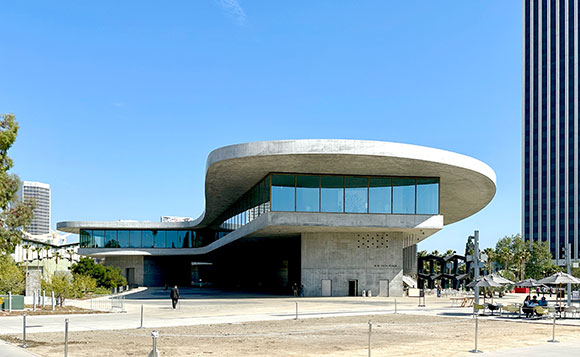
(photo by Anthony Poon)

All this said, I continue my review which began at a 2017 lecture where the selected Swiss architect, Peter Zumthor, presented his preliminary concepts. I followed up with a 2025 review of the project under construction. Today, I make the claim that the new LACMA, known as the David Geffen Galleries—despite controversies and shortcomings—is a masterwork, nothing short of the expected creative prowess from this Pritzker-prized architect.
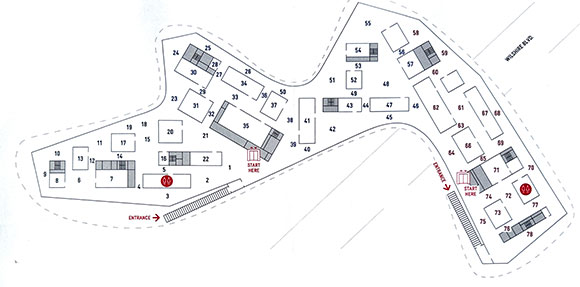
Musuem floor plan: Getting lost in the art or confusing and disorienting.
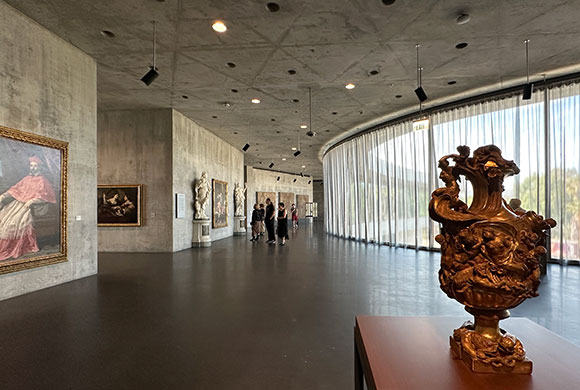
Galatea Vase by Italian Baroque sculptor Massimiliano Soldani Benzi, 1695. (photo by Anthony Poon)

Much has already been written about museum director Michael Govan’s meandering curation: a non-traditional, non-linear, mostly formless arrangement of 2,000 works of art currently on exhibit (organized by oceans?). It’s a free fall of chronology, historical themes, and art viewing. Consider a Greek sculpture from antiquity confronting a Francis Bacon triptych. Or 18th-century Mexican pottery coupling with 2026 food photography by Brooklyn-based Stephanie Shih. Or 14th-century Spanish-colonial paintings bonding with a 1963 Studebaker Avanti car.
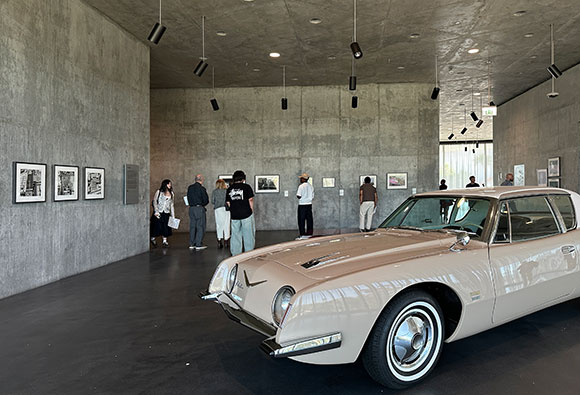
(photo by Anthony Poon)

(This is not so dissimilar to Philadelphia Museum of Art currently relocating the bronze statue of Rocky Balboa from the exterior steps into the museum next to Haring, Basquiat, and Warhol. Pop movie culture meets high art.)
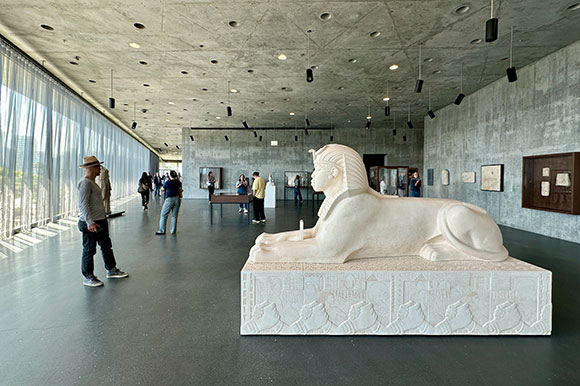
Neo-Egyptian sphinx by Lauren Halsey, 2023. (photo by Anthony Poon)

Radical gallery layout aside, the existential question remains, as I have wondered in past discussions of museum designs: Should a museum be a silent vessel to present art or an apparent work of art in and of itself? A past anecdote of Frank Lloyd Wright reveals ironies around his famed Guggenheim Museum. When Wright was asked how art was supposed to be viewed within this peculiar ramping spiral of galleries, he proclaimed that his building was the work of art and takes precedence over the art within.

Developed with SOM as collaborating architect/engineer, LAMCA is certainly no mute actor, akin to Wright’s sentiment. The museum is a bold, visceral, visionary statement, sometimes in union with the art, sometimes in dispute.
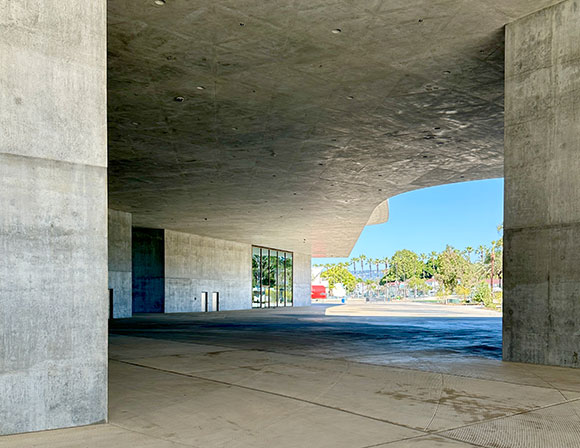
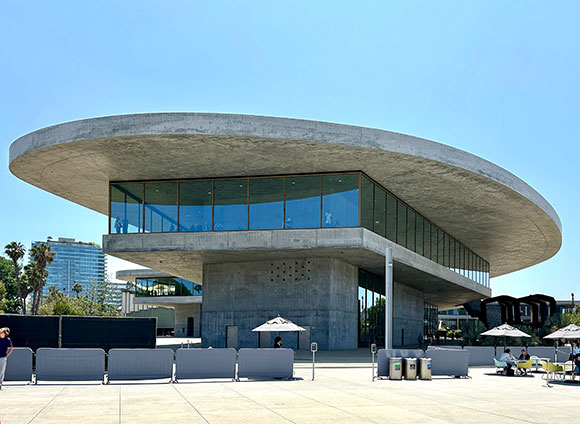
Covered exterior spaces awaiting outdoor furniture, events, and Erewhon café serving $21 mango smoothies. (photo by Anthony Poon)

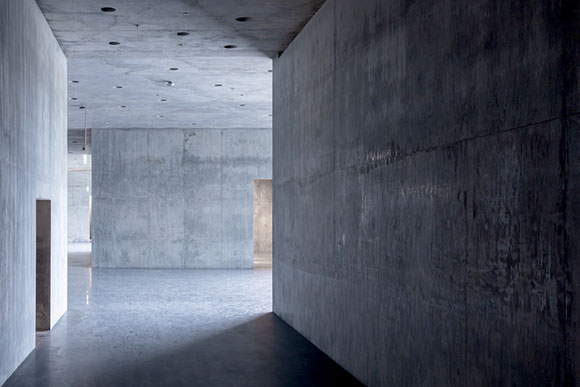
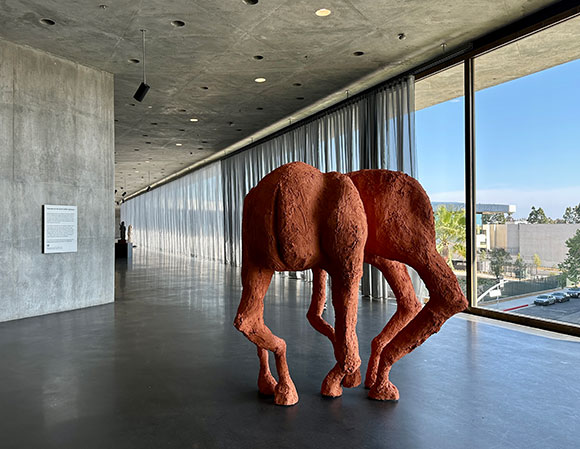
With the spaces defined singularly by concrete—all walls, floors, and ceilings—the rawness can be a wonderful contrasting backdrop to the elegance of much of the historical works, for example, teapots and tapestries. But when the Brutalist nature overwhelms, as in the interior galleries, the art is subsumed by primitiveness, not unlike art in a warehouse.
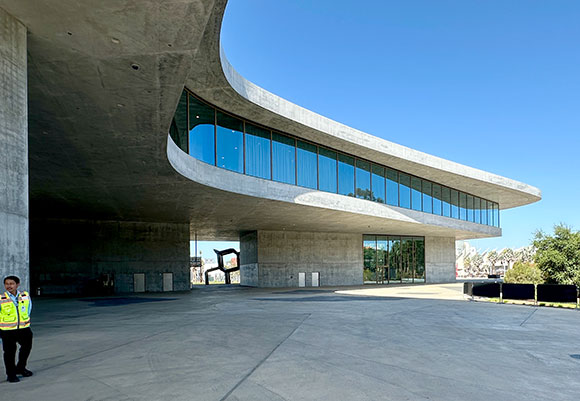
(photo by Anthony Poon)

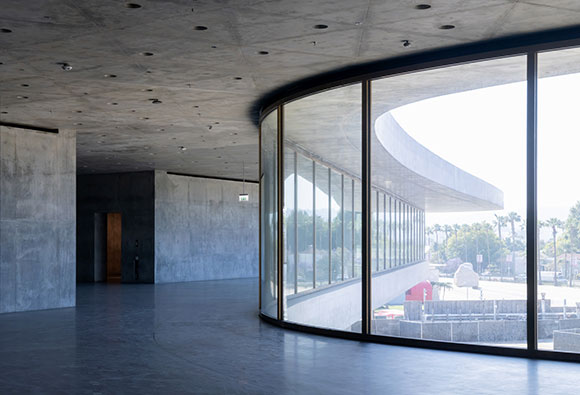
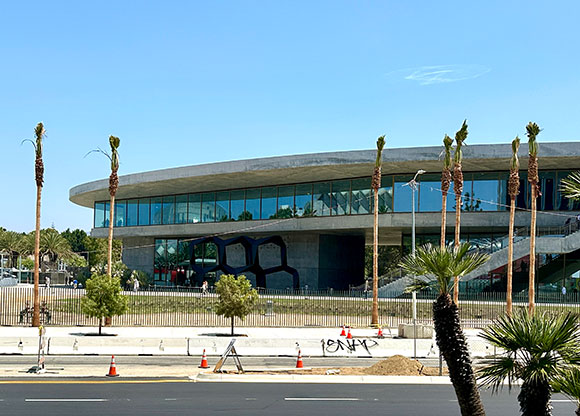
The exterior continuous glass walls, 28-foot-tall wrapping a building the size of three football fields, deliver the horizontal raking light that Zumthor sought for presenting sculpture, while also offering views to the museum’s diverse context: Mid-Wilshire, La Brea Tar Pits, Hollywood Hills, and surrounding neighborhoods. But when this Los Angeles sun creates glare, especially on the glass-enclosed works, visitors place their faces close upon the art hoping to find a functional viewing angle. The metallic perimeter curtains by Japanese textile designer, Reiko Sudo, protect light-sensitive artwork, a significant concern of curators, and do soften the sun but often not enough for digesting the art.
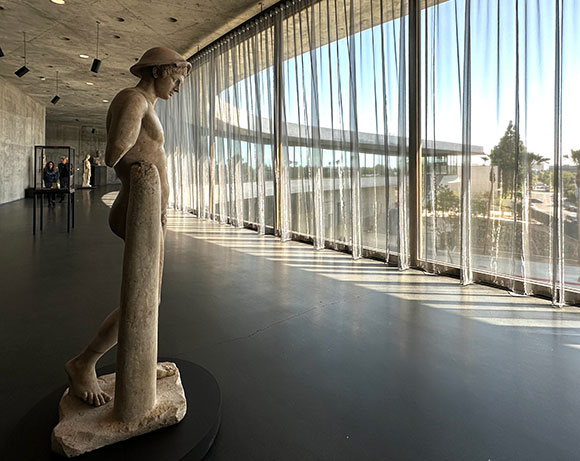
“The Bateman Mercury,” 2nd-century BC Roman marble reproduction of a 4th-century BC Greek original. (photo by Anthony Poon)

So yes, Zumthor’s design does conflict in some areas, but I favor this tension, this vibration between what is traditionally expected from the pearl-clutching art crowd and the evolving future of art consumption. Progress is built upon new ideas, challenges to the norm, even constructed upon outrage.
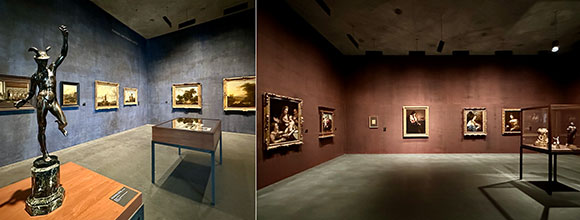
Interior concrete walls are colored with a mineral glaze, based on ancient Mesoamerican staining that use nanoparticles suspended in silica. Left: Foreground bronze sculpture is “Mercury” by Dutch Mannerist sculptor Willem Danielsz van Tetrode, 1560. (photos by Anthony Poon)
The Futility of Conquest” by Liz Glynn, 2023. (photo by Anthony Poon)

Despite Zumthor’s explicit frustrations with working in the US and the compromises from the original concept—such as the black concrete, continuous fluidity of the exterior, articulated roof, typical Zumthor details—the museum is a success. I favor the Wrightian approach that such a building should not be a voiceless container for art. Architects are indeed artists, and architecture is indeed art. And we should celebrate LACMA for showing how potent this understanding can be.
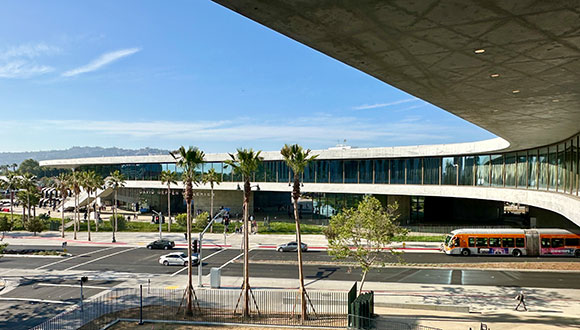
Regarding universal design, consider the vertical inconvenience of the eight-story Whitney Museum of American Art, New York, eight-story Walker Art Center, Minneapolis, or the recently opened seven-story New Museum, New York. In contrast, the single exhibition floor of the new LACMA is a welcome relief for many. Not just wheelchair-bound, but visually-impaired, non-active visitors, family with a stroller, and so on. (photo by Anthony Poon)

Think of the city of Los Angeles, or any city for that matter, as an urban-scale canvas. Every building placed on this backdrop—every home and skyscraper, park and freeway, mall and museum—is like an artist’s dab of paint on canvas. Such a canvas is neither blank nor neutral as each city brings its history, topography, natural features, climates and micro-climates. Upon our canvas, Peter Zumthor has served us a declaration. Some will hate it, but I suspect most will love it, especially in the long run. And no one can ignore it.
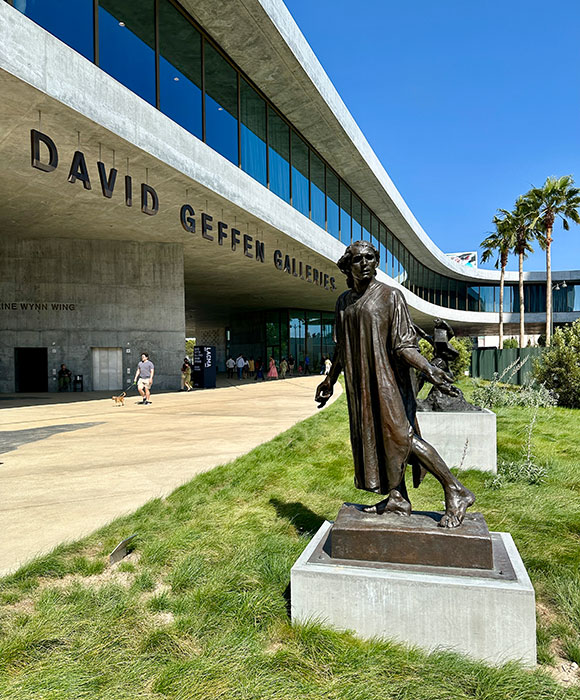

Auguste Rodin’s “Burghers of Calais” (1895) at the Iris and B. Gerald Cantor Sculpture Garden. (photo by Anthony Poon)

#208: ZUMTHOR IN PROGRESS AT LACMA

July 4, 2025

(photo by Anthony Poon)

In June, LACMA (Los Angeles County Museum of Art) invited select visitors to marvel at their nearly finished $750 million museum. Of this project by Pritzker-honored, Swiss architect, Peter Zumthor, celebration and applause accompanied uneasiness and doubt.

(photo courtesy of Iwan Baan)

Named the David Geffen Galleries, Zumthor’s new museum exploits minimalism to various extremes. Only two materials—concrete and glass—define the entirety of this 347,500-square-foot structure, of which 110,000 square feet comprise the exhibition area. Contrasting the perimeter of floor-to-ceiling windows set in brass frames, every other surface is concrete—as in concrete walls, concrete floors, concrete roof, concrete ceiling, concrete stairs, and so on.

(photo courtesy of Iwan Baan)

Critics pondered: How do you hang art on concrete walls or from concrete ceilings?

LACMA’s CEO, Michael Govan, defended, “You can just drill right into the walls.” He claimed that with each new exhibit, curators can patch up the holes and drill more where needed. “It’s supposed to be like a good pair of old blue jeans that gets better with time.” Sentiments of patina referenced wabi-sabi. I predict that the future of these concrete surfaces will have some kind of hanging display system, hopefully in matching brass.

(photo courtesy of Iwan Baan)

Critics continued: With so much glass, isn’t sunlight bad for viewing art and the preservation of it? In earlier presentations, Zumthor stated his fascination with horizontal light striking sculptures. Also, light-controlled galleries placed away from the windows will address UV light and radiant heat

(photo courtesy of Iwan Baan)

Curiosity revolved around this museum conceived as a massive one-floor, curving form, as compared to a traditional boxy building of multiple floors, hierarchical departments, and chronological galleries.

LACMA responded, “The horizontal, single-level layout eliminates traditional cultural hierarchies, placing all works on the same plane…” Of the “non-hierarchical” architecture, Govan exclaimed democratically, “I don’t want anyone in the front.”

The project’s progress is a milestone in a journey over two decades. It started with an international design competition in 2001, won by Rem Koolhaas with a glass roof design—not convincingly buildable. Zumthor entered the scene in 2009, impressing architects, as he usually does, with ideas of incredible genius. The original design comprised an all-black building supposedly inspired by the amoebic shapes at the nearby La Brea Tar Pits. To accommodate Zumthor’s vision, called by many as “The Blob,” he required the demolition of four major buildings on the museum campus.

(photo by Anthony Poon)

At LACMA, one can see the strengths apparent in Zumthor’s portfolio. His work exudes an authority through elemental minimalism. His architecture edits and curates moves of simplicity and singularity. His uncompromising details may be attributed to his cabinet maker father. Investigating basic materials like concrete, stone, and wood, Zumthor’s structures are sensuously tactile—a palpable spirituality.

But expectations can be so high, maybe too high. There are disappointments here. In 2014, the design was forced, due to budget, to be smaller and in conventional gray concrete, no longer an enigmatic black. The building maintains the heroic minimalism, but loses the elegance and exquisite beauty seen in the architect’s other works. The poetry coming from simplicity still persists, but many of the compromises are severe, particularly for an architect considered to be uncompromising. One of the most unfortunate changes from the original scheme is the straightening of curving floors and windows, seen most impotent under a roof where the bold sweeping edge remains.

(photo by Anthony Poon)

With such concessions, the architect has distanced himself, “saying he had repeatedly been forced to ‘reduce’ his design, and that the experience had convinced him to never again work in the US,” reported The Guardian. Adding insult to injury, several advocacy groups had banned to stop the project. Even alternative designs were proposed pro-bono from many architects.

(photo by Anthony Poon)

LACMA’s new David Geffen Galleries and its 142,000 works of art are targeted to open in spring 2026—and the final judgment is TBD. Stay tuned.

© Poon Design Inc.