Tag Archives: MAD ARCHITECTS

#218: THE MOST BEWITCHING BUILDINGS OF 2025
January 9, 2026

(photo from ArchDaily)

Once again, it is time for me to highlight ten works of architecture that caught my eye last year—bewitched my design sensibilities. There are many more than just ten projects that deserve recognition, but such is life in an industry of subjective creativity.

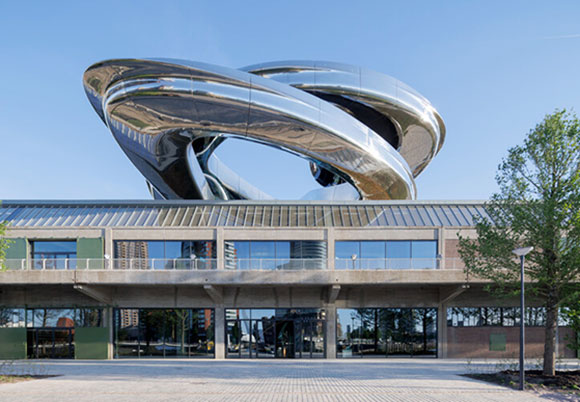
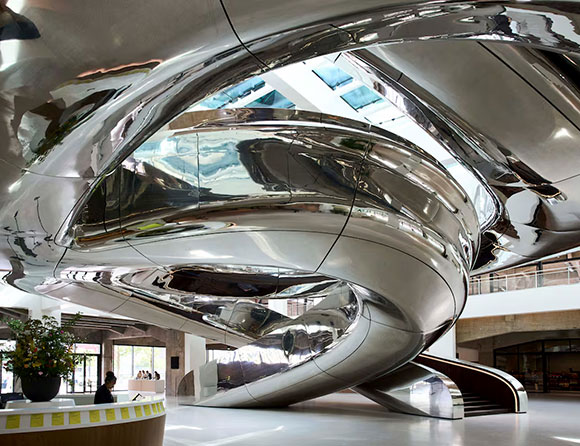
1: For the Fenix Museum of Migration in Rotterdam, a renovation of a century-old warehouse receives an iconic double-helix staircase. Entitled The Tornado, this stainless steel feature spirals up through the two levels of the warehouse, then bursts through the roof reaching for the sky—a metaphor for the journey of migration. By MAD Architects, the 160,000-square-foot museum exhibits artifacts telling the story of migration around the globe, past and present.
(phot by AP Photo/Peter Dejong)

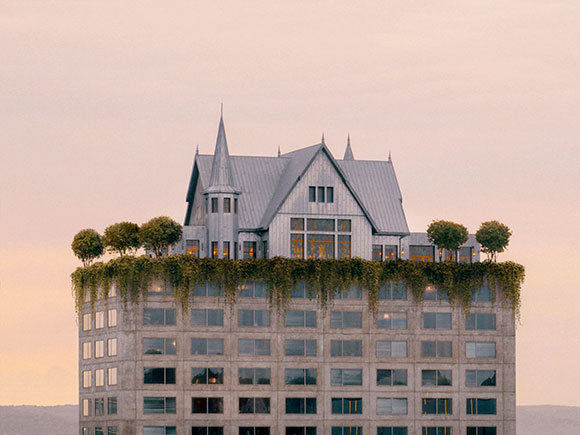
2: Architect Philippe Starck proclaims, “Maison Heler was born of a surreal, poetic tale I imagined. It is a hotel conceived as a habitable work of art, a literary principle crystallized in matter.” A dream-like, whimsical “mansion” tops off this nine-story, 104-room Maison Heler hotel, located in Metz, France. Entirely wrapped in standing seam metal panels, the rooftop replica of a 19th century house comprises a restaurant and bar, standing in stark (Starck?) contrast to the aggressively and intentionally dull hotel beneath.
(photo from starck.com)

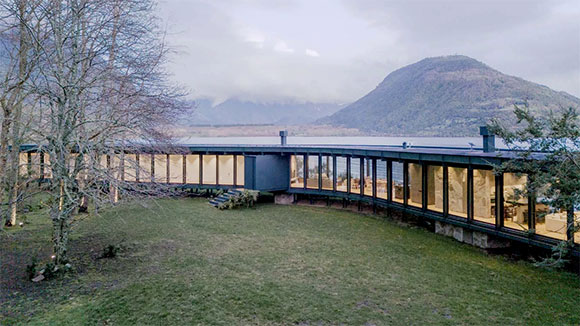
3: The Lago Ranco Retreat by Hevia Poblete Arquitectos curves its thin linear form just slightly, sweeping gently through the landscape, welcoming in panoramic views. In Chile, this 3,000-square-foot, five-bedroom, getaway home on a lake comprises a modular steel exoskeleton. Excessively repetitive, the exact architectural/structural section repeats itself three dozen times.
(photo by Marcos Zegers)

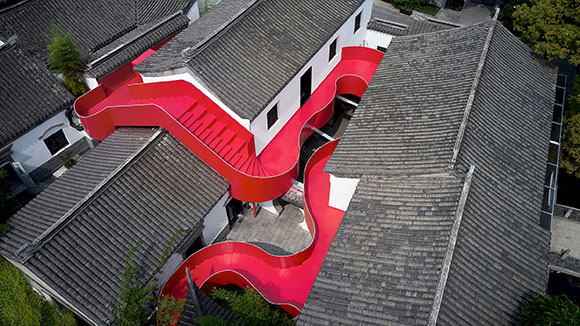
4: With Big Red Crayfish, architect Dayi Design created an addition/renovation with a visually stunning juxtaposition of old and new, backdrop and accent, gray/white and Chinese red. At this historic complex on the banks of Nanjing’s Qinhuai River, a steel ribbon of red stairs and paths weave up and down, in and out, through and around, knitting together several commercial structures.
(photo from architizer.com)

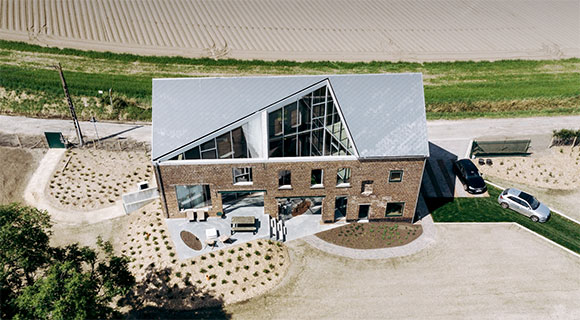
5: In Pepingen, Belgium, a triangular courtyard carves into an existing farmhouse, delivering light and air to this traditional barn. Double-height spaces and split-level areas surrounding this aggressive cutout. Entitled Lyco House by architect OYO, much of the original structure remains to display a conversation between the past and the future. The design is an intervention where more is added through subtracting.
(photo by Karen Van der Biest)

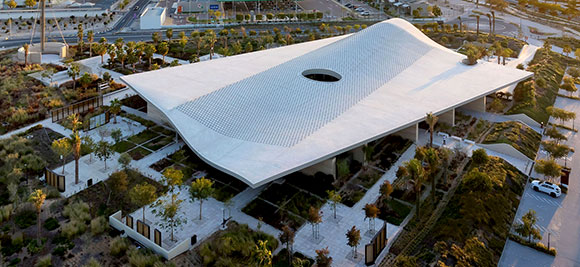
6: The first of its kind in the Muslim world, the Al-Mujadilah Center and Mosque for Women, Qatar, provides 50,000 square feet of educational, worship, and community spaces, to include classrooms, courtyards, event areas, and a prayer hall. Designed by Diller Scofidio + Renfro, the roof with its 5,000 light wells sits both boldy and gently in the cityscape like a slightly folded piece of paper and provides a landmark presence. The concept of bringing together many diverse activities and interests “under one roof” has literally been accomplished.
(photo by Iwan Baan)

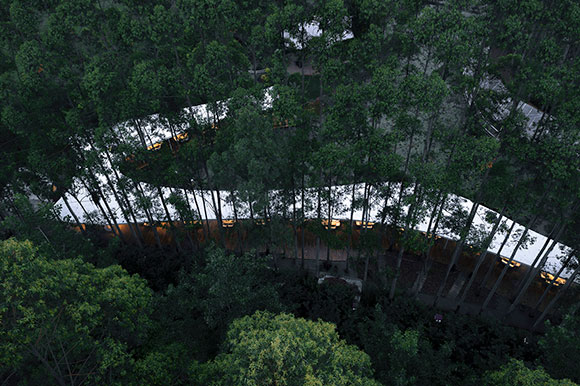
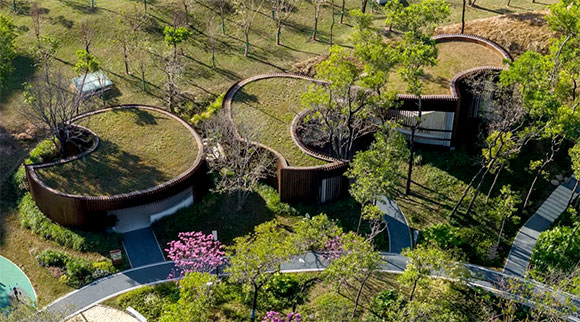
7: A modest 4,700-square-foot project by Atelier Xi can say a lot about nature, sustainability, and sheltering into the earth. In Shenzhen, China, the steel pavilions of the Qiaochengbei Park Visitor Center weather, show a wabi-sabi patina that unifies this modest village. With minimal disturbance to the landscape, building forms wind around existing trees. Living roofs tell the earth to receive the structures gracefully into the 16.5-acre park.
(photo by Zhang Chao)

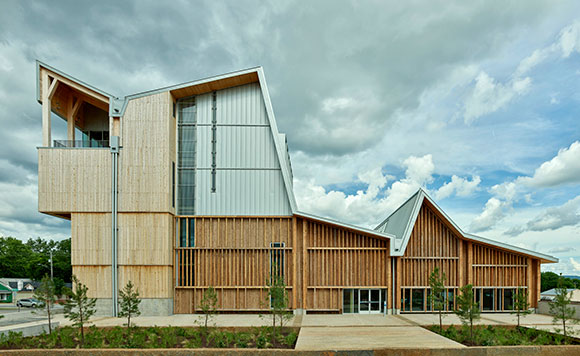
8: Supporting the building’s timber design innovation degree program at the University of Arkansas, Grafton Architects exploits mass-timber construction to its fullest. The Anthony Timberlands Center for Design and Materials Innovation in Fayetteville houses 45,000 square feet of education around design-building and research in wood, digital fabrication/prototyping, and a materials research division. Though the roof angles may appear arbitrary, like an architect inscribing his signature, the slopes and heights are driven by the activities within.
(photo by Timothy Hursley)

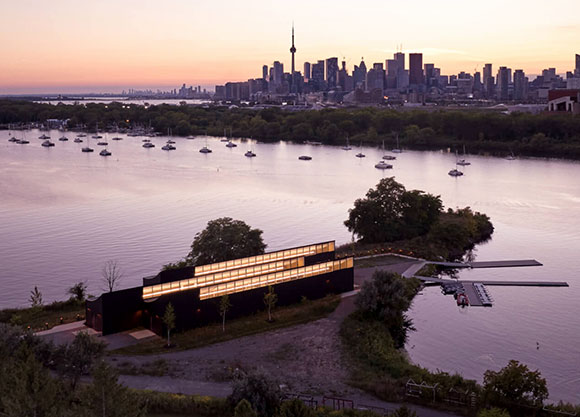
9: Inspired by the lines of racing boats, the 9,400-square-foot Lindsay Boathouse is modest and minimal, yet expressive . Architects VJAA shifts and slides three rectilinear masses—two storing the boats and one containing the gym and office. Employing low carbon, cross laminated timber and expansive bird safe glazing, this passively heated and cooled structure takes in views of the lake with Toronto’s skyline in the background.
(photo by Doublespace Photography)

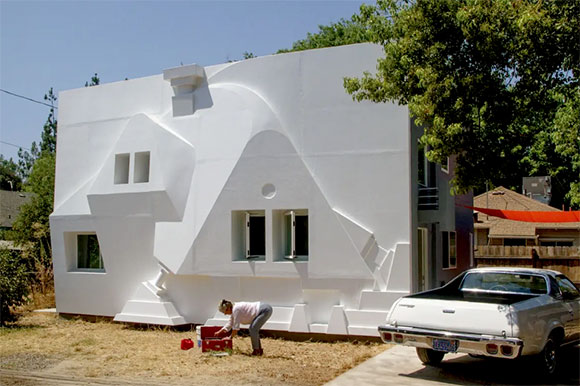
10: With a shoestring budget of $150,000 and modest building footprint of 900 square feet, architect/builder Ben Pennell created an eccentric and bizarre duplex residence at 210 Semple Street, Modesto, California. The sculptural façade employed CNC-cut plywood forms and a white gel-coat applied to fiberglass cloth. During the creation of this surreal work that calls upon the Grotesque, Pennell comments on “the asphyxiating burdens of this intolerably capitalistic existence.”
(photo by Ben Pennell)

For past years’ “top ten,” visit 2019, 2020, 2021, 2022, 2023, and 2024. Or see my all-time 15 favorite buildings. Check out my favorite projects in Los Angeles and around Los Angeles. Lastly, my favorite architects living and from the past.

#186: ANOTHER BAKER’S DOZEN

April 26, 2024

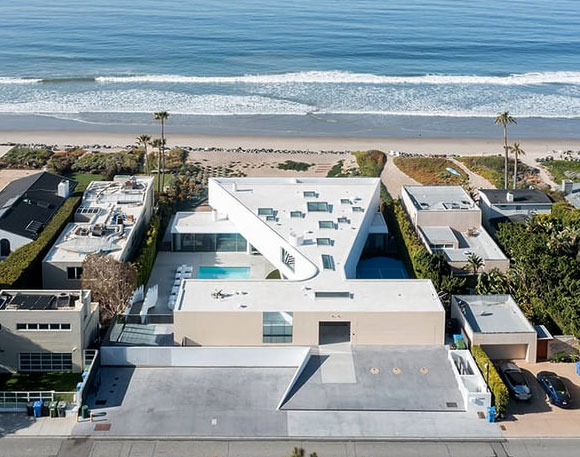
Broad Beach Residence, Malibu, California (photo by Iwan Baan)

A few years ago, I listed some of my favorite buildings in the city of Los Angeles. Today, I offer another dozen favorites from Southern California, but outside of Los Angeles proper. There are many wonderful works of architecture in our region that to choose only thirteen is impossible. Regardless, here are some in no particular order, from residences to retail, from restaurants to religious to research.

Broad Beach Residence, Malibu, California (photo by Iwan Baan)

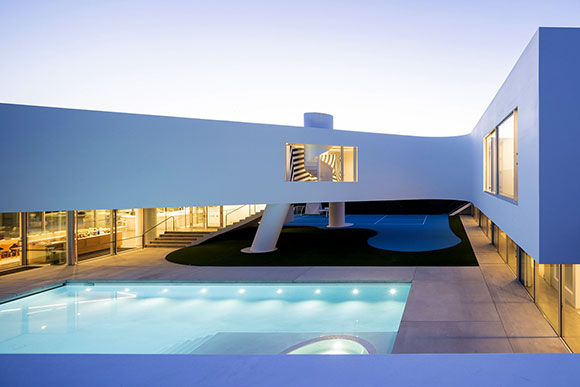
1: The 10,800-square-foot, six-bedroom Broad Beach Residence offers a new form to residential architecture. The triangular composition by Michael Maltzan Architecture starts narrow at the street and expands towards the beach and ocean, maximizing views to the horizon. This martini glass-shape houses two major bedrooms hovering above a courtyard with swimming pool and basketball court, replete with indoor-outdoor enjoyment of the Malibu coast.
(W)rapper, Culver City, California (photo by Anthony Poon)

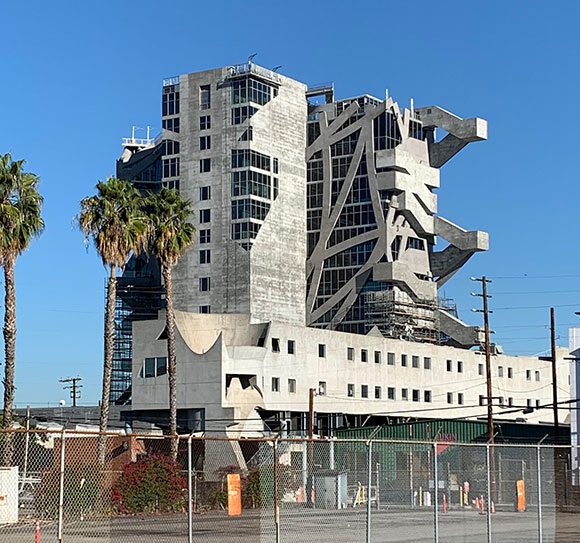
2. The old saying goes, “Love me, hate me, but don’t ignore me.” So it is for this Culver City office known as the (W)rapper, by Eric Owen Moss Architects. The 17-story structure has the honor of being 2023’s most written about building. The bizarre steel exoskeleton with its aggressively cantilevered stairs, oddly shaped glazing, and large expanses of solid walls result in a sublime and grotesque presence in a low-lying skyline. The verdict: I admire the courage.

Prada Epicenter, Beverly Hills, California (photo by Anthony Poon)

3. In Beverly Hills, OMA reinvents shopping at the Prada Epicenter on Rodeo Drive. From the street, the floor rolls up to the second level, becoming an amphitheater to display fashions or socialize. The traditional storefront display is subverted by eliminating the condition. Instead, the store opens to the street in its entirety—secured at closing by a massive aluminum panel that rises out of the sidewalk. Street retail displays are set in the concrete floor, where a shopper looks downward on, separated by elliptical glass panels upon which one stands, if feeling courageous. Unfortunately, many of the architect’s original ideas did not survive recent renovations.

Gardenhouse, Beverly Hills, California (photo by Anthony Poon)

4. MAD Architects—creators of the upcoming, monumental, 300,000-square-foot Lucas Museum of Narrative Art—designed a whimsical mixed-use project of 18 condos and commercial spaces. Entitled Gardenhouse, the architects envisioned a 48,000-square-foot “hillside village” in Beverly Hills, where an assemblage of quirky house-like forms rise from the building’s living façade.

Frank Gehry’s house, Santa Monica, California (photo by IK’s World Trip)

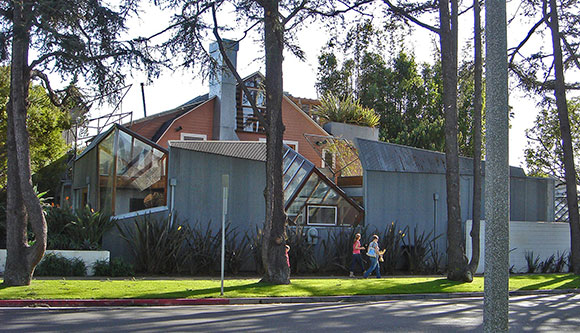
5. During the many decades of its making, the neighbors hated this house. To their astonishment, the masterful creation has become one of the most famous residences in the world, a living thesis of and personal residence to Frank Gehry’s seminal ideas. For the existing Dutch colonial, Santa Monica house, the architect engaged the traditional personality with torn apart walls and roofs revealing a skeletal expression of wood studs. Enter the 1970s premiere of chain link fence, raw plywood, and corrugated metal to the world of high design.

Chiat/Day Building, Venice, California (photo from The Architect’s Newspaper)

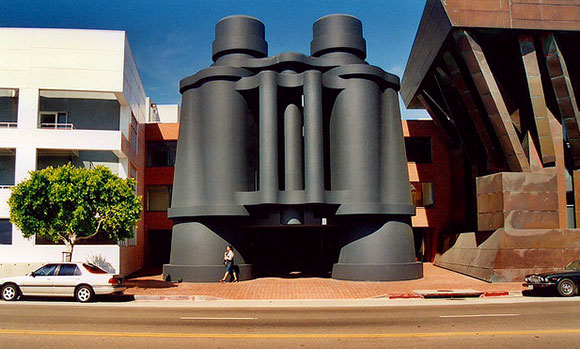
6. Gehry at it again, this time in Venice. Often called the “Binocular Building,” the Chiat/Day headquarters, now occupied by Google, blurs the line between art and architecture. Visitors and cars enter the 75,000-square-foot building through the binoculars, a functional sculpture with offices within, created with artists Claes Oldenburg and Coosje van Brugge. On the right sits a tree-like composition in copper panels, and on the left, a contrasting enameled metal ship form.

Maison Martin Margiela, Beverly Hills, California (photo by Poon Design)

7. Thinking of the Maison Martin Margiela store in Beverly Hills, I am reminded of the Sparkletts water delivery truck and its tiny shimmering discs—a kinetic surface reflecting the sun. Played out on a much larger scale, architects Johnson Marklee covered the Margiela’s façades entirely in these mirror-like discs. Always in motion (and not captured well in a photograph), this visual treat sparkles while displaying wind patterns swooshing down the retail street.

Kate Mantalini, Beverly Hills, California (photo from morphosis.com)

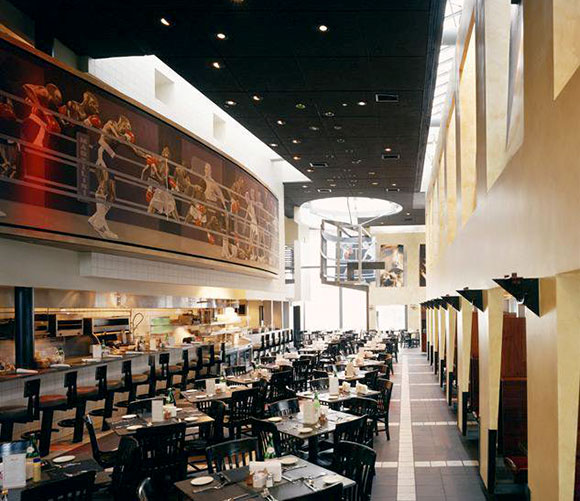
8. Though Kate Mantalini closed in 2014, this Beverly Hills restaurant was an icon, both socially and architecturally. As a place to see-and-be-seen, the design was no quiet backdrop. Architect Morphosis created an energetic living room of art, sculpture, and architecture: angled walls, oculus/skylight sundial, steel beam compositions, curved mural of boxers, striped black and white tile floor, and irreverent giant headshots of Andie MacDowell (why her?). The final result remains in memory as a local attraction and an influential early work from the Pritzker-prized architect.

Wayfarers Chapel, Rancho Palo Verdes, California (photo by Olive Stays)

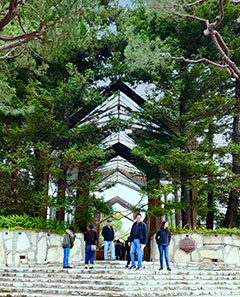
9. When the Wayfarers Chapel first opened in Rancho Palo Verdes, the 1950s site was not the lush forest of trees as one encounters today. On a bluff overlooking the ocean, Lloyd Wright (son of Frank Lloyd Wright) designed a crystalline glass and wood structure surrounded by majestic skies and vast land. As dramatic as the chapel’s origin was, the current state is no less powerful—now a magical building surrounded by dense trees. One enters as if in a romantic fairy tale. Last year, the chapel was named a National Historic Landmark. (Unfortunately due to recent land movements, the chapel has been slated to be dismantled and reconstructed at a new location TBD.)

Riviera United Methodist Church, Torrance, California (photo by Anthony Poon)

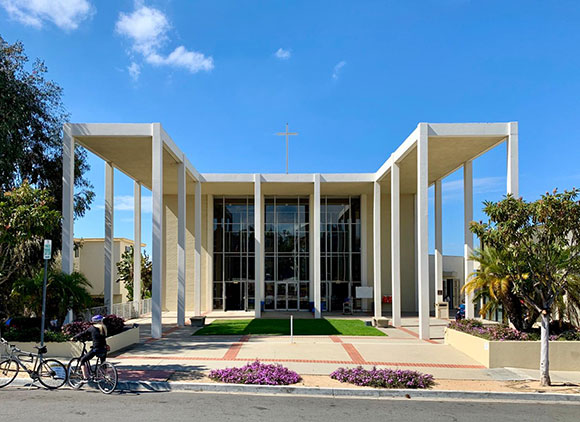
10. A lesser known work from Richard Neutra, the Riviera United Methodist Church displays the simplicity and elegance of colleague Mies van der Rohe’s “less is more.” Neutra introduced the International Style to California, alongside his once-roommate at the famed Kings Road House, Rudolf Schindler—architect of said house (which was no. 14 on this list). Coincidentally in the early 1900s, both Neutra and Schindler arrived from Austria and worked for Frank Lloyd Wright. For this church, Neutra embraced the rectilinear nature of post-and-beam construction, adapting it to the fresh air of Redondo Beach.

Case Study House No. 8, Pacific Palisades, California (photo from archilovers.com)

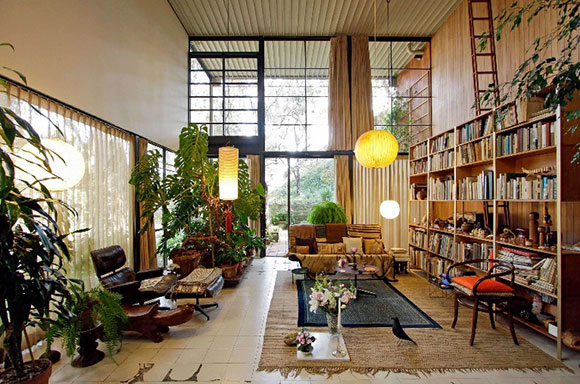
11. The Case Study House No. 8, also the Eames House, served as the modest 1,500-square-foot personal residence and 1,000-square-foot design laboratory for husband-wife architects, Charles and Ray Eames. For this National Historic Landmark in the Pacific Palisades, the house should possess an “unselfconscious” and the “way-it-should-be-ness.” Through new technologies, off-the-shelf materials, and standard components, the architects pioneered much of today’s pre-fab, modular construction industry. (L)

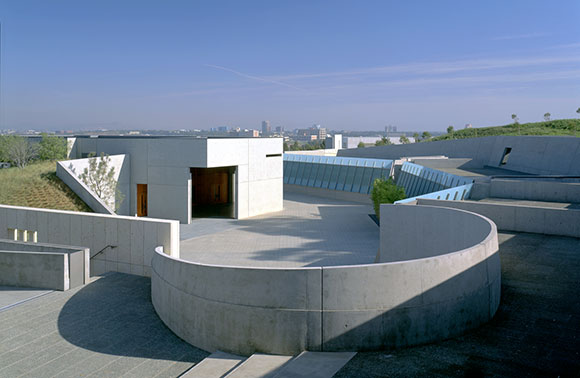
Neurosciences Institute, La Jolla, California (photo from twbta.com)

12. With the Neurosciences Institute, Tod Williams Billie Tsien Architects created a “monastery for scientists.” In La Jolla, three structures—theory center, 350-seat auditorium, and labs—nestle into the earth and form a courtyard. As is typical of the architects’ work, this research campus explores the most sublime and fetishized (obsessive?) details and materials: sand blasted concrete, redwood panel sun shades, bas-relief surfaces, jade green serpentine stone, fossil stone from Texas, and bead-blasted stainless steel. This tactile environment confronts all the senses.

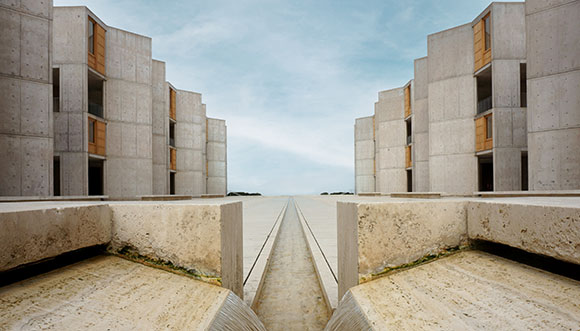
Salk Institute for Biological Studies, California (photo by Adam Bignell on Unsplash)

13. Ask any architect, this is the hero of them all: the Salk Institute. If a work can be named one of greatest of all time, Louis Kahn’s 412,000-square-foot research center in La Jolla is high on this list. Jonas Salk, who created the polio vaccine, asked the architect to “create a facility worthy of a visit by Picasso.” With influences from monastery design, Kahn’s profound composition inspires scientists, architects, and everyday visitors, with its otherworldly beauty and axial relationship to the clouds, horizon, and beyond.
(For my 2023 favorites from around the world, visit here.)

#163: THE MOST BREATHTAKING BUILDINGS OF 2022

December 30, 2022

(photo from Adam Mork)

In 2017, I listed my all-time favorites. In 2019, I presented ten projects I called the most seductive. In 2020, the adjective used was most intriguing. In 2021, my essay displayed buildings that were the most striking. For the end of 2022, I highlight what takes my breath away. Defining breath-taking typically involves words such as awe-inspiring, astonishing, wondrous, and even out-of-this-world.

(photo from Adam Mork)

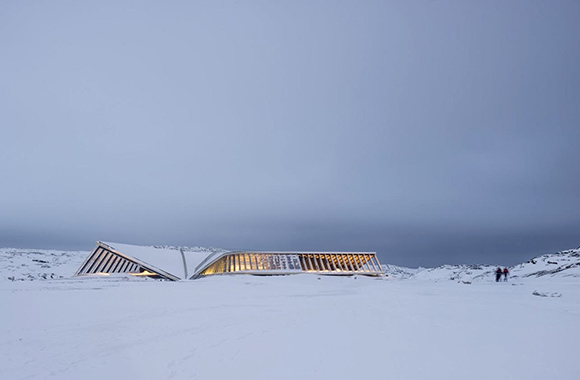
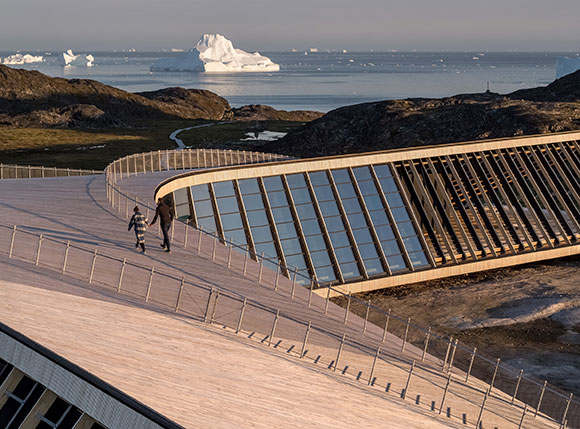
1: The western coast of Greenland offers the Ilulissat Icefjord Centre, both a research center and eloquent sculpture. Focusing on the study of massive glaciers and climate change, Dorte Mandrup’s design expresses the human condition within the science of ice, such as archeological artifacts contained in prisms of glass.

(photo by Felix Bartels on Unsplash)

2: MVRDV’s “art depot” at the Museumpark, Rotterdam, comprises multiple exhibit halls, a rooftop garden, and restaurant. This Depot Boijmans Van Beuningen takes a behind-the-scenes approach by presenting all current works along with ones usually hidden in storage, both in full display. The architect sees the mirrored exterior as an innovative response to complementing the surroundings.

(photo by Iwan Baan)

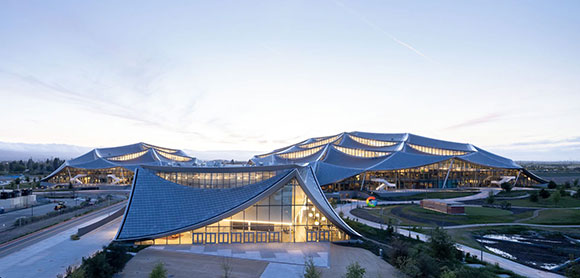
3: Google Bay View aims to operate the 42-acre campus on carbon-free energy by 2030. For Silicon Valley in Mountain View, California, a collaboration between Denmark’s  BIG and England’s Heatherwick Studio created 1.1 million square feet of building, which includes an event center for 1,000, short-term accommodation for 240 employees, 20 acres of open space, and three main buildings covered in lightweight translucent canopy structures.

(photo by Office of Architecture in Barcelona)

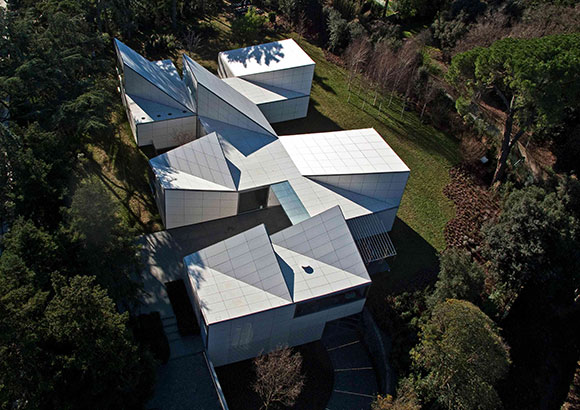
4: The project’s title, Origami House, is apt as this Barcelona house folds, creases, and rises out of the land adjacent to a forest and golf course. Designed by Office of Architecture in Barcelona, the paper white crispness and hidden service facilities (where are the stairs?) delivery a surreal composition, part home, part arts and crafts, and part dreamscape.

(photo by CreatAR Images)

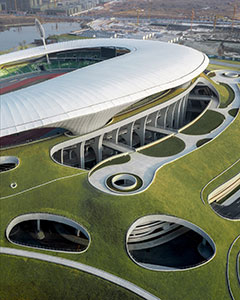
5: MAD Architects conceived the Quzhou Stadium in China as “a piece of land art.” Though with allusions to Bradbury’s science fantasy, this 30,000-seat stadium is no fiction. As an Earthwork, it links the worlds of art installation, landscape design, and architecture, while also straddling the visions of a mad man and artistic genius.

(photo by Leonardo Finotti)

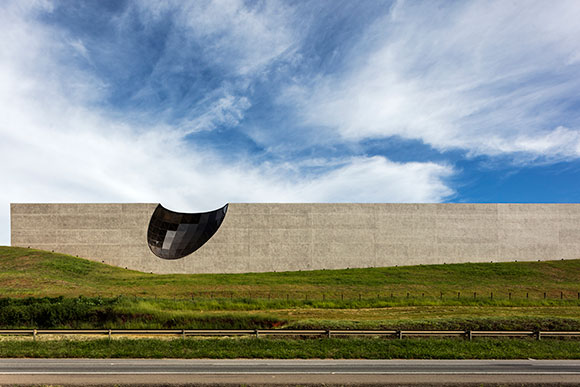
6: Since the 18th century, coffee has been a mainstay of Brazil’s economy. For the city of Carmo de Minas, Gustavo Penna Arquiteto & Associados deliver an iconic headquarters for CarmoCoffees. Introverted and introspective, save for the concave skylight, this warehouse for processing, tasting, and selling coffee explores the colors found in coffee beans.

(photo by Iwan Baan)

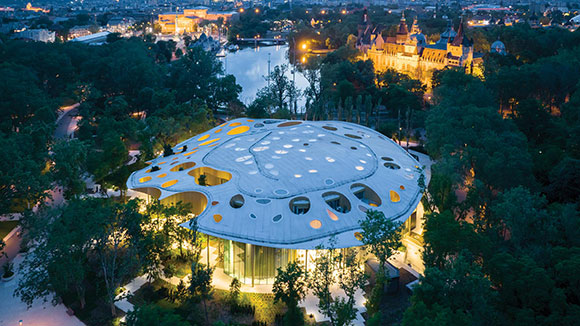
7: Sou Fujimoto reinterprets nature at the Hungarian House of Music in Budapest’s City Park. Inspired by sound waves, the roof structure with its 100 Swiss cheese-like holes is both inspired by nature and “neo-nature.” The connection from inside to outside is exploited though a continuous translucent glass façade, like a candy wrapper.

(photo by W Workspace)

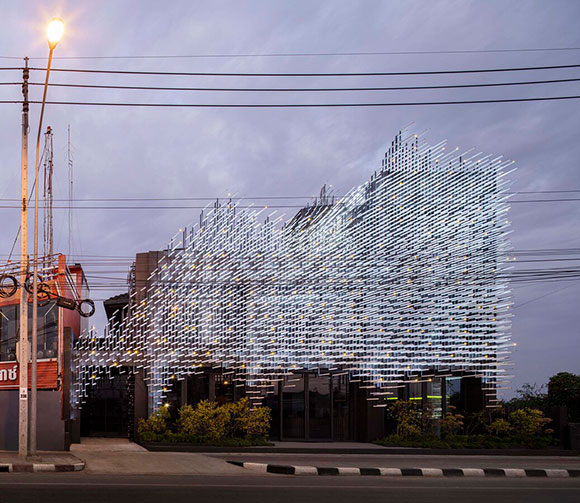
8: Tens of thousands of aluminum pieces make up the high-relief exterior of the Museum of Modern Aluminum. Bangkok possesses a deep history of aluminum production, and he city of Nonthaburi became home to this 4,300-square-foot, prickly composition by HAS Design and Research. Serving as both a public space and urban getaway, the museum is viewed as an extension of the natural landscape offering contemplation on this busy street.

(photo by Atelier FCJZ)

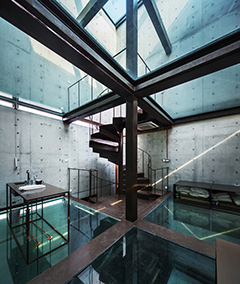
9: Different than the Rohe’s Farnsworth House and Johnson’s Glass house, both using glass in the vertical direction, Yung Ho Chang explores glass in the horizontal direction. Unlike the two renowned precedents which allow views out to the landscape, the Vertical Glass House focuses on viewing up to the sky and down to the earth. Located in Shanghai, China, the residence is poetic and ambitious, though with glass floors, perhaps impractical.

(photo by OMA, Chris Stowers)

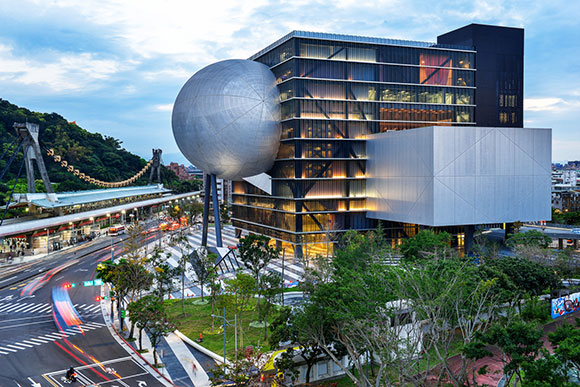
10: OMA often explores new types and forms of architecture. With the Taipei Performing Arts Center in Taiwan, the exploration reveals powerful results if not clumsily beautiful. OMA reversed the typical floor plan where the audience and performance spaces are central within the overall structure. Instead, the technical support spaces are now in the middle, and the audience is dramatically cantilevered on the exterior, hovering over public spaces, greeting the city’s fabric.

(For my recent list of faves in Los Angeles, visit here.)

#146: THE MOST STRIKING BUILDINGS OF 2021

January 7, 2022

(photo by Junya Ishigami + Associates)

Once again, I look back at the past year in search of stand out projects. Instead of “the best”—which I dare anyone to define—I listed the most intriguing for 2020 and the most seductive for 2019. For closing out 2021, the operative adjective is striking. Common synonyms for ‘striking’ include: stunning, dramatic, prominent, remarkable, unusual, and beautiful.

(photo by Spaceshift Studio)

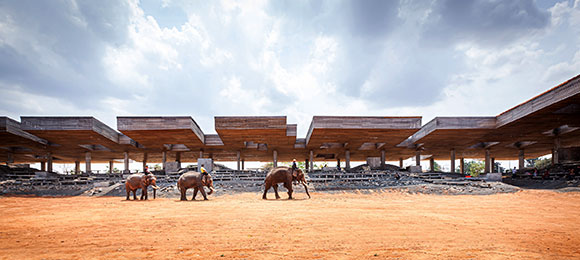
1: In Thailand, elephants are seen not as random animals or pets, but as family members. For this project, elephants are the clients. Bangkok Project Studio created Elephant Museum Elephant World, housing 200 elephants in accommodations of grandeur and beauty, honoring their place in the country’s ancient history and royal ceremonies. With a nod to heritage and community, half a million bricks were proudly handmade from regional soil using a traditional local method.

(photo by MAD Architects)

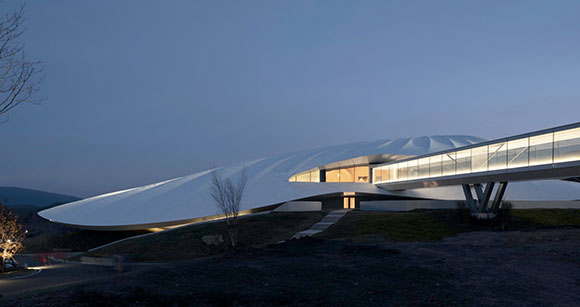
2: Whether a metaphor of a potato chip or a clamshell, the Yabuli Entrepreneurs’ Congress Center sits gracefully in the dramatic topography and freezing climate of Shangzhi, Harbin, China. Capturing an agenda of critical thinking and ambitious vision, MAD Architects has designed the headquarters for the international economic platform known as the China Entrepreneur Forum.

(photo by ZAV Architects)

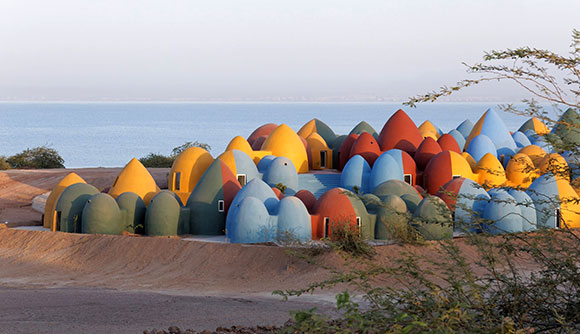
3: Housing for this historic port at the strait of Hormuz in the Persian Gulf explores colors, shape, scale, and playfulness. A project of both childlike simplicity and heroic vision, ZAV Architects has offered numerous domes using an adobe technique of rammed earth and sand, pioneered by the famed Iranian-American architect, Nader Khalili.

(photo by Birdview)

4: MUDA-Architects delicately weaves architecture into nature for the Garden Hotpot Restaurant. Located in Chengdu, China, the design reduces the building to almost nothing, as it plays hide-n-seek with its amoeboid-like forms twisting through trees. The structure’s circumference measures 1,000 feet with a mere height of 10 feet, and white fluorocarbon paint finishes the galvanized steel roof which is held up by pencil-thin columns only 3 ½” in diameter.

(photo by Birdview)

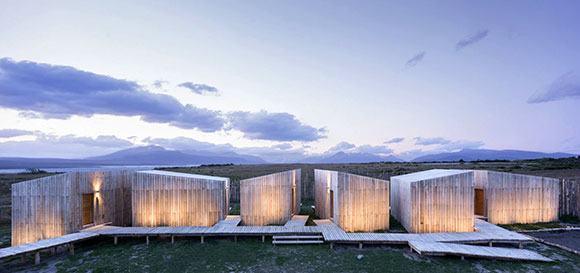
5: As if Donald Judd installed land art in Puerto Natales, Chili, the abstract beauty of reduction is captured at the Aka Patagonia Hotel. By designer Larrou, an elevated walkway links the prefabricated wood cabins to each other. Together, the elemental box-like quarters—mute on one side but open on the other—embrace views to Chile’s Golfo Almirante Montt canal.

(photo by Alejandro Arango)

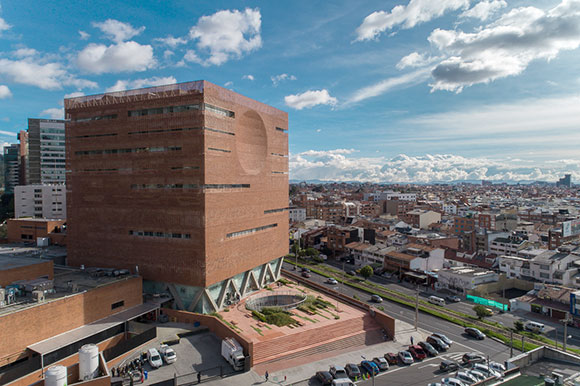
6: Known as the Santa Fe de Bogotá Foundation, this 12-floor hospital expansion uses brick in innovative and non-intuitive methods. Rather than the typical gravity-driven compressive state of masonry, architect El Eqiupo de Mazzanti explores brick in an extensive state like a woven fabric. Located in Bogota, Colombia, the massive iconic cube of a building with its signature dent on the surface is both massive and light, both solid and translucent.

(photo by Edmund Sumner)

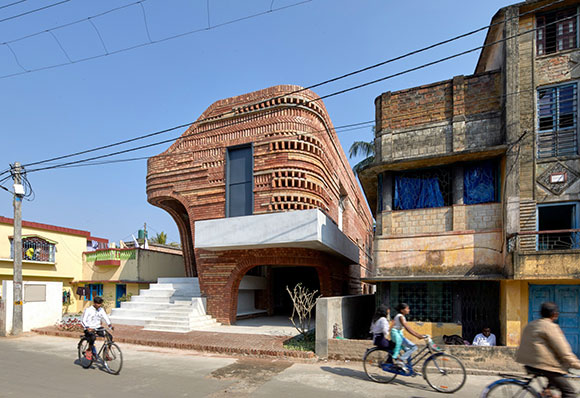
7: A community building and a work of street sculpture, the Gallery House by Abin Design Studio serves the neighborhood with multipurpose spaces, gathering hall, dormitory, and garage. In Bansberia, West Bengal, India, the architect teamed with a local ceramic artist to select masonry blocks that were discarded for industrial use, a kind of reincarnation of rejected materials.

(photo by Jonathan Leijonhufvud)

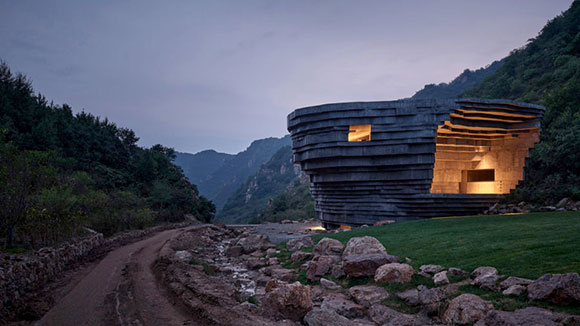
8. The Chapel of Sound, an 8,500-square-foot open-air concert hall, is a music venue never before seen. Located in Hebei Province, 200 yard from the Great Wall of China, the structure looks like an outgrowth of the hillside terrain , or perhaps an alien rock formation. By Open Architecture, this concert hall of cantilevered, stacked layers of concrete sits near a mountain resort, and includes a dressing room, green room, and restrooms.

(photo by Philip Vile)

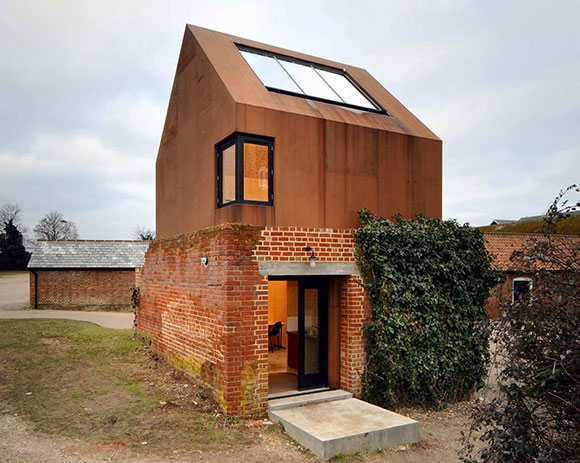
9: Old meets new in Edinburgh, Scotland, for the music campus at Snape Maltings. Architect Haworth Tompkins has conceived of an artist studio where a weathering Corten steel box is inserted into a Victorian ruin of brick and decay. Within the plywood interior sits a flexible art space or performance/rehearsal room, which includes a mezzanine and kitchenette. With no intention of blending the new addition with the existing conditions, the result is less about cohesion and more about a curious parasitic relationship.

(photo by Junya Ishigami + Associates)

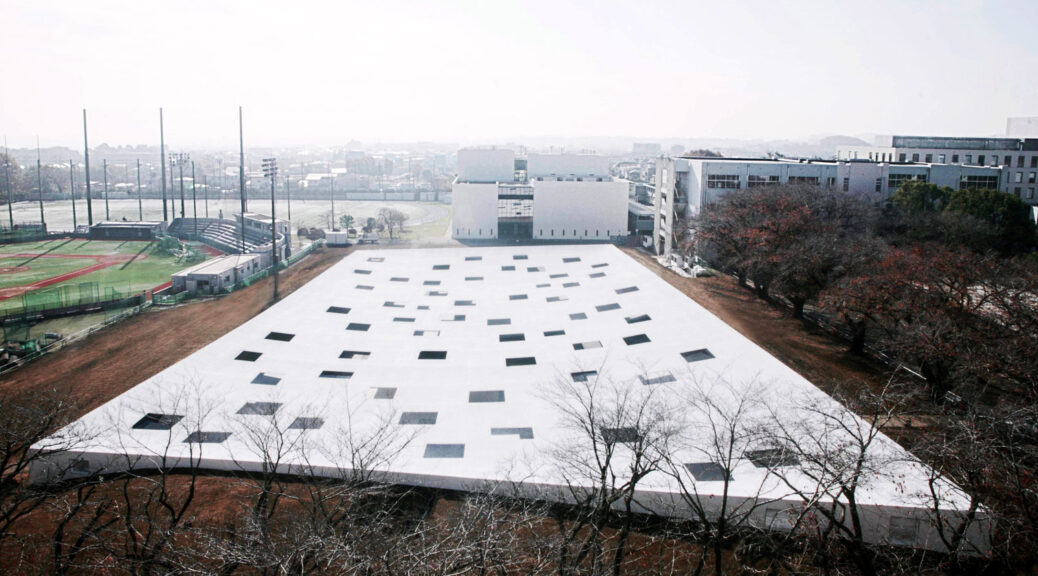
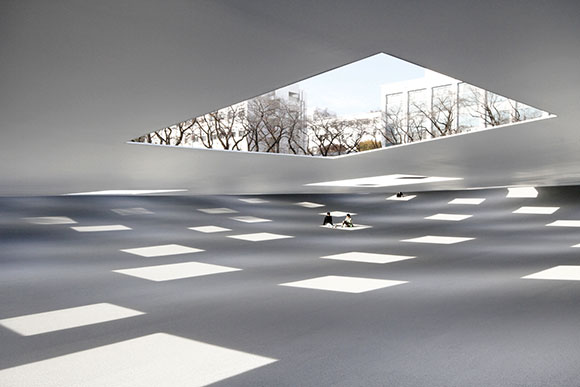
10: (See first image and above.) Striking due to its ambiguity, this plaza at Kanagawa Institute of Technology, Tokyo, is a versatile semi-outdoor gathering space, a massive urban sculpture of 59 ceiling cutouts, and an amazing feat of engineering akin to a suspension bridge. Architect Junya Ishigami states, “The process of passing time becomes the subject”.

(For the 2017 list of my all-time 15 favorite buildings, visit here.)

© Poon Design Inc.