Tag Archives: Michael Graves

#216: TRIBUTE | ROBERT A.M. STERN (1939-2025) AND THE BEST OF TIMES

December 7, 2025

Clay model study, Grand Harbor Community, Vero Beach, Florida (model by RAMSA model studio, photo by RAMSA)

I didn’t know what to expect when I got the phone message. It was the late 80s. I recently graduated from architecture school, relocated from California to New York, and worked at a no-name corporate firm in Midtown Manhattan. Surprisingly, I received a job offer through voicemail from the famed Robert A.M. Stern Architects (“RAMSA”). Accepting the offer, I felt a little guilty jumping that no-name ship. But it wasn’t much of a Sophie’s Choice: staying at a generic architecture company vs. joining a leading voice of the groundbreaking Postmodern movement.
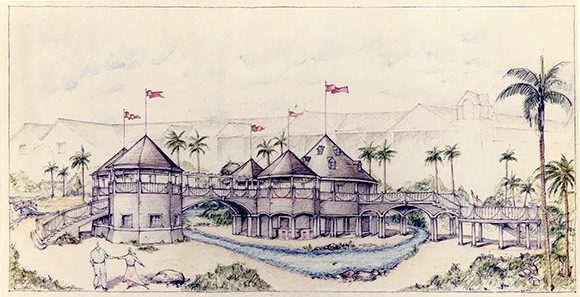
“Fantasy Pool,” Disney’s Yacht Club Resort, Lake Buena Vista, Florida (drawing by Anthony Poon)

When an undergraduate student, my colleagues and I crammed into a car to cross the bay from Berkeley to San Francisco to the Fine Arts Museum—to hear Mr. Stern articulate his provocative thoughts on Postmodernism. This topic was not only the cutting edge design philosophy at the time, but the center of our architectural studies. Opinionated and charismatic, Stern inspired us with words and images of grand residences in The Hamptons. In a somewhat traditional Shingle Style of the late 1800s, his designs possessed a wry twist—either of wit and humor, a contortion of proportions, or an irreverent use of classical motifs. These were not just houses, but philosophical critique and commentary.
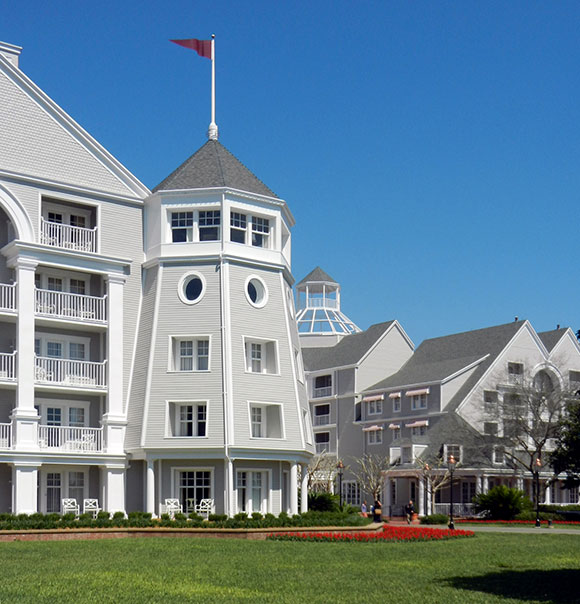
Disney’s Yacht Club Resort, Lake Buena Vista, Florida (photo by Anthony Poon)
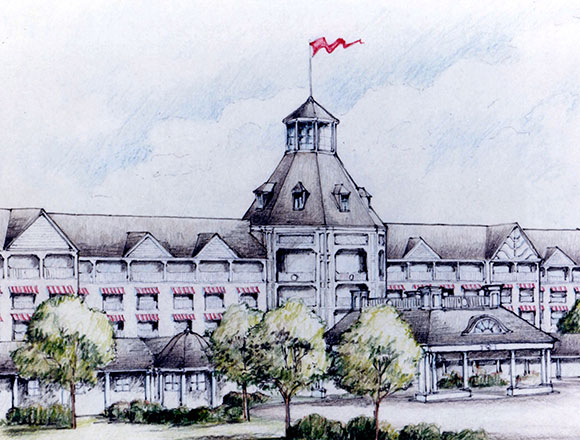
Disney’s Yacht Club Resort, Lake Buena Vista, Florida (drawing by Anthony Poon)

Little did I know that a few years later, I would be employed by this Robert A.M. Stern. At the office, it felt like a privilege to call him simply “Bob.” Like calling Robert Mapplethorpe, “Rob.” Or David Bowie, “Dave.”
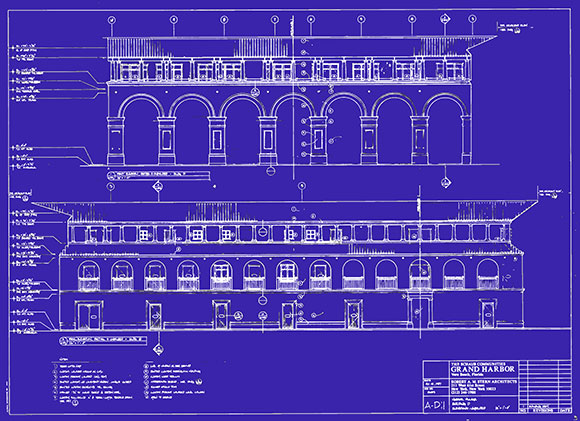
Construction document, Grand Harbor Community, Vero Beach, Florida (drawing by Anthony Poon)

Bob’s reputation intimidated us 20-something architects, but though he was astutely opinionated, he was accessible, always ready to chat with new employees and fresh minds. He engaged both the Big Picture—the importance of architecture and who it serves—as well as the details—the profile and proportions of a roof cornice, for example.
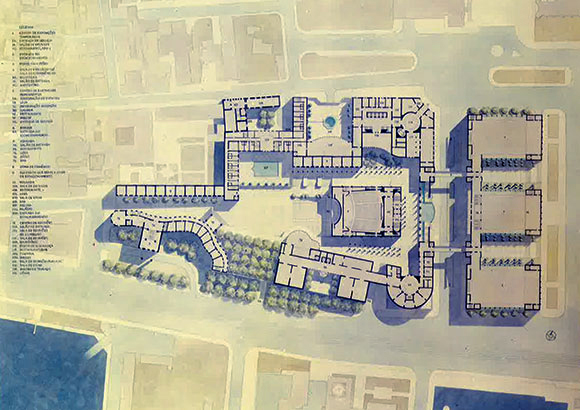
Site plan, Cultural Center, Lisbon, Portugal

In hindsight, the opportunities at RAMSA now seem like unbelievable gifts of opportunity. For the competition to design a cultural center in Lisbon, Portugal, I was personally given the chance to design an entire city complex. I was not just drafting a senior architect’s ideas, but rather, I was actually drawing hands-on my own ideas for Bob’s review and endorsement.
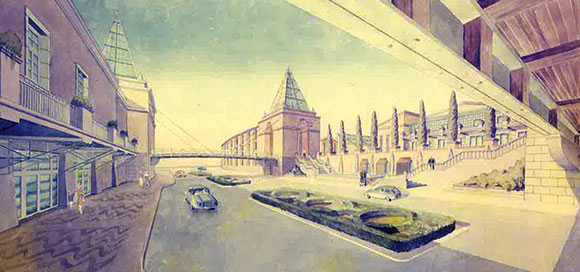
Street view, Cultural Center, Lisbon, Portugal (drawing by Anthony Poon, watercolor by RAMSA)

And for this project, I worked day and night. Literally day and night. Over the final week, I worked an average of 20 hours a day! At the enthusiastic age of 23, one can actually work 20 hours then race home to a studio apartment to nap, shower, and change, then return to work. Some might think of this as employee abuse or a reason to check in with a labor attorney, but for me, the creative adrenalin kept me going for days—and with a smile and gratitude for such an opportunity. Though we didn’t win the commission, Bob, our gracious host/employer, treated the team to a five-star dinner (Le Cirque Brasserie, I think). I wore my newly purchased grey, double-breasted suit from Giorgio Armani.
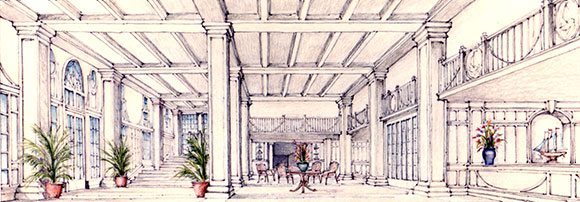
Disney’s Yacht Club Resort, Lake Buena Vista, Florida (drawing by Anthony Poon)

One weekend, Bob invited RAMSA employees to the celebration of Michael Graves’ 25th anniversary teaching at Princeton. I witnessed a rare panel discussion between the rising Starchitects of the time. During the deliberation: Bob viewed the work of Frank Gehry  through the lens of historicism; Gehry expressed confusion over “deconstruction vs. deconstructionism vs. deconstructivism”; and surprising Michael Graves, Peter Eisenmann claimed that though architecture is subjective, there are rights and wrongs in architecture. He argued, “If one is supposed to go up, you don’t design a stair that goes down!”

When master planning Euro Disney in 1987 (now Disneyland Paris), Bob invited the most influential architects of the time to collaborate on this grand project. I came into the office that extraordinary weekend to watch Bob design alongside Frank Gehry, Robert Venturi, Michael Graves, and Stanley Tigerman. Knowing such an event could either be a teamwork or clash of titans, Bob moderated with grace, intelligence, and diplomacy.
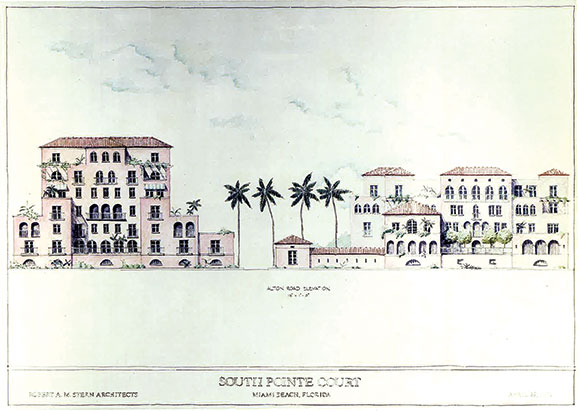
South Pointe Court, Miami Beach, Florida (drawing by Anthony Poon)

The pace never slowed. During the Christmas season, Bob was invited to team with Calvin Klein and design one of the famed holiday windows at Bergdorf Goodman. World-famous architects joined world-famous fashion designers to create a 5th Avenue streetscape of festive artistry.
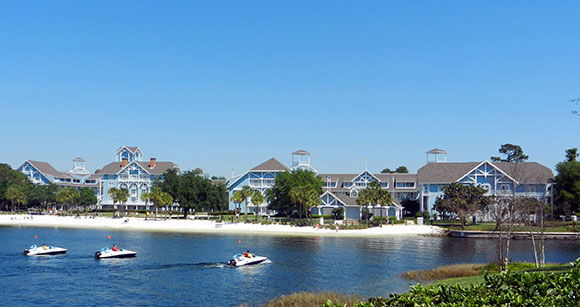
Disney’s Beach Club Resort, Lake Buena Vista, Florida (photo by Anthony Poon)

I was employee number 100. When I left, RAMSA grew to 150 employees. During my short time there, I only got to know Robert A.M. Stern briefly, but the many experiences created the most treasured recollections a young architect could ask for.
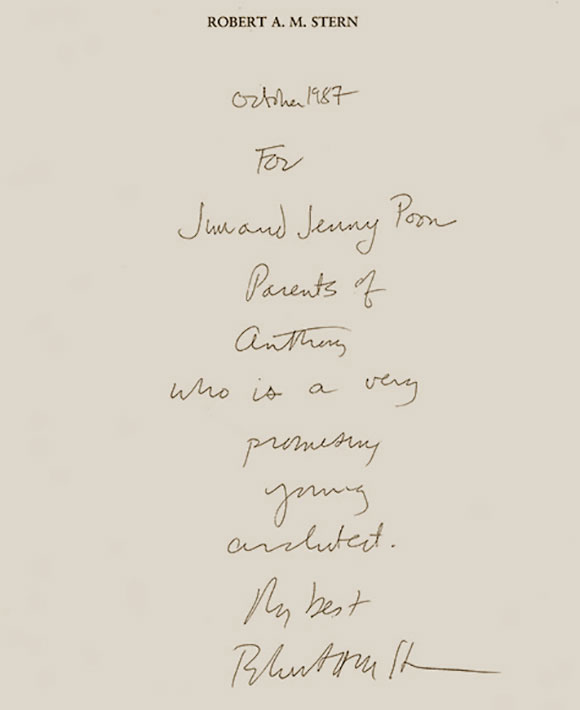

From Robert A.M. Stern to my parents, inscribed within his monograph, Robert A.M. Stern: Buildings and Projects 1981-1985

#154: WHAT IS YOUR BRAND?

June 24, 2022

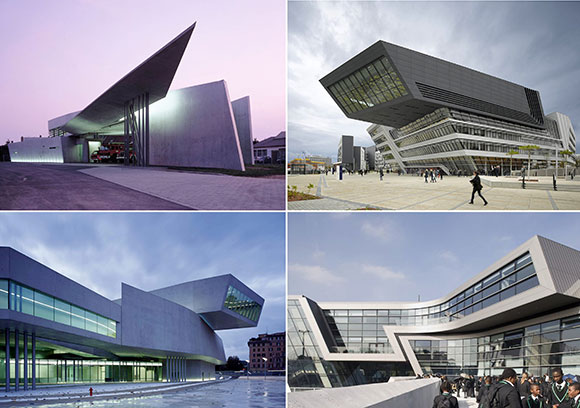
Architecture by Zaha Hadid – upper left: Vitra Fire Station, Weil am Rhein, Germany; upper right: Library and Learning Centre University of Economics, Vienna, Austria; lower right: MAXXI: Museum of XXI Century Arts, Rome, Italy; lower right: Evelyn Grace Academy, London, England (photos from www.re-thinkingthefuture.com)

Whether a company, institution, or even an individual, it is imperative to establish a brand—a distinct identity, a unique look and feel that distinguishes from others. But whereas branding can help to establish a foothold in the marketplace, does it limit evolution of self?

Our retail and hospitality clients call their brand, “trade dress.” A corporation might brand their company identity through the enactment of a mission statement. However one’s brand is created and implemented, it can offer a road map, and others can join this journey knowing where they are going. Speak the company names of Apple, BMW, Disney, or McDonald’s, and everyone has a sense of that company’s brand, what they pitch, what is sold, and who we as customers consume.

Porsche Panamera (photo by Peter Miranda on Unsplash)

On the other hand, an established brand can be like a straitjacket, restraining deviation and exploration that might lead to new opportunities. When Porsche, an automaker known for German efficiency and lean design, presented the Panamera, customers were baffled. This hulking sedan—more akin to an over-stuffed luxury vehicle than the agile Carrera—startled some, wondering what happen to the brand of Porsche. Was it risk-taking evolution or misguided brand confusion? The term “off-brand” reverberated in the halls of criticism.

Art by Patrick Nagel – left to right: Untitled (photo from artsandcollections.com); Untitled (photo from dreamboatsandhose.wordpress.com); Commemorative #10 (photo from 1stdibs.com); Jennifer Dumas (photo from fineart.ha.com)

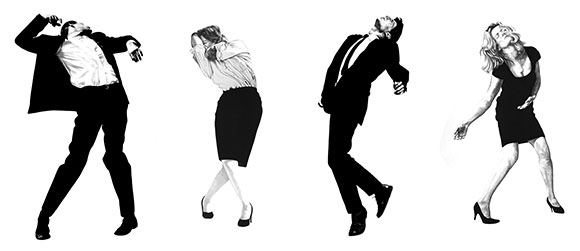
In art, consider the commercially successful works like Patrick Nagel’s soft-porn, male-fantasy caricatures (above) or Robert Longo’s thrashing individuals in business attire (below). Such art have reaped great exposure over the decades, from leading the pop culture zeitgeist to expanding in niche communities, to relishing a Renaissance of mainstream market presence. Some argue that the work, and that of many artists, look the same. But in the context of branding, repetition is not necessarily a bad thing, as it results in recognizability.

Art by Robert Longo – Blonde one: Barbara (photo from fineartmultiple.com)
Man leaning back: Untitled (photo from pacegallery.com)
Women with hands over face: Cindy (photo from whitney.org)
Untitled (photo from redbubble.com)

In architecture, companies big and small are branded as well. Some architects have developed a brand as a formulaic visual style. Others have branded their design process or a model of customer service. In the sphere of artistry, being predictable could be a death blow. But at times, cookie cutter processes can make for good business.

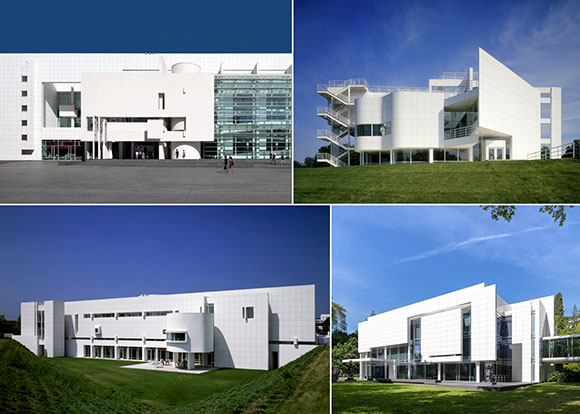
Architecture by Richard Meier – top left: Barcelona Musuem of Contemporary Art, Barcelona, Spain (photo by Alexie Bague, Plane-Site); top right: The Atheneum, New Harmony, Indiana (photo from archdaily.com); bottom left: Swissair North American Headquarters, Melville, New York (photo from rmparchives.xyz); bottom right: Museum Frieder Burda, Baden-Baden, Germany (photo from facebook.com/friederburda)

When an architect like Frank Gehry or Richard Meier (above), or actually any number of well-known designers, approach a project with the same road map resulting in what the building will look like, such formulas are profitable through their efficiency. For example, Meier doesn’t need to explore all the paint colors offered to him. He already knows that his building will be some shade of white. In business, this kind of brand saves times and makes the production swift. Clients don’t question the results much because they know the brand, and even expect it. The pitch is simple and evident from the start.

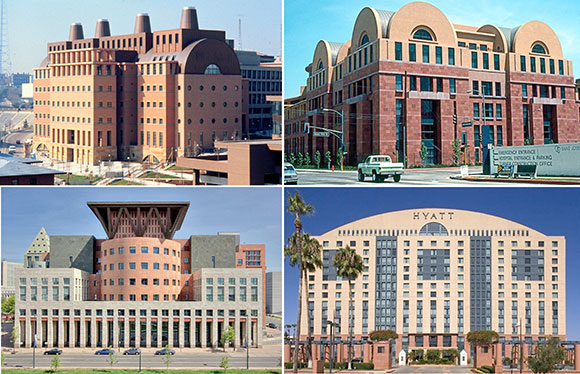
Architecture by Michael Graves – top left: Engineering Research Center, University of Cincinnati, Ohio (photo from reddit.com): top right: Disney Headquarters, Burbank, California (photo from friendsofarch.photoshelter.com); lower left: Denver Central Library, Colorado (photo from pinterest.com/jann5068/christopher-wren); lower right: Hyatt Regency La Jolla at Aventine, La Jolla, San Diego (photo from travel.usnews.com)

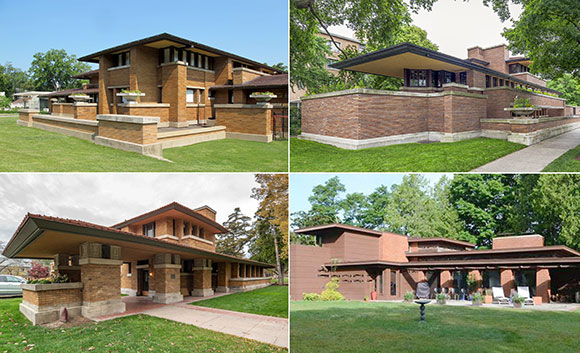
Same can be said with Michael Graves and his Post-Modern creations (above), Zaha Hadid’s extraordinary sweeping forms (at top), or Frank Lloyd Wright’s Prairie style (at bottom) .

Architecture by Frank Lloyd Wright – upper left: Darwin D. Martin House, Buffalo, New York (photo from susancohangardens.com); upper right: Frederick C. Robie House, Chicago, Illinois (photo from architectmagazine.com); lower left: Allen House in Wichita, Kansas (photo from visitwichita.com); lower right: Schwartz House, Two Rivers, Wisconsin (photo from wrightinwisconsin.org)

But what about risks and experimentation? Evolution, artistic progress, improvisation —such things fuel the design journey, challenges the industry’s status quo, as well as internal agendas. Finding the right balance within the spectrum is the challenge—to create a brand that provides recognition and stability, while paving paths to an unknown future.

#41: TO BE LOVED

July 22, 2016

Portland Building, Oregon, by Michael Graves Architecture & Design (photo from archinect.com)

In my last year as an undergrad, the brilliant (to some) Michael Graves gave an evening lecture. As one of the founders of Post Modernism, Graves sparked a movement of creative but tradition-bound architects.

The lecture hall on the UC Berkeley campus was packed; no, over packed. Architecture, art, and even philosophy and history majors plus faculty filled the large auditorium. Alongside filled seats, students littered the aisles and corridors—on the steps, on the floor, wall to wall. Even the entire stage, typically left empty for the dramatic effect of the lecturer at his podium, was covered with eager audience members. This forced Graves to reach the podium by crossing the stage as if it were a minefield.

Which in a way it was.

Addition to the Whitney Museum, by Michael Graves Architecture & Design, Whitney Museum on the left, Graves addition on the right and on top (photo by Michael Graves Architecture & Design)

Delivering a fascinating presentation, Graves entertained with wonderful wit. At one point, he showed a slide of a city downtown, and said disapprovingly, “You can have office towers like these that are black, white or maybe grey.”

Then Graves displayed a slide of his misunderstood but enjoyable 1982 Portland Building in Oregon. He declared with enthusiasm that the freshness of his building lay in the happy shades of yellow, maroon and turquoise. “Or you can also have color!”

The esteemed architect concluded his two-and-a-half hour lecture by unveiling his ongoing design process for a big addition to the Whitney Museum of American Art in New York City. The original museum, a brutal mass of a building faced with dark grey granite, presented only one window facing Madison Avenue. For those who support the friendliness of Post Modernism, Marcel Breuer’s 1960’s Whitney was an uninviting and even mean building—the worst of Modernism. (I admit that this building is a personal fave.)

Addition to the Whitney Museum, by Michael Graves Architecture & Design (photo by Michael Graves Architecture & Design)

That night, Graves displayed his multitude of designs being developed for the Whitney, each one already rejected by the museum committee. There were so many designs that it seemed to be an excessive, mindless path of creativity.

Was it the architect? Was it the client? Each design iteration was more bizarre than the last. Regardless of whether my young mind could comprehend the architect’s meandering artistic journey, a Post Modern addition to an existing Modern building exhibited the battle between the two artistic movements.

At the end of the epic presentation, the audience was split right down the middle. Some students cheered in support for this courageous architect’s vision. Other students booed his philosophy of architecture.

Graves tried to hold his ground at the podium, but even this senior diplomat could not handle the mix of admiration and disdain. Of love and hatred.

Graves raised his arms to quiet the audience. With tears running down his face, he felt defeat and embarrassment. Silence fell. Despite his stature in the industry, the very mortal designer expressed that night what many an artist must feel again and again, whether in private or in public. Here, he did so in public.

Exhausted of all defense, Michael Graves simply said: “All anyone wants, is to love and be loved.”

#12: TRIBUTE: MICHAEL GRAVES INSPIRES (1934-2015)

July 3, 2015

Team Disney Building, Burbank, California (photo by Kristen Colada Adams on Unsplash)

Writing my business plan for Poon Design Inc. decades ago, a small paperback on entrepreneurship suggested that I think about an existing company that might be a model for my future company. The topics at hand were not about the business model, profits, size of staff, or geography—or even design style.

Rather, the topic was about design culture. What kind of design culture did I envision for Poon Design, and what architectural firm inspired me?

The answer was a New Jersey company: Michael Graves Architecture & Design.

My interest did not have anything to do with Michael Grave’s colorful Post Modern buildings with their whimsical motifs and cartoonish proportions. My interest was in what Grave’s entitled “Humanistic Design.”

Graves designed for people. He did not design for headlines and critics, for academic debates, or for personal legacy. Designing for people—sounds obvious, right? It is no easy task to make good on this philosophy, as well as build a culturally impactful, artistically significant, and prolific career around designing in this basic manner. For people.

Graves and his team applied this belief system to every aspect of design, from hotels to houses, from office buildings to toasters, from university research centers to the design of a wheelchair. Sure, many architects believe their repertory is this broad. During his time, Graves was a pioneer in designing without borders.

Late 1980’s, beginning my young adult life in Manhattan, I was a fan of the New York Five. For a national conference with a seminal follow up book, the Museum of Modern Art assembled five architectural voices. All five held a common interest in Modernism and the landmark architecture of Le Corbusier (1887-1965). The five architects became instantly celebrated: Peter Eisenman, Charles Gwathmey, John Hejduk, Richard Meier, and of course, Michael Graves.

Though I was fascinated with the (mostly unbuilt) work of Hejduk (1929-2000), Graves was the individual that I studied, even as he abruptly departed the New York Five. He rejected the Five’s philosophical Modernist common ground. In a heralded crusade on the intellectual battlefields, Graves led a Post Modern movement that was diametrically opposed to the repertory of the New York Five (now Four). Alongside him stood other leaders, such as Robert Venturi and my past employer, Robert Stern,

A new chapter for him, Graves used bright colors instead of stark whites. He used classical elements such as pediments and columns, instead of abstract forms and zero ornamentation. He used humor and wit, instead of severe Bauhaus rationalism.

In the late eighties, I was fortunate to be invited to Graves’ 25th anniversary celebration at Princeton University, where he was the Professor of Architecture Emeritus for 39 years. As a young architect in my twenties, I joined the most influential voices of our industry to honor a man of artistic virtuosity and commitment.

Michael Graves passed away in March of this year. All of us who work in his shadow, are standing in an impressively long shadow.

#9: “WITH GREAT POWER THERE MUST ALSO COME GREAT RESPONSIBILITY!”

May 30, 2015

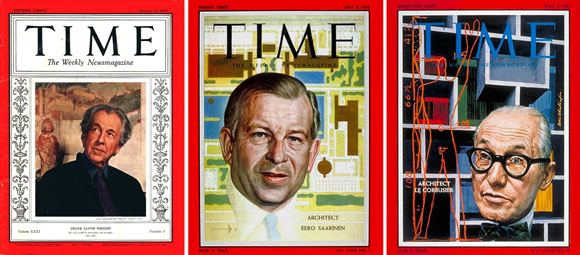
Covers of Time: Wright, January 17, 1938, Saarinen, July 2, 1956, and Le Corbusier May 5, 1961

Are architects celebrities? Are they rock stars? Do “Starchitects” exist amongst mere mortals?

Years back at UCLA, I attended a lecture by Pritzker Prize, Dutch architect Rem Koolhaas (my Harvard professor). Endless crowds lined up all day in advance for the evening performance. Upon opening the doors, the large auditorium was full in seconds. The organizers opened up two additional auditoriums with the lecture to be broadcast on screens. All this, and masses of people still could not fit in the venues. Front row: Brad Pitt, Martha Stewart, Dianne Keaton, Michael York, Vidal Sassoon, and other design fans and fanatics.

Seattle Central Library (photo by Anthony Poon)

Further years back at UC Berkeley, I attended a lecture by AIA Gold Medalist, New York architect Michael Graves. Similar thing. Hundreds, perhaps thousands, of people showed up trying to squeeze into a college lecture hall. Hoping to graze his shroud. Hoping to bask in god-like enlightenment.

I am not proposing that an architect could fill a stadium like Taylor Swift, a concert hall like Lang Lang, an arena like Jordan, or a theater like Baryshnikov. Rather, I am impressed with and a little weary of the influence that some architects possess by simply standing at a podium with a PowerPoint of their latest projects, anecdotes and social theories.

With his world travels and outrageous behavior, perhaps Frank Lloyd Wright was the first Starchitect. But Ancient Greece had Mnesikles. The Renaissance had Michelangelo. The British Crown had Wren. Modernism had Le Corbusier. And he, alongside Wright, Eero Saarinen and Mies van der Rohe graced the covers of Time magazine.

Sure, the spotlight is flattering. The ego is stroked, as an architect’s head inflates larger and larger.

But all this said, being an architect comes with responsibilities. Some responsibilities are obvious and some, not so obvious: provide buildings for shelter, provide a roof that won’t collapse on your head, provide beautiful structures that will stir and inspire, provide creative designs that will support the evolution of cities, and provide tremendous visions that will challenge a nation’s cultural complacency. Architects have a voice. By mere role playing, we are provided a soap box to stand on, wave our hands, wail profound statements—and hope to affect education, social policies, and the spirit of our time. Our zeitgeist.

In several venues, we have influence. As comic book writer Stan Lee declared in 1962, “With great power, there must also come great responsibility!”

This responsibility may be, at one end of the spectrum, designing homes for the homeless or hospitals in third world countries. At another end of the spectrum, the responsibility can be in designing with awareness for children, the handicap or the aging. Or working with non-profit organizations. Or being a steward for the environment. Or rebuilding a city after a natural disaster.

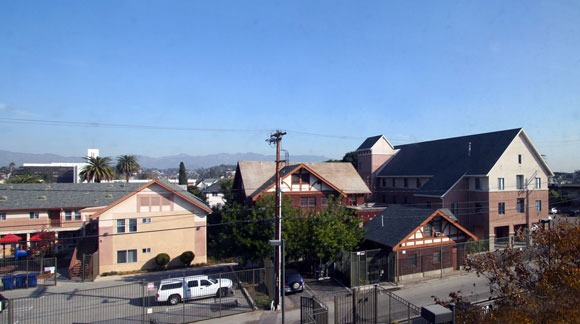
Good Shepherd Center for Homeless Women & Children, Los Angeles, California, by Anthony Poon with KAA
Good Shepherd Center for Homeless Women & Children, Los Angeles, California, by Anthony Poon (w/ KAA)

In 1968, civil rights leader Whitney Young directly insulted and challenged architects at a national convention in Portland, Oregon with this, “You are not a profession that has distinguished itself by your social and civic contributions to the cause of civil rights . . . You are most distinguished by your thunderous silence and your complete irrelevance.” Fire in the belly of architects, a battle was waged.

We can choose to be a celebrity in the limelight or we can choose to change the world quietly. Either way, we must choose responsibly.

#8: HEATHERWICK DESIGNS EVERYTHING

May 18, 2015

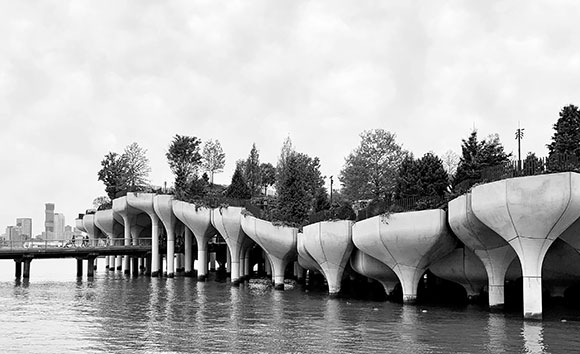
Little Island, Pier 55 (photo by Anthony Poon)

Architecture companies that do more than architecture impress me.

I don’t mean the firms that provide additional services like interior design, landscape design, master planning, and/or graphic design. If you are a Design (with a capital “D”) driven company, than your field of Architecture (with a capital “A”) should inherently include such endeavors.

The recent passing of Michael Graves brings to mind how inspiring it is when an architect evolves and branches out, elevating his talent beyond the category of “building design,” which sometimes sounds like creating a mundane parking structure or coordinating an air conditioning system. Mr. Graves launched a Post-Modern movement of designing for all functions, for all people, at all scales. (Teapot, anyone?) This concept of what I like to call “comprehensive design services” are also offered from contemporaries like Rios Clementi Hale Studios or historical legends like Frank Lloyd Wright.

At Poon Design, we provide design services of all types. In our past, we even offered the unique specialty of music programming for restaurant or retail projects. We posited a simple concept that music was as essential to the success of a branded space and its customer experience, as the right spatial forms, appropriately selected materials, and strategic lighting design. All of it, music as well, comprised Architecture.

Then there is Heatherwick Studio, www.heatherwick.com.

Heatherwick Studio has taken the idea of complete design services to a new level. Heatherwick has embraced broad design and research wholeheartedly, as evidenced by the studio’s current exhibition called “Provocations: The Architecture and Design of Heatherwick Studio” at the Hammer Museum in Los Angeles.

Upon arrival to the museum, you encounter the famous Spun Chairs in the courtyard. Irresistible to all—children, teens, adults and seniors—you will see dozens of people gleefully spinning like giant-size tops on these chairs, design courtesy of Heatherwick.

With large public and private architectural projects, both executed or proposed—from the new Google Campus in Northern California, to a university building in Singapore, to a Capetown museum—Heatherwick also designs at other, more curious scales. From smallest to biggest, its portfolio boasts a Longchamp handbag, an extruded aluminum bench, the Olympic cauldron, newspaper kiosks, a London red bus, a portable bridge, and a grand park in the middle of an Abu Dhabi desert.

Heatherwick’s “Seed Cathedral,” the U.K pavilion at the 2010 Shanghai World Expo, drew worldwide attention. Measuring approximately 50’ x 50’ x 50’, the pavilion is make up of 60,000 protruding clear acrylic rods, the tips of which encapsulate 250,000 seeds. Magical and mesmerizing, the design stunned architects and non-architects alike.

I am eager to see the breadth of Heatherwick’s design work, particularly the larger projects, executed in real life. Of their dozen featured grand architecture works, less than half are implemented. We have a lot to look forward to from Heatherwick in the coming decades.

Don’t miss the exhibit. Admission is free (as is playing on the ping pong tables in the courtyard). Exhibit closes May 24, 2015. Provocations at the Hammer Museum.

© Poon Design Inc.