#217: TRIBUTE | FRANK GEHRY (1929-2025) AND A VISIT TO BILBAO
December 16, 2025
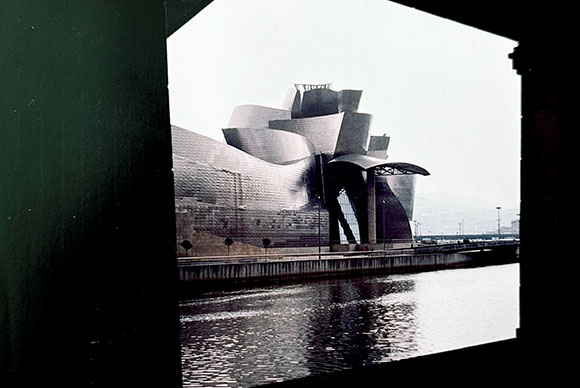
From across the river passing under a bridge (photo by Anthony Poon)
In 1998, I was traveling through Spain, and this new building just opened: the Guggenheim Museum. In the obscure industrial port city of Bilbao, the Basque Country of northern Spain, this museum was the talk of the industry. So I wrapped up my tour of Barcelona, then hopped on a short flight to check out the buzzy Guggenheim structure. No doubt, it was a work of genius.
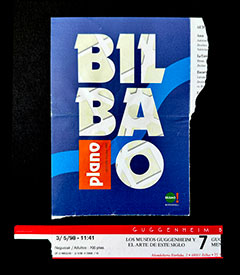
Program booklet and visitor wristband
My travel partner asked, “Why do we need go out of our way to some unknown town just to see a single building.”
I responded, “Well, based on all the press, reviews, rumors, etc., missing this opportunity would be like being in Egypt and not seeing the pyramids.”
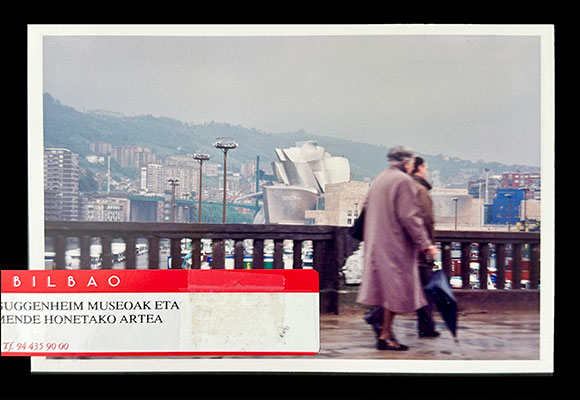
As seen from the bus soon to arrive at the museum (photo by Anthony Poon)
There is little I can add in this tribute to Frank Gehry (1929-2025) that hasn’t already been said in thousands of articles from the past weeks. After all, he is the most celebrated and visionary architect of our generation.
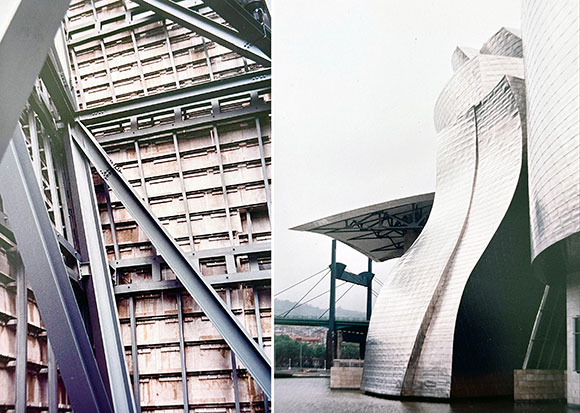
A pairing of glass and metal panels (photo by Anthony Poon)left : the structure behind the exterior titanium skin; right: the museum meeting its river setting (photos by Anthony Poon)
Instead, I will simply share images from that random rainy visit in the 90s to Bilbao. The iPhone was certainly not yet invented. My following grainy photos are shot on a Nikon FE2 on ISO 200 film. Despite the greyness of that day, the importance of this single work of architecture was as illuminating as a bright afternoon.
Plane ticket, Barcelona to BilbaoFish scale-like titanium panels (photo by Anthony Poon)
#216: TRIBUTE | ROBERT A.M. STERN (1939-2025) AND THE BEST OF TIMES
December 7, 2025
Clay model study, Grand Harbor Community, Vero Beach, Florida (model by RAMSA model studio, photo by RAMSA)
I didn’t know what to expect when I got the phone message. It was the late 80s. I recently graduated from architecture school, relocated from California to New York, and worked at a no-name corporate firm in Midtown Manhattan. Surprisingly, I received a job offer through voicemail from the famed Robert A.M. Stern Architects (“RAMSA”). Accepting the offer, I felt a little guilty jumping that no-name ship. But it wasn’t much of a Sophie’s Choice: staying at a generic architecture company vs. joining a leading voice of the groundbreaking Postmodern movement.
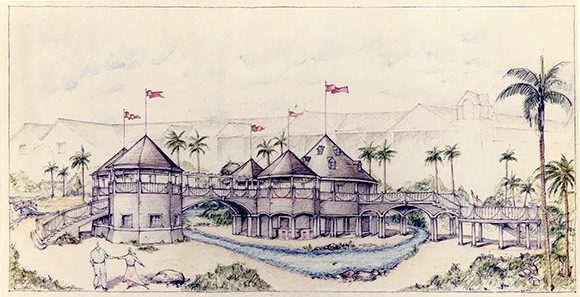
“Fantasy Pool,” Disney’s Yacht Club Resort, Lake Buena Vista, Florida (drawing by Anthony Poon)
When an undergraduate student, my colleagues and I crammed into a car to cross the bay from Berkeley to San Francisco to the Fine Arts Museum—to hear Mr. Stern articulate his provocative thoughts on Postmodernism. This topic was not only the cutting edge design philosophy at the time, but the center of our architectural studies. Opinionated and charismatic, Stern inspired us with words and images of grand residences in The Hamptons. In a somewhat traditional Shingle Style of the late 1800s, his designs possessed a wry twist—either of wit and humor, a contortion of proportions, or an irreverent use of classical motifs. These were not just houses, but philosophical critique and commentary.
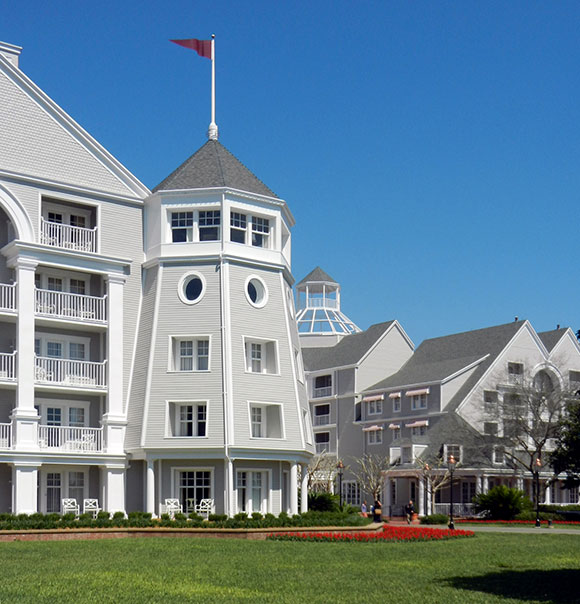
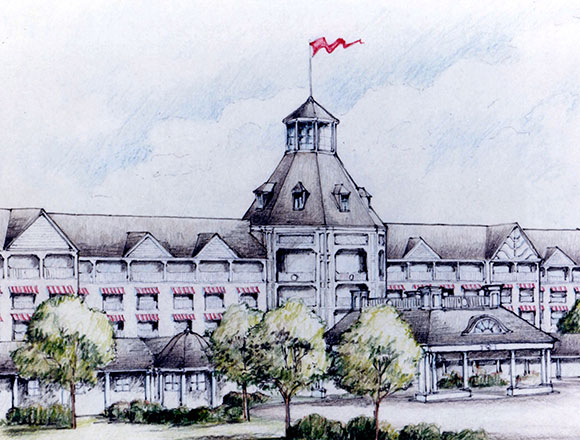
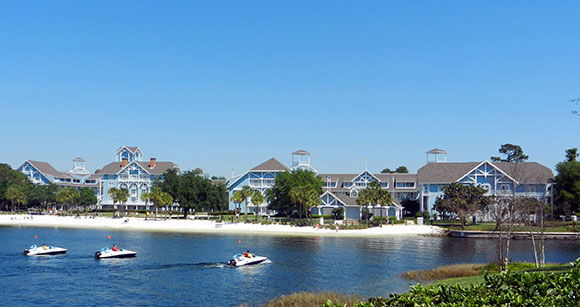
Disney’s Yacht Club Resort, Lake Buena Vista, Florida (photo by Anthony Poon)Disney’s Yacht Club Resort, Lake Buena Vista, Florida (drawing by Anthony Poon)
Little did I know that a few years later, I would be employed by this Robert A.M. Stern. At the office, it felt like a privilege to call him simply “Bob.” Like calling Robert Mapplethorpe, “Rob.” Or David Bowie, “Dave.”
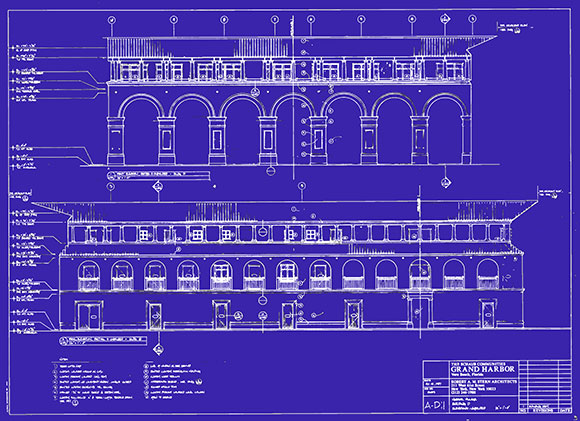
Construction document, Grand Harbor Community, Vero Beach, Florida (drawing by Anthony Poon)
Bob’s reputation intimidated us 20-something architects, but though he was astutely opinionated, he was accessible, always ready to chat with new employees and fresh minds. He engaged both the Big Picture—the importance of architecture and who it serves—as well as the details—the profile and proportions of a roof cornice, for example.
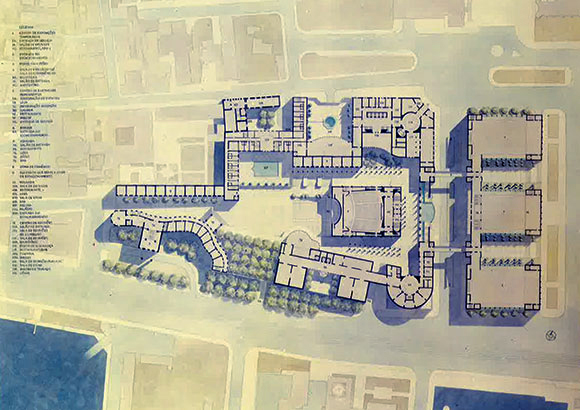
Site plan, Cultural Center, Lisbon, Portugal
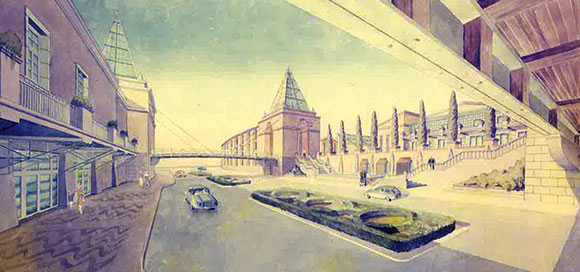
In hindsight, the opportunities at RAMSA now seem like unbelievable gifts of opportunity. For the competition to design a cultural center in Lisbon, Portugal, I was personally given the chance to design an entire city complex. I was not just drafting a senior architect’s ideas, but rather, I was actually drawing hands-on my own ideas for Bob’s review and endorsement.
Street view, Cultural Center, Lisbon, Portugal (drawing by Anthony Poon, watercolor by RAMSA)
And for this project, I worked day and night. Literally day and night. Over the final week, I worked an average of 20 hours a day! At the enthusiastic age of 23, one can actually work 20 hours then race home to a studio apartment to nap, shower, and change, then return to work. Some might think of this as employee abuse or a reason to check in with a labor attorney, but for me, the creative adrenalin kept me going for days—and with a smile and gratitude for such an opportunity. Though we didn’t win the commission, Bob, our gracious host/employer, treated the team to a five-star dinner (Le Cirque Brasserie, I think). I wore my newly purchased grey, double-breasted suit from Giorgio Armani.
Disney’s Yacht Club Resort, Lake Buena Vista, Florida (drawing by Anthony Poon)
One weekend, Bob invited RAMSA employees to the celebration of Michael Graves’ 25th anniversary teaching at Princeton. I witnessed a rare panel discussion between the rising Starchitects of the time. During the deliberation: Bob viewed the work of Frank Gehry through the lens of historicism; Gehry expressed confusion over “deconstruction vs. deconstructionism vs. deconstructivism”; and surprising Michael Graves, Peter Eisenmann claimed that though architecture is subjective, there are rights and wrongs in architecture. He argued, “If one is supposed to go up, you don’t design a stair that goes down!”
When master planning Euro Disney in 1987 (now Disneyland Paris), Bob invited the most influential architects of the time to collaborate on this grand project. I came into the office that extraordinary weekend to watch Bob design alongside Frank Gehry, Robert Venturi, Michael Graves, and Stanley Tigerman. Knowing such an event could either be a teamwork or clash of titans, Bob moderated with grace, intelligence, and diplomacy.
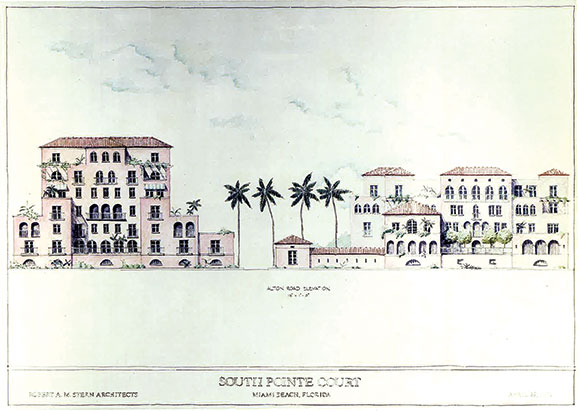
South Pointe Court, Miami Beach, Florida (drawing by Anthony Poon)
The pace never slowed. During the Christmas season, Bob was invited to team with Calvin Klein and design one of the famed holiday windows at Bergdorf Goodman. World-famous architects joined world-famous fashion designers to create a 5th Avenue streetscape of festive artistry.
Disney’s Beach Club Resort, Lake Buena Vista, Florida (photo by Anthony Poon)
I was employee number 100. When I left, RAMSA grew to 150 employees. During my short time there, I only got to know Robert A.M. Stern briefly, but the many experiences created the most treasured recollections a young architect could ask for.
From Robert A.M. Stern to my parents, inscribed within his monograph, Robert A.M. Stern: Buildings and Projects 1981-1985
#194: COMPLEXITY AND CONTRADICTION IN TRANSITION PLANS
October 11, 2024
West Olympic Science Hub, Los Angeles, California, by BA Collective (rendering from bacollective.com)
All great businesses evolve. This cliché we know. But how does a celebrated name-brand architecture firm evolve beyond the celebrated founder? Some companies have lost their cache with the exit of its founder. What will become of Gehry Partners when Frank Gehry retires? On the other hand, Zaha Hadid Architects continues to flourish beyond the 2016 passing of its name founder. Legacies can progress with thoughtful planning or sink under its own weight of arrogance.
Neue Zollhof, Dusselfdorf, Germany, by Frank Gehry (photo from Pixabay)Glasgow Riverside Museum of Transport, Glasgow, England, by Zaha Hadid (photo by Charlie Irvine on Pixabay)
Many strategic companies speak of the transition plan, which comprises many things, e.g., business plan, org chart, stock ledger, legal documents, etc.—all with an eye towards an unknown future. A transition plan represents the significant act where the founder(s) pass on the firm’s ownership and operations to the next generation of (patiently-waiting) leaders. Whether a mom-pop studio of a few architects or a corporation of several thousand, transitions can bring about ego battles, company politics and seismic cultural shifts, as well as promising opportunities.
Beware of a condition known as founder-itis. When inflicted, an aging founder simply won’t let go of the reins, often forcing promising successors to desert the firm. Their prospects within the company dwindle each year as the founder keeps a choking grip on the dimming future.
Eagle + West, Brooklyn, New York, by Rem Koolhaas (photo by Koushalya Karthikeyan on Pexels)
Some name-brand firms can suffer from transitions. After the starchitect-founder retires, will a client still commission this firm—a business that no longer offers the creative force of said starchitect, but rather untested new personalities or artificially-elevated middle managers? Or perhaps the host of new leaders will be an even stronger design force? But with the current zeitgeist of hyper media and celebrity fascination, the shadow of our industry’s luminaries (Gehry, Hadid, Koolhaas, Mayne, Meier, Zumthor, or any Pritzker Prize-honored architect) is long and omnipresent?
A tactical founder can reap many rewards with an exit strategy into a setting sun: overseeing the company’s reputation into new promising hands, maintaining an executive salary with partial ownership, profit sharing, reduced liability, and having an enjoyable place to continue working part time as a productive architect—as this founder sails off into semi-retirement, then full retirement.
Orange County Museum of Art, Costa Mesa, California, by Morphosis (photo by Anthony Poon)
When should founders consider a transition plan? Most management advisors recommend as early as possible, such as 40 or 50 years old. But with most architects rarely retiring at the national average of 66, and with some architects working decades longer (Philip Johnson and I.M. Pei into their 90s!), many founders will delay the discussion as long as possible, such as into their 70s or beyond.
Louvre Pyramid, Paris, France, by I.M. Pei (photo by Kirandeep Singh Walia on Pexels)
The recommended early planning is simply because it can take years to come up with a plan, choose successors or nurture leaders, define shifting duties, and inform stakeholders and the marketplace. In addition, there are the legal and financial terms: How much is the company worth; how many successors will buy into the firm and what percentage equity for each; or how much stock will the founder maintain over the years as it eventually reduces to zero? After creating a plan, the implementation can take years or over a decade.
Getty Center, Los Angeles, California, by Richard Meier, (photo by Ludovic Charlet on Unsplash)
To signal transitions and an eye to the future, I.M. Pei & Associates became Pei Cobb Freed & Partners in 1989, Polshek Partnership became Ennead in 2010, and Richard Meier & Partners became Meier Partners in 2021, to name a few in New York. In Los Angeles, Anshen + Allen became CO Architects in 2010, Ehrlich Architects became EYRC in 2015, and Belzberg Architects became BA Collective in 2023. It is often said: all good businesses evolve. Stay tuned.
The International Performance Center, Shenzhen, China, by Ennead (rendering from ennead.com)
#186: ANOTHER BAKER’S DOZEN
April 26, 2024
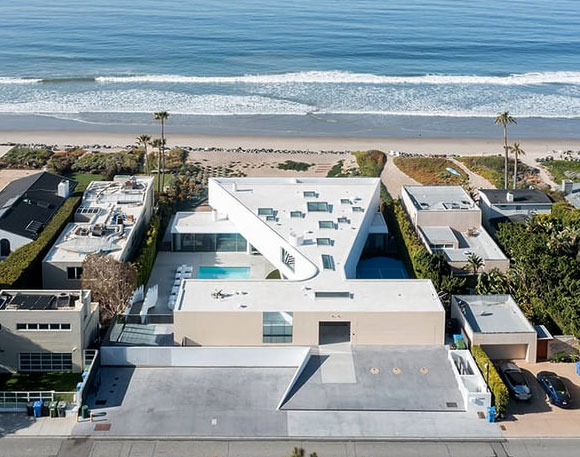
Broad Beach Residence, Malibu, California (photo by Iwan Baan)
A few years ago, I listed some of my favorite buildings in the city of Los Angeles. Today, I offer another dozen favorites from Southern California, but outside of Los Angeles proper. There are many wonderful works of architecture in our region that to choose only thirteen is impossible. Regardless, here are some in no particular order, from residences to retail, from restaurants to religious to research.
Broad Beach Residence, Malibu, California (photo by Iwan Baan)
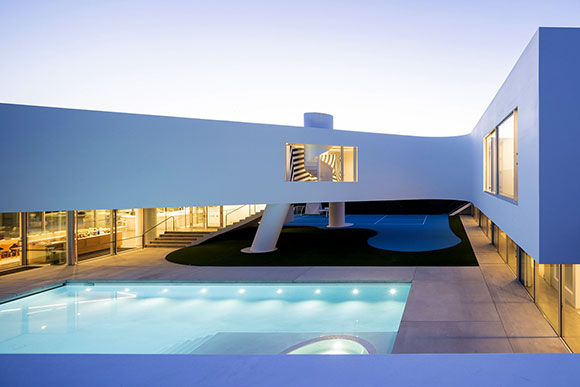
1: The 10,800-square-foot, six-bedroom Broad Beach Residence offers a new form to residential architecture. The triangular composition by Michael Maltzan Architecture starts narrow at the street and expands towards the beach and ocean, maximizing views to the horizon. This martini glass-shape houses two major bedrooms hovering above a courtyard with swimming pool and basketball court, replete with indoor-outdoor enjoyment of the Malibu coast.
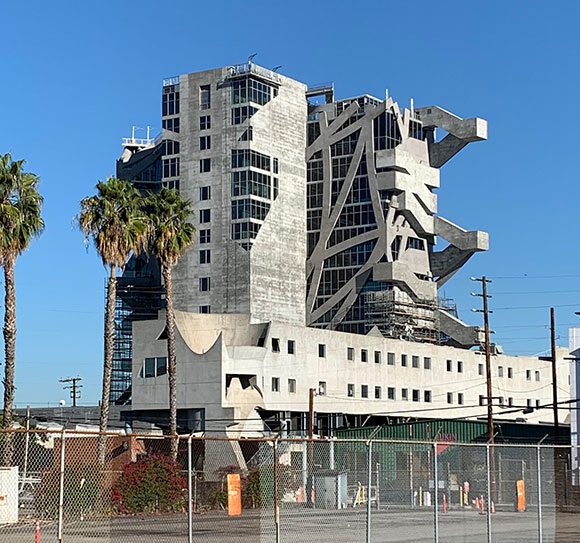
(W)rapper, Culver City, California (photo by Anthony Poon)
2. The old saying goes, “Love me, hate me, but don’t ignore me.” So it is for this Culver City office known as the (W)rapper, by Eric Owen Moss Architects. The 17-story structure has the honor of being 2023’s most written about building. The bizarre steel exoskeleton with its aggressively cantilevered stairs, oddly shaped glazing, and large expanses of solid walls result in a sublime and grotesque presence in a low-lying skyline. The verdict: I admire the courage.
Prada Epicenter, Beverly Hills, California (photo by Anthony Poon)
3. In Beverly Hills, OMA reinvents shopping at the Prada Epicenter on Rodeo Drive. From the street, the floor rolls up to the second level, becoming an amphitheater to display fashions or socialize. The traditional storefront display is subverted by eliminating the condition. Instead, the store opens to the street in its entirety—secured at closing by a massive aluminum panel that rises out of the sidewalk. Street retail displays are set in the concrete floor, where a shopper looks downward on, separated by elliptical glass panels upon which one stands, if feeling courageous. Unfortunately, many of the architect’s original ideas did not survive recent renovations.
Gardenhouse, Beverly Hills, California (photo by Anthony Poon)
4. MAD Architects—creators of the upcoming, monumental, 300,000-square-foot Lucas Museum of Narrative Art—designed a whimsical mixed-use project of 18 condos and commercial spaces. Entitled Gardenhouse, the architects envisioned a 48,000-square-foot “hillside village” in Beverly Hills, where an assemblage of quirky house-like forms rise from the building’s living façade.
Frank Gehry’s house, Santa Monica, California (photo by IK’s World Trip)
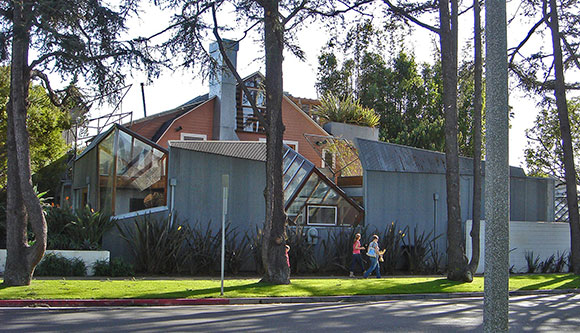
5. During the many decades of its making, the neighbors hated this house. To their astonishment, the masterful creation has become one of the most famous residences in the world, a living thesis of and personal residence to Frank Gehry’s seminal ideas. For the existing Dutch colonial, Santa Monica house, the architect engaged the traditional personality with torn apart walls and roofs revealing a skeletal expression of wood studs. Enter the 1970s premiere of chain link fence, raw plywood, and corrugated metal to the world of high design.
Chiat/Day Building, Venice, California (photo from The Architect’s Newspaper)
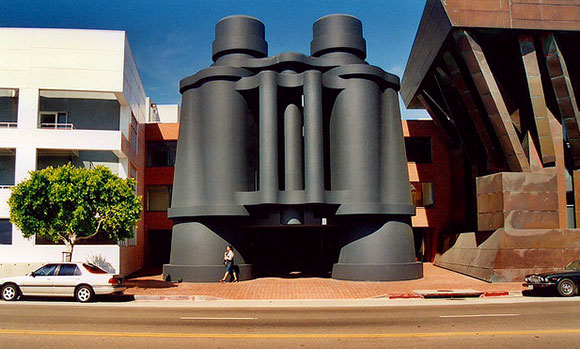
6. Gehry at it again, this time in Venice. Often called the “Binocular Building,” the Chiat/Day headquarters, now occupied by Google, blurs the line between art and architecture. Visitors and cars enter the 75,000-square-foot building through the binoculars, a functional sculpture with offices within, created with artists Claes Oldenburg and Coosje van Brugge. On the right sits a tree-like composition in copper panels, and on the left, a contrasting enameled metal ship form.
Maison Martin Margiela, Beverly Hills, California (photo by Poon Design)
7. Thinking of the Maison Martin Margiela store in Beverly Hills, I am reminded of the Sparkletts water delivery truck and its tiny shimmering discs—a kinetic surface reflecting the sun. Played out on a much larger scale, architects Johnson Marklee covered the Margiela’s façades entirely in these mirror-like discs. Always in motion (and not captured well in a photograph), this visual treat sparkles while displaying wind patterns swooshing down the retail street.
Kate Mantalini, Beverly Hills, California (photo from morphosis.com)
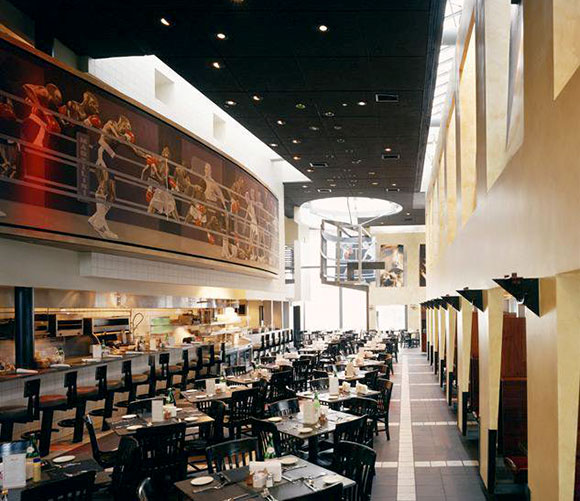
8. Though Kate Mantalini closed in 2014, this Beverly Hills restaurant was an icon, both socially and architecturally. As a place to see-and-be-seen, the design was no quiet backdrop. Architect Morphosis created an energetic living room of art, sculpture, and architecture: angled walls, oculus/skylight sundial, steel beam compositions, curved mural of boxers, striped black and white tile floor, and irreverent giant headshots of Andie MacDowell (why her?). The final result remains in memory as a local attraction and an influential early work from the Pritzker-prized architect.
Wayfarers Chapel, Rancho Palo Verdes, California (photo by Olive Stays)
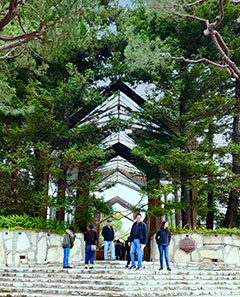
9. When the Wayfarers Chapel first opened in Rancho Palo Verdes, the 1950s site was not the lush forest of trees as one encounters today. On a bluff overlooking the ocean, Lloyd Wright (son of Frank Lloyd Wright) designed a crystalline glass and wood structure surrounded by majestic skies and vast land. As dramatic as the chapel’s origin was, the current state is no less powerful—now a magical building surrounded by dense trees. One enters as if in a romantic fairy tale. Last year, the chapel was named a National Historic Landmark. (Unfortunately due to recent land movements, the chapel has been slated to be dismantled and reconstructed at a new location TBD.)
Riviera United Methodist Church, Torrance, California (photo by Anthony Poon)
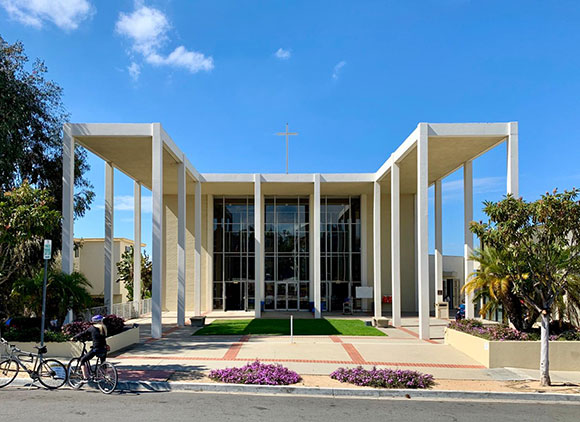
10. A lesser known work from Richard Neutra, the Riviera United Methodist Church displays the simplicity and elegance of colleague Mies van der Rohe’s “less is more.” Neutra introduced the International Style to California, alongside his once-roommate at the famed Kings Road House, Rudolf Schindler—architect of said house (which was no. 14 on this list). Coincidentally in the early 1900s, both Neutra and Schindler arrived from Austria and worked for Frank Lloyd Wright. For this church, Neutra embraced the rectilinear nature of post-and-beam construction, adapting it to the fresh air of Redondo Beach.
Case Study House No. 8, Pacific Palisades, California (photo from archilovers.com)
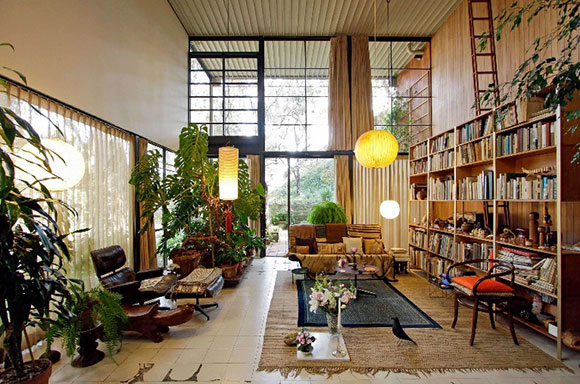
11. The Case Study House No. 8, also the Eames House, served as the modest 1,500-square-foot personal residence and 1,000-square-foot design laboratory for husband-wife architects, Charles and Ray Eames. For this National Historic Landmark in the Pacific Palisades, the house should possess an “unselfconscious” and the “way-it-should-be-ness.” Through new technologies, off-the-shelf materials, and standard components, the architects pioneered much of today’s pre-fab, modular construction industry. (L)
Neurosciences Institute, La Jolla, California (photo from twbta.com)
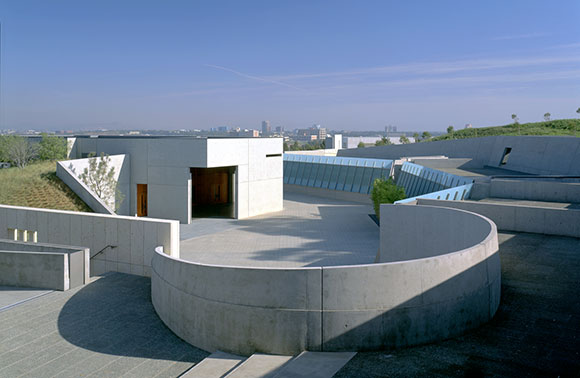
12. With the Neurosciences Institute, Tod Williams Billie Tsien Architects created a “monastery for scientists.” In La Jolla, three structures—theory center, 350-seat auditorium, and labs—nestle into the earth and form a courtyard. As is typical of the architects’ work, this research campus explores the most sublime and fetishized (obsessive?) details and materials: sand blasted concrete, redwood panel sun shades, bas-relief surfaces, jade green serpentine stone, fossil stone from Texas, and bead-blasted stainless steel. This tactile environment confronts all the senses.
Salk Institute for Biological Studies, California (photo by Adam Bignell on Unsplash)
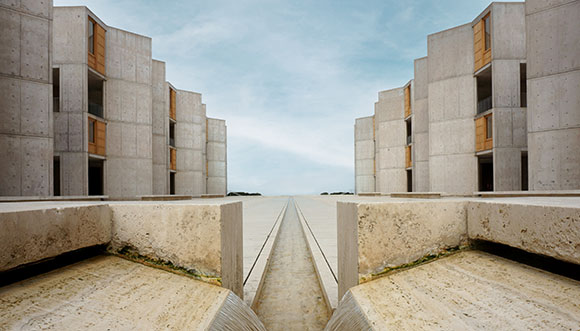
13. Ask any architect, this is the hero of them all: the Salk Institute. If a work can be named one of greatest of all time, Louis Kahn’s 412,000-square-foot research center in La Jolla is high on this list. Jonas Salk, who created the polio vaccine, asked the architect to “create a facility worthy of a visit by Picasso.” With influences from monastery design, Kahn’s profound composition inspires scientists, architects, and everyday visitors, with its otherworldly beauty and axial relationship to the clouds, horizon, and beyond.
(For my 2023 favorites from around the world, visit here.)
#179: MY TOP TEN FAVE ARCHITECTS
December 1, 2023
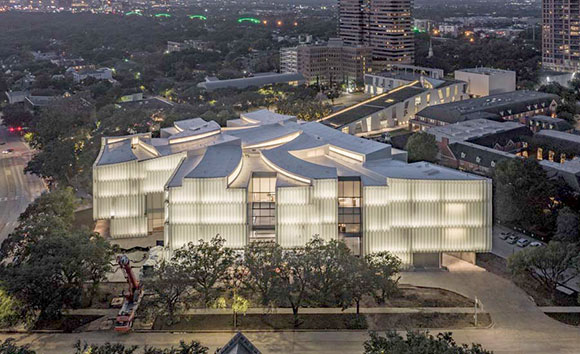
The Nancy and Rick Kinder Building at the Museum of Fine Arts, Houston, Texas, by Steven Holl. The architect’s inspiration came from the changing shapes of clouds and the trapezoidal shape of the property. (photo by Richard Barnes)
“Hey Anthony, who is your favorite architect?,” I am often asked.
I might reply, “Can there only be one fave? What is your favorite book or your favorite song?”
upper left: La Pedrera, Barcelona, Spain, by Antoni Gaudi (photo by Erwin Litschauer from Pixabay); upper right: La Muralla Roja in foreground, Xanadu in background, Calp, Spain, by Ricardo Bofill (photo by Lena Polishko on Unsplash); lower left: National Parliament, Bangladesh, by Louis Kahn (photo by Pexels from Pixabay); lower right: Colline Notre Dame du Haut, Ronchamp, France, by Le Corbusier (photo by Ricardo Gomez Angel on Unsplash)
For nearly all, there is no one favorite piece of music. For me, there is no one favorite architect. There are several dozen. But here I try, gathering a mere list of ten, in no particular order. Just a note: My list comprises living architects, so excludes favorites like Antoni Gaudi, Louis Kahn, Le Corbusier, and Ricardo Bofill.
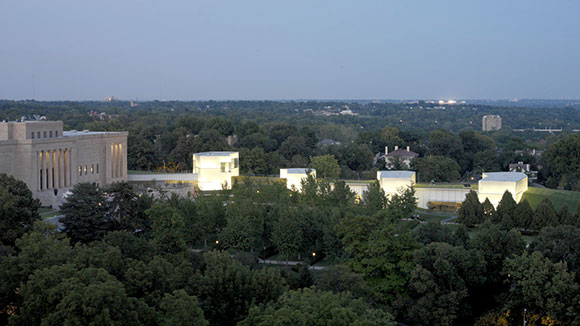
The Nelson-Atkins Museum of Art, Kansas City, Missouri, by Steven Holl. Adjacent to the renovated museum, five enigmatic glass structures deliver various qualities of natural light into the interconnected subterranean galleries. (photo by Andy Ryan)
1: Steven Holl
Holl possesses an individualistic vision of architecture, where his signature watercolors establishes the conceptual agenda for each project. This New York–based architect blends complex building programs—both new structures as well as additions—with seemingly random sculptural shapes, while applying his mastery of shaping natural light. Time magazine called him “America’s Best Architect” for “buildings that satisfy the spirit as well as the eye.”
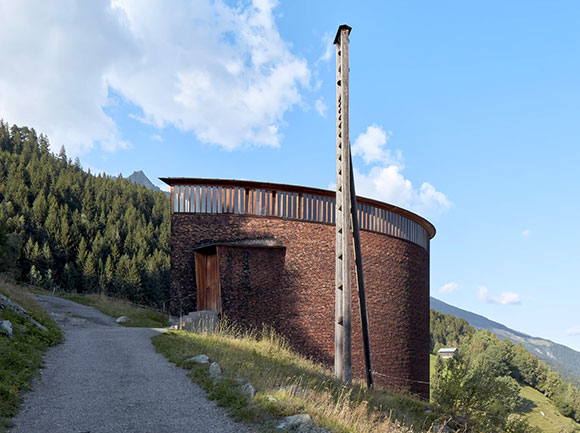
Saint Benedict Chapel, Sumvitg, Switzerland, by Peter Zumthor. Impeccably crafted, the leaf-shaped, one-room structure explores a lemniscate, an algebraic, hyperbolic, inverse curve. (photo by Federico Covre)
2: Peter Zumthor
Often called the “architect’s architect,” there is no one else practicing today so often referred to as a “master” of his craft. Each project from the Swiss architect, the son of a cabinet maker—whether a home, chapel, or museum—is precisely uncompromising, often austere, and elemental, embracing the basics of architecture, e.g., shelter, light, materials. Zumthor suggests, “Architecture is not a vehicle or a symbol for things that do not belong to its essence.”
CCTV, Beijing, China, by Rem Koolhaas. A visionary corporate building instead of the usual and predictable company skyscrapres (photo by Hanson Lu on Unsplash)
3: Rem Koolhaas
Dutch architect, provocative theorist, prolific author, professor at Harvard, and one-time filmmaker—Koolhaas brings gravitas and intellectualism to his practice. His work is known for its clarity in conceptual thinking, where a simple idea or diagram drives the development of an entire project, whether a house, library, or entire town. Time magazine put him in their top 100 of “The World’s Most Influential People.”
Quinta do Portal Winery, Celeirós do Douro, Spain, by Alvaro Siza. An elegant composition of a modest material palette and minimal moves. (photo by Rui Alves on Unsplash)
4: Alvaro Siza
Some buildings from this Portugues architect are quiet and minimal, like his Leca Swimming Pools—so integrated into the waterfront that one doesn’t even know where the buildings end and the land begins. Other projects combine invention, and poetry. “Every design,” Siza states, “is a rigorous attempt to capture a concrete moment of a transitory image in all its nuances . . . the more precise they are, the more vulnerable.”
He Art Museum, Shunde, Foshan, Guangdong Province, China, by Tadao Ando. As usual, “less is more.” (photo by Clu Soh on Unsplash)
5: Tadao Ando
Self-taught Japanese architect started out as a truck driver and professional boxer. Contrasting the delirium of such a past, Ando’s portfolio is the epitome of minimalism, exploring a profound nothingness. Nearly all his projects are composed of primarily two materials. 1) poured-in-place concrete—concrete walls, concrete floors, concrete roofs, and 2) natural light (yes, I view light as a construction material). Though many of his buildings appear to be the similar, celebrities flock to own an Ando design: Beyonce and Jay-Z, Kanye West, Tom Ford, Kim Kardashian, amongst others.
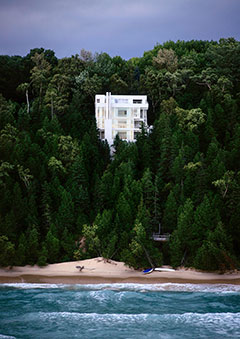
Douglas House, Emmet County, Michigan, by Richard Meier. Restored twice since its 1973 completion, this 3,000-square-foot, waterfront residence is one of the most iconic Modernist homes of recent generations—and added to the National Register of Historic Places. (photo by Scott Frances)
6: Richard Meier
New York architect Meier (now retired with controversy) claims, “White conventionally has always been seen as a symbol of perfection, of purity and clarity.” He established his design language, for better or for worse, as the one of the most recognizable styles in history—a singular vision and personal brand of Modernism, stark white surfaces, and strict geometries. The formality and strictness in Meier’s work, though rigid and severe for some, provide an oasis of calm for others.
Elbphilharmonie Hamburg, Germany, by Herzog and de Meuron. A new glassy, 2,100-seat concert hall sits upon an 1875-constructed warehouse, rebuilt in 1963. The sweeping roof provides a plaza with views of the docks and city. (photo by Wolfgang Weiser onPixabay)
7: Herzog & de Meuron
Based in Basel, Switzerland, the partnership of Jacques Herzog and Pierre de Meuron approaches architecture as a deep dive into design philosophy, experimental methods, and technology. They believe their work “can meet the needs of our rapidly and radically changing world.” Each project is a reinvention of their creative process, with a fetishization of form making, textures, patterns, and materials—both traditional and radical.
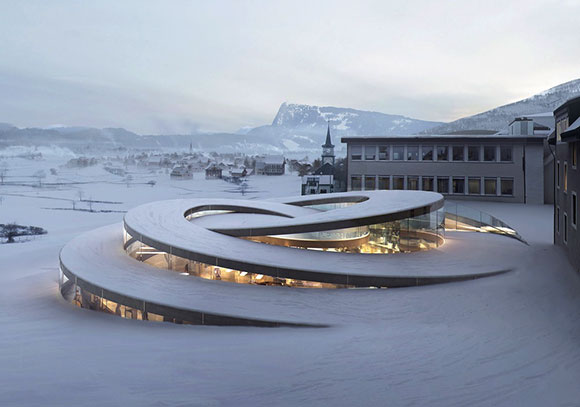
Musée Atelier Audemars Piguet, Le Brassus, Switzerland, by Bjarke Ingels. This spiraling museum displaying watchmaking history contrasts the company’s traditional 1875 workshop building. (photo by Bjarke Ingels Group)
8: Bjarke Ingels
Many of Ingels’ projects—bold, exaggerated, and cartoonish—appear to have leapt off the pages of a comic book. In fact, he published a 2009 graphic novel entitled, Yes Is More: An Archicomic on Architectural Evolution. His firm of 700 architects, simply known as BIG, is one of the fastest rising companies in the global marketplace. The Wall Street Journal called this Copenhagen-based architect, “Innovator of the Year” for architecture and “one of the design world’s rising stars.”
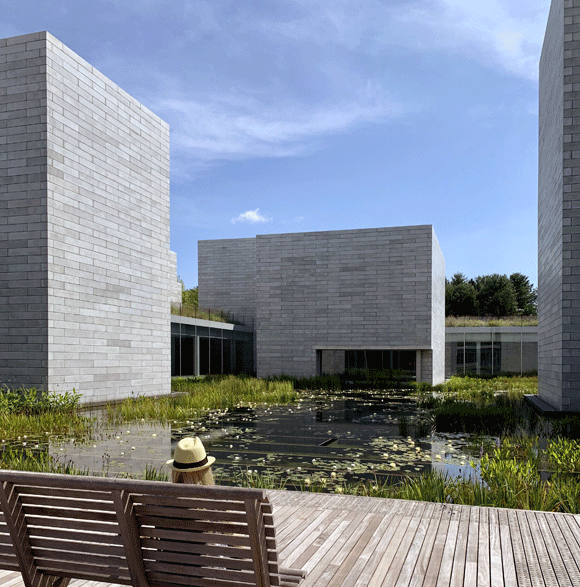
Glenstone Museum, Potomac, Maryland, by Thomas Phifer. Mute boxy structures clad in Carderock stone form an introspective campus the combines art, architecture, and landscape. (photo by Anthony Poon)
9: Thomas Phifer
One of the lesser known names on my list, and not yet a Pritzker Laureate like more than half of my list, Phifer established his Manhattan studio after working for Richard Meier. Whether Phifer’s work comprises the self-proclaimed “light buildings that landed lightly on the land” or Thomas De Monchaux’s description of “a river stone, embedded in the flow of its place,” I would suggest that Mies’ “less is more” is the rule. If ever in the D.C. area, do not miss a visit to the Glenstone Museum.
The Biomuseo, Panama, by Frank Gehry. Leaning away from brand, folding flat planes replace Gehry’s expected curvaceous forms. (photo by Zeluloidea on Pexels)
10: Frank Gehry
The stunning collisions of steel, glass, and stone from this Canadian-born American has made him the most famous living architect on the planet. Though often accused of aesthetic sameness—a kind of architectural one-liner—the mastery of his design vocabulary never ceases to impress. With the 1997 completion of the Guggenheim Museum in Bilbao, Spain, Gehry’s single building attracted so many visitors to the area that the entire economy of the Basque region improved dramatically.
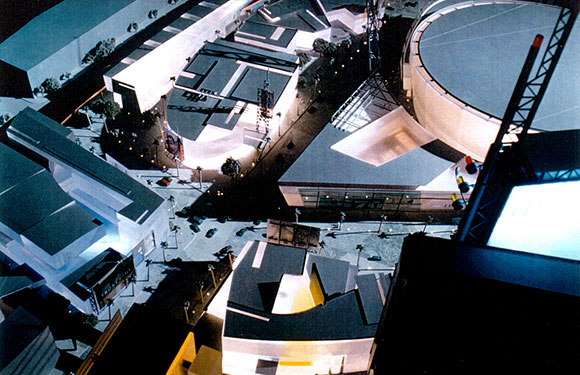
Staples Center and downtown Los Angeles, California – materials: acrylic, lacquer paint, LED lighting, incandescent lighting, fluorescent lighting, and mini-television, by Anthony Poon (w/ NBBJ, photo by John Lodge)
It makes me uneasy when architects replace physical models with computer renderings, replacing a centuries-old craft with software-driven images that pander more to marketing and promotion than exploration and abstract thinking.
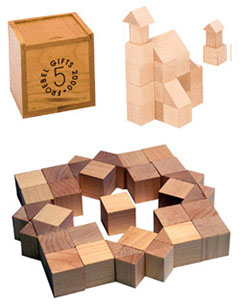
Fröbel blocks (photo from frobelgifts.com)
Frank Lloyd Wright’s mother gave her young son the Fröbel blocks, to encourage the inquisitive boy to think three-dimensionally, to create structures like an architect. German educator, Friedrich Fröbel (1782-1852), conceived of a set of wooden cubes, spheres, and cylinders for children to capture their curious need to organize, create, and build. Fröbel proclaimed, “The active and creative, living and life-producing being of each person, reveals itself in the creative instinct of the child. All human education is bound up in the quiet and conscientious nurture of this instinct of activity; and in the ability of the child, true to this instinct, to be active.”
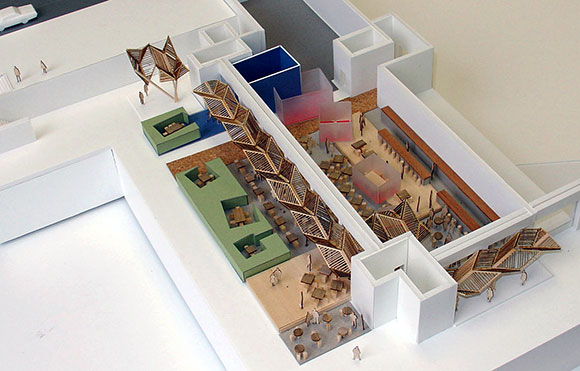
Chaya Downtown restaurant, Los Angeles, California – materials: foamcore, various woods, museum board, chip board, acrylic, and craft paper, by Poon Design (photo by Anthony Poon)
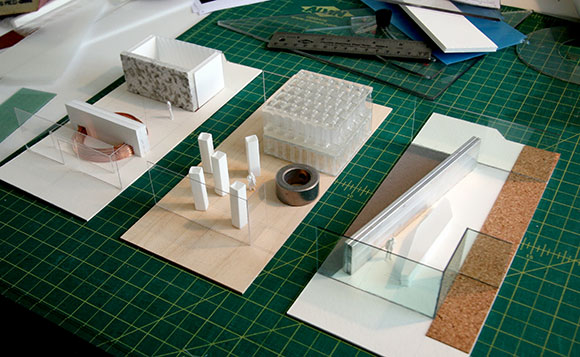
For generations, architects, young and old, engaged in a process of building miniature physical representations of design ideas. Whether Lego or Lincoln Logs as a kid or laser cutting and a 3D printer as a professional, the making of a physical model in scale was inherent in the process of all architects.
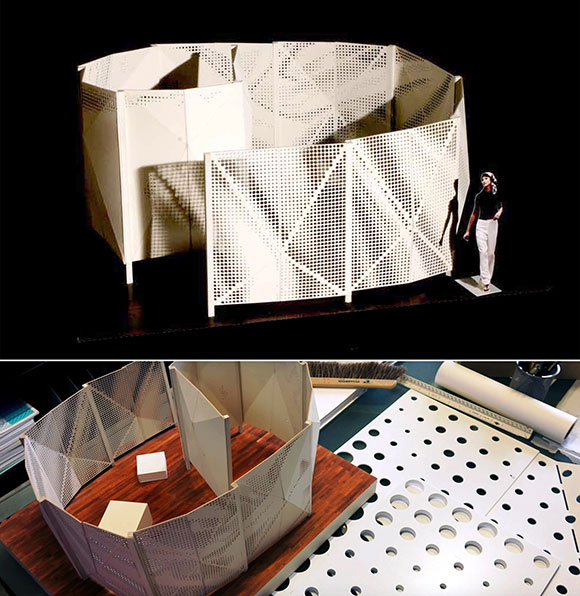
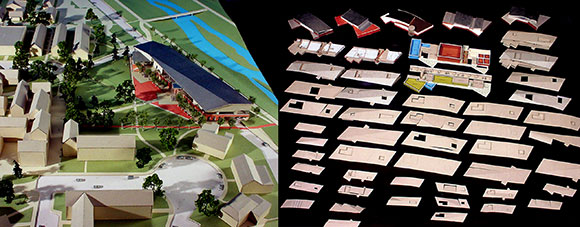
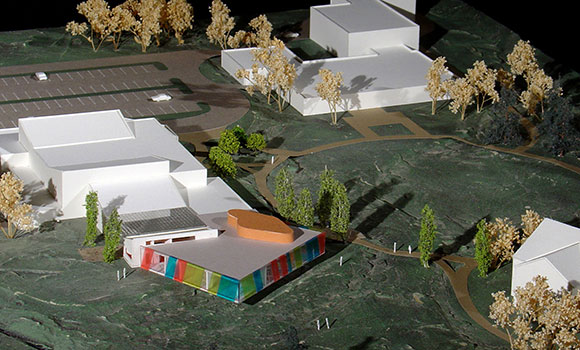
Enzoani bridal store, Riyadh, Saudi Arabia – materials: foamcore, laser prints, basswood, spray paint, and museum board, by Poon Design (photo by Poon Design)University Center, University of the Pacific, Stockton, California — materials: foamcore, chip board, museum board , craft people, metallic paper, aluminum cars and people, and wire trees, by Anthony Poon (w/ HHPA, photo by Foaad Farah)
I separate “physical model” from today’s “digital model,” the latter meaning a computer file, a virtual three-dimensional object. Digital modeling has reaped tremendous advancements in photorealistic renderings and “fly-throughs.” The sexy presentation drawings provide a client with an image as if standing there looking at the real building.
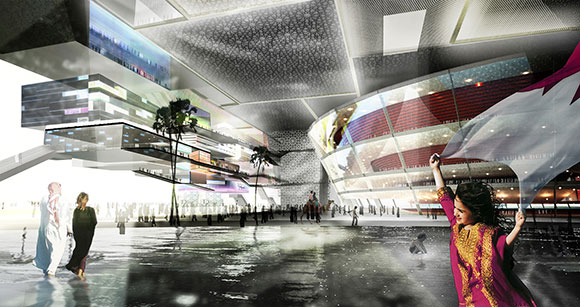
At times, computer renderers can’t seem to control their self-indulgence as the renderings are over-the-top with multiple light sources, mirror-like reflections on glistening surfaces, over saturation of colors and patterns, perfect skies and sunsets, and supermodels populating the buildings—all resulting in a surrealism that overtakes any substance of the rendering. These exciting images try to show the real thing, but often fail. Renderings should capture the personality and emotion of the space, the story of the design, not a photorealistic replication of materials and surfaces.
Sports City Stadium, Doha, Qatar, by Meis (rendering by Mike Amaya)
There is limited tactile connection in computer processing, other than the clicking of one’s mouse. And architecture, both its process and final product, is tactile and physical. I like feeling how a graphite lead gently wears into the toothy surface of a sheet of vellum. I like scoring a piece of chipboard with an X-Acto No. 11 blade, then carefully bending the chipboard with both hands.
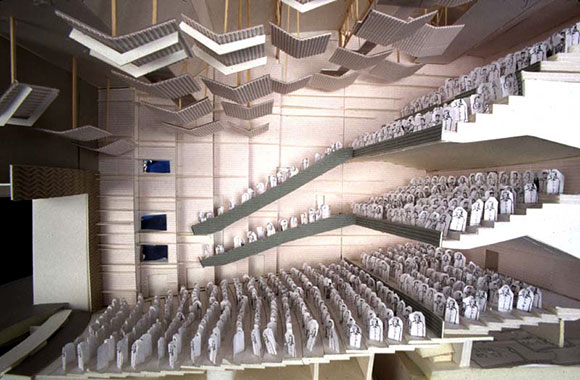
Toppings Yogurt, Pacific Palisades, California – materials: museum board, foamcore, acrylic, stainless steel, cork, copper, stone, honeycomb plastic panel, by Poon Design (photo by Anthony Poon)San Diego Civic Theatre, California – materials: foamcore, basswood, museum board, laser prints, and craft paper, by Anthony Poon (w/ HHPA, photo by Foaad Farah)
As a physical object, a model is the closest thing to the physical building. But of course, it is a smaller version. But it is through such abstraction that one can comprehend the concepts driving the design. The client can hold a model and study it from infinite angles, or place her eyes, head even, into a large model to experience the space.
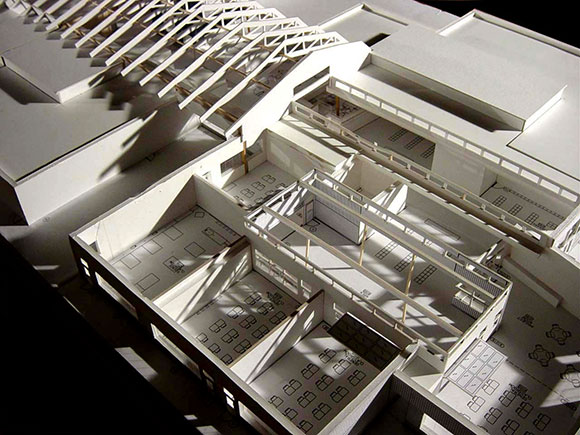
Herget Middle School, West Aurora, Illinois – materials: foamcore, laser prints, basswood, spray paint, and museum board, by Anthony Poon (w/ A4E, photo by Anthony Poon)
Whether a detailed representational model with little people, cars, and trees, with colors and textures suggesting the actual materials of construction, or a concept model made fast and crude, torn apart and glued back together experimenting ideas that flash into the imagination of the designer—models are an investigative design tool.
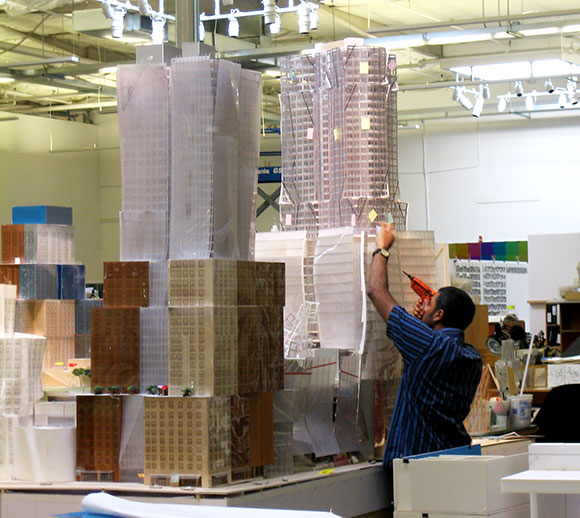
Model making at Gehry Partners, Los Angeles, California (photo by R+D Studio)
Frank Gehry’s process centers around making models with his famed model shop, as does Morphosis with its obsessive use of a large format 3D printer, evidenced by the new book, M3: Modeled Works. This 1,008-page tome focuses exclusively on photos of physical models that span founder Thom Mayne’s career, displayed in reverse chronology, from high tech to low tech model making tools.
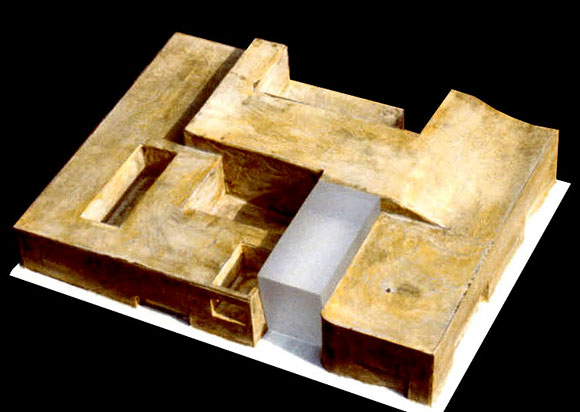
Educational Center and Library Addition, Holocaust Human Rights Center, University of Maine, Augusta – materials: museum board, acrylic, modeling paste, gesso, and acrylic paints, by Poon Design (photo by Anthony Poon)
Whether architectural models are created with recycled corrugated cardboard and discarded scraps or exotic woods and archival museum-quality materials, the design themes told are can be powerful, poetic even. The thing to keep in mind is that model making is but one tool in the process, as is rendering software, as is A.I. or color pencils.
Korean Museum of Art, Los Angeles, California – materials: museum board, acrylic, modeling paste, gesso, and acrylic paints, by Poon Design (photo by Anthony Poon)